 WaywardHouse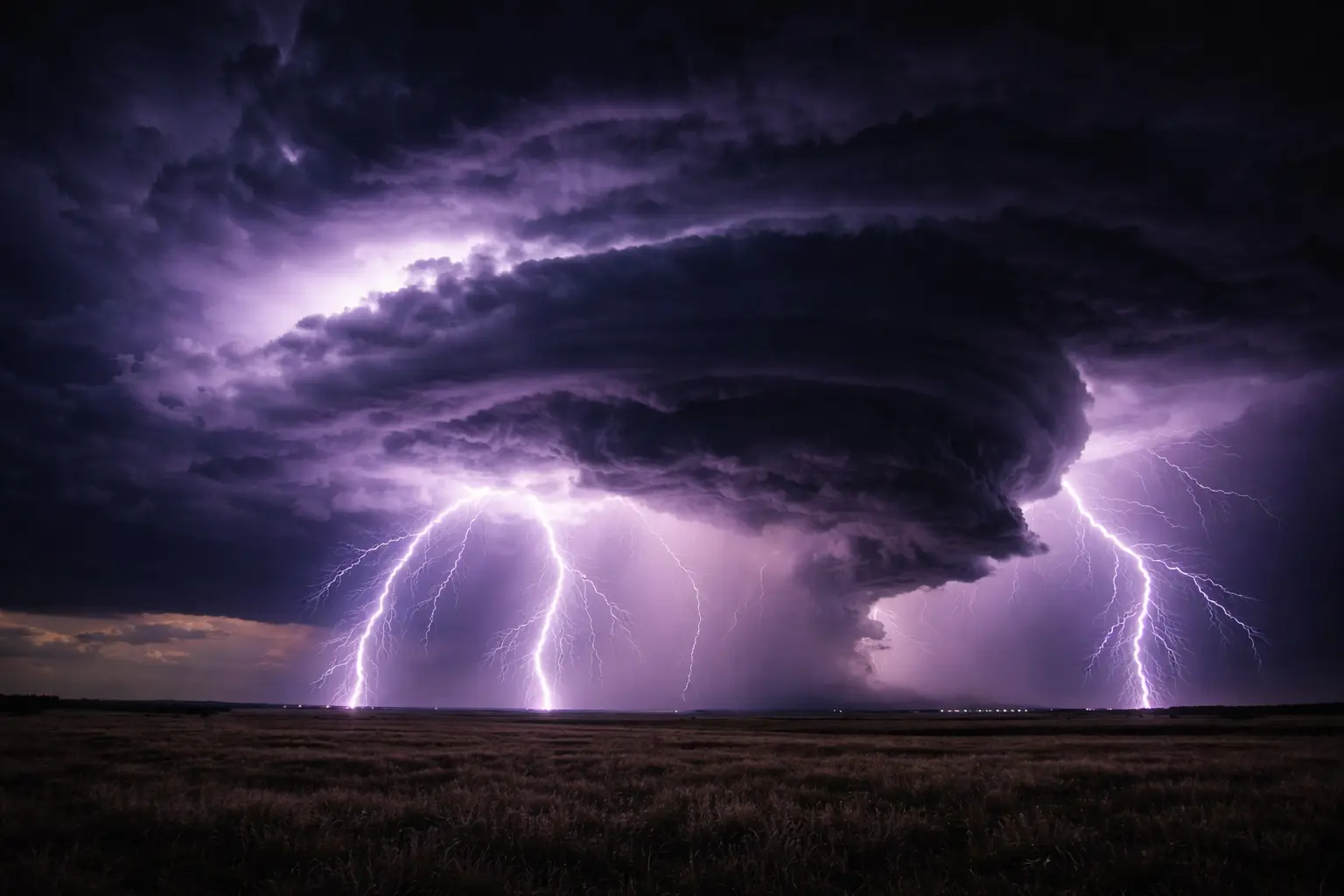
Thunderstorm Dynamics and Severe Weather
What atmospheric conditions produce severe thunderstorms? Convective Available Potential Energy (CAPE) and wind shear determine storm intensity and structure. This model derives CAPE equations, implements updraft velocity calculations, demonstrates supercell dynamics, and predicts severe weather occurrence.
Prerequisites: cape, updraft velocity, supercell dynamics, shear vorticity
1. The Question
Will today’s atmospheric conditions produce tornadoes?
Thunderstorm requirements:
- Moisture: High humidity (fuel)
- Instability: Warm surface, cool aloft (buoyancy)
- Lift: Trigger mechanism (front, convergence, terrain)
- Shear: (For organization and severity)
Storm types:
Single-cell: Short-lived (30-60 min), pulse storms
Multicell: Cluster, longer-lived (2-4 hours)
Supercell: Rotating updraft, most severe (hours)
Severe criteria (USA):
- Hail ≥1 inch (2.5 cm)
- Wind ≥58 mph (93 km/h, 50 kt)
- Tornado (any intensity)
Applications:
- Severe weather forecasting
- Warning lead time
- Aviation safety
- Agriculture (hail damage)
- Insurance risk assessment
2. The Conceptual Model
CAPE (Convective Available Potential Energy)
Energy available for updrafts:
\[CAPE = g \int_{LFC}^{EL} \frac{T_v' - T_{v,env}}{T_{v,env}} dz\]Where:
- $g$ = 9.81 m/s²
- $LFC$ = level of free convection (m)
- $EL$ = equilibrium level (m)
- $T_v’$ = virtual temperature of parcel (K)
- $T_{v,env}$ = environmental virtual temperature (K)
Virtual temperature:
\[T_v = T (1 + 0.61 q)\]Where $q$ = mixing ratio (kg/kg)
Units: J/kg (energy per unit mass)
Typical values:
- CAPE < 1000: Weak instability
- CAPE = 1000-2500: Moderate
- CAPE = 2500-4000: Strong
- CAPE > 4000: Extreme (supercell environment)
Maximum updraft velocity:
\[w_{max} = \sqrt{2 \times CAPE}\]Example: CAPE = 3000 J/kg
\[w_{max} = \sqrt{6000} = 77 \text{ m/s}\]Extreme updraft!
Wind Shear
Change in wind with height:
Bulk shear (0-6 km):
\[S = \sqrt{(u_6 - u_0)^2 + (v_6 - v_0)^2}\]Where $u, v$ = wind components at surface (0) and 6 km.
Critical thresholds:
- S < 10 m/s: Disorganized storms
- S = 10-20 m/s: Organized multicells
- S > 20 m/s: Supercells likely
Storm-relative helicity (SRH):
Measures streamwise vorticity:
\[SRH = \int_0^{z} (V - C) \cdot \frac{\partial V}{\partial z} dz\]Where:
- $V$ = environmental wind vector
- $C$ = storm motion vector
SRH > 150 m²/s²: Tornadic supercells favored
Supercell Structure
Rotating updraft:
Mesocyclone (2-10 km diameter, rotation).
Key features:
Updraft: 20-50 m/s, tilted (shear)
Downdraft: Rear-flank, forward-flank
Hook echo: Radar signature (tornado possible)
Overshooting top: Penetrates tropopause
Vorticity sources:
Environmental shear → horizontal vorticity
Updraft tilts → vertical vorticity (rotation)
3. Building the Mathematical Model
Parcel Theory
Lifted parcel:
Starts at surface with temperature $T_0$, pressure $p_0$.
Dry adiabatic ascent:
\[T = T_0 \left(\frac{p}{p_0}\right)^{R/c_p}\]Where:
- $R/c_p = 0.286$ (dry air)
Condensation occurs at LCL (lifting condensation level):
\[LCL \approx 125 (T_0 - T_d)\]Where $T_d$ = dew point temperature (°C).
Above LCL:
Moist adiabatic (slower cooling, ~6°C/km vs 10°C/km dry).
Buoyancy:
\[B = g \frac{T_v' - T_{v,env}}{T_{v,env}}\]Positive B → acceleration upward.
Updraft Equation
Vertical momentum:
\[\frac{dw}{dt} = B - \frac{1}{\rho} \frac{dp}{dz} - \varepsilon w\]Where:
- $w$ = vertical velocity
- $B$ = buoyancy
- $\varepsilon$ = entrainment/drag coefficient
Simplified (neglecting pressure gradient, drag):
\[w^2 = 2 \times CAPE\]More realistic (with entrainment):
\[w^2 = 2 \times CAPE \times (1 - \varepsilon)\]Typical $\varepsilon = 0.3-0.5$
Actual updrafts: 50-70% of theoretical maximum.
Hail Growth
Embryo ascent in updraft:
Hailstone grows by accretion (collecting supercooled droplets).
Terminal velocity balance:
\[w = V_t\]Where $V_t$ = hailstone fall speed.
For spherical hailstone:
\[V_t = \sqrt{\frac{8 r g \rho_h}{3 C_d \rho_a}}\]Where:
- $r$ = radius (m)
- $\rho_h$ = 900 kg/m³ (ice density)
- $C_d$ = 0.6 (drag coefficient)
- $\rho_a$ = air density
Updraft required for large hail:
1 inch (2.5 cm): $w \approx 25$ m/s
2 inch (5 cm): $w \approx 35$ m/s
4 inch (10 cm): $w \approx 50$ m/s
Extreme CAPE enables giant hail.
4. Worked Example by Hand
Problem: Calculate CAPE and predict severe weather potential.
Sounding data (simplified):
Surface (1000 mb):
- Temperature: 30°C
- Dew point: 24°C
500 mb (5.5 km):
- Temperature: -10°C
Environmental lapse rate: 7°C/km (average)
Wind profile:
- Surface: 180°/10 kt
- 6 km: 240°/40 kt
Calculate LCL, CAPE, bulk shear, severe potential.
Solution
Step 1: LCL
\[LCL = 125 \times (30 - 24) = 125 \times 6 = 750 \text{ m}\]Step 2: Parcel path
Assume moist adiabatic above LCL: ~6°C/km
At 5.5 km:
From surface (30°C):
- Dry ascent to 0.75 km: $T = 30 - 10(0.75) = 22.5°C$
- Moist ascent 4.75 km: $T = 22.5 - 6(4.75) = -6.0°C$
Parcel temperature at 5.5 km: -6°C
Environment: -10°C
Buoyancy: Parcel warmer by 4°C!
Step 3: CAPE (simplified)
Assume average buoyancy from LFC (1 km) to EL (12 km):
Average $\Delta T = 3°C$, depth = 11 km
\[CAPE = 9.81 \times \frac{3}{273} \times 11000 = 9.81 \times 0.011 \times 11000 = 1187 \text{ J/kg}\]Moderate CAPE
Step 4: Maximum updraft
\[w_{max} = \sqrt{2 \times 1187} = \sqrt{2374} = 48.7 \text{ m/s}\]Strong updrafts possible
Step 5: Bulk shear
Wind at surface: $u_0 = 10 \sin(180°) = 0$, $v_0 = 10 \cos(180°) = -10$ kt
Wind at 6 km: $u_6 = 40 \sin(240°) = -34.6$ kt, $v_6 = 40 \cos(240°) = -20$ kt
\[S = \sqrt{(-34.6 - 0)^2 + (-20 - (-10))^2} = \sqrt{1197 + 100} = \sqrt{1297} = 36 \text{ kt} = 18.5 \text{ m/s}\]Moderate-strong shear
Step 6: Severe weather potential
- CAPE = 1187 J/kg (moderate)
- Shear = 18.5 m/s (organized storms)
- Combination: Severe thunderstorms likely
- Hail (updrafts support 1-2 inch)
- Wind (downdrafts, shear)
- Tornadoes possible (if SRH also elevated)
Severe thunderstorm watch warranted.
5. Computational Implementation
Below is an interactive severe weather parameter simulator.
CAPE: -- J/kg
Max updraft: -- m/s
Severe potential: --
Storm type: --
Observations:
- CAPE increases with surface warmth and mid-level cooling
- High moisture (small T-Td spread) increases CAPE
- Shear determines storm organization and severity
- Combination of high CAPE and strong shear = supercells
- Hodograph shows wind turning with height (directional shear)
- Straight hodograph = less favorable for rotation
Key insights:
- Both instability (CAPE) and shear required for severe weather
- Supercells need 2500+ J/kg CAPE and 20+ m/s shear
- Maximum updraft velocity scales with square root of CAPE
- Storm type predictable from environmental parameters
6. Interpretation
Tornado Forecasting
Ingredients:
- CAPE: Energy for updrafts
- Shear: Rotation potential (SRH)
- LCL: Low cloud base (<1500 m favors tornadoes)
- Capping: Inhibition layer (prevents early convection, stores energy)
Significant Tornado Parameter (STP):
\[STP = \frac{CAPE}{1500} \times \frac{SRH}{150} \times \frac{2000 - LCL}{1000} \times \frac{S}{20}\]STP > 1: Significant tornado (EF2+) environment
STP > 3: Violent tornado possible
May 20, 2013 Moore, OK:
- CAPE: 3500 J/kg
- SRH: 400 m²/s²
- Shear: 25 m/s
- STP: ~6
- Result: EF5 tornado
Hail Forecasting
MESH (Maximum Expected Size of Hail):
Based on radar-derived maximum reflectivity and height.
Environmental indicators:
- CAPE > 2000 J/kg
- Strong mid-level winds (advect hail)
- Wet-bulb zero height ~2.5-3.5 km (growth zone)
Record hail: 8 inch diameter (20 cm), South Dakota 2010.
Required updrafts ~60+ m/s (CAPE >5000 J/kg).
Aviation Hazards
Thunderstorms dangerous for aircraft:
Turbulence: Updrafts/downdrafts exceed aircraft capability
Icing: Supercooled droplets
Lightning: Electronics damage, structural
Hail: Airframe damage, windscreen cracks
Avoidance: 20+ nautical miles from severe storms
Microbursts:
Localized downdraft (< 4 km diameter).
Surface wind divergence: 100+ kt possible.
Windshear: Fatal on takeoff/landing.
7. What Could Go Wrong?
Capping Inversion Too Strong
Warm layer aloft prevents lifting to LFC.
CAPE exists but storms never initiate.
Forecaster dilemma:
Severe environment, but no storms (false alarm).
Solution: Monitor for triggers (fronts, outflow boundaries).
Mesoscale Convective Systems
Organized complex of storms.
Different dynamics than isolated supercells.
MCS: Squall line, bow echo, derecho
Challenges:
- Evolving structure
- Complex outflow interactions
- Rapid changes
Derechos: Widespread wind damage (>100 mph possible).
Storm Mergers
Multiple storms interact.
Can intensify or weaken depending on configuration.
Example - Fujiwara effect:
Storms orbit each other, merge.
Unpredictable evolution.
Tornadic Debris Signature
Radar detects lofted debris, not tornado itself.
TDS = tornado confirmed
But: Tornado may dissipate before reaching target.
Warning verification challenge.
8. Extension: Dual-Polarization Radar
Polarimetric variables:
ZDR (differential reflectivity):
- Shape information
- Large hail (ZDR < 0 dB, tumbling)
KDP (specific differential phase):
- Rain rate, hail discrimination
ρHV (correlation coefficient):
- Mixed hydrometeors
- Debris (ρHV < 0.90)
Improved:
- Hail detection
- Heavy rain estimation
- Tornado warning (TDS)
9. Math Refresher: Hydrostatic Balance
Pressure Gradient
Vertical pressure gradient:
\[\frac{dp}{dz} = -\rho g\]Hydrostatic equation
Buoyancy:
Deviation from hydrostatic produces vertical acceleration.
\[\frac{dw}{dt} = -\frac{1}{\rho} \frac{dp}{dz} - g = B\]Where $B$ = buoyancy force.
Summary
- CAPE quantifies energy available for convective updrafts from surface to equilibrium level
- Maximum updraft velocity scales as square root of 2×CAPE typically 50-70% of theoretical
- Wind shear determines storm organization with >20 m/s favoring supercells
- Severe weather requires combination of instability (CAPE >1500 J/kg) and shear (>15 m/s)
- Supercells feature rotating updrafts capable of producing large hail and tornadoes
- Significant Tornado Parameter combines CAPE, shear, LCL, and SRH for tornado forecasting
- Hail growth requires strong updrafts balancing terminal velocity of growing stones
- Applications span severe weather prediction, aviation safety, insurance risk assessment
- Dual-polarization radar provides enhanced hydrometeor classification and debris detection
- Critical tool for warning lead time and public safety during severe convective events