 WaywardHouse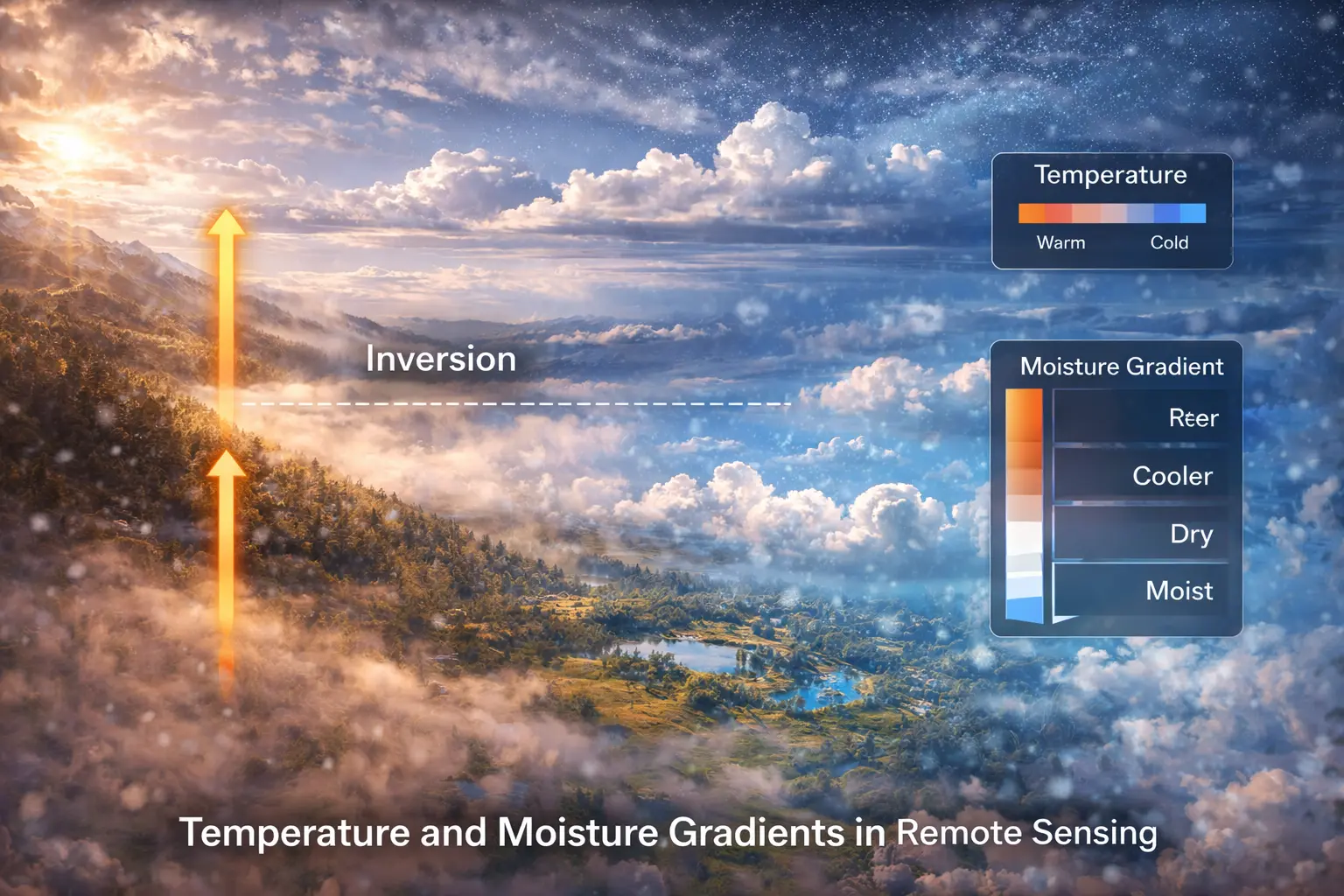
Temperature and Moisture Gradients
Temperature normally decreases with height, but not always—inversions trap pollution and create fog. Moisture also varies vertically, controlling cloud formation and precipitation. This model derives lapse rates, introduces stability concepts, and models how temperature and humidity profiles affect weather.
Prerequisites: lapse rate, stability analysis, saturation, adiabatic process
1. The Question
Why does temperature usually decrease with altitude, and when does it increase instead?
Climb a mountain and temperature drops—about 6–10°C per kilometer. But sometimes:
- Nighttime inversions: Temperature increases with height near the ground
- Valley fog: Cold air trapped below, warm air above
- Smog episodes: Pollution trapped under a warm lid
Similarly, moisture varies with height:
- Surface air may be humid
- Upper air often dry
- Cloud base marks where air saturates
The mathematical question: What determines the vertical gradient of temperature and moisture, and when is the atmosphere stable vs. unstable?
2. The Conceptual Model
Environmental Lapse Rate
The environmental lapse rate ($\Gamma$) is the actual temperature decrease with height:
\[\Gamma = -\frac{dT}{dz}\]Sign convention: Positive $\Gamma$ means temperature decreases upward (normal).
Typical value: $\Gamma \approx 6.5$ K/km (global average troposphere)
Adiabatic Lapse Rates
Adiabatic process: No heat exchange with surroundings (air parcel moves too fast for heat transfer).
Dry adiabatic lapse rate ($\Gamma_d$):
Rising unsaturated air cools by expansion.
Where:
- $g = 9.8$ m/s² (gravity)
- $c_p = 1005$ J/kg/K (specific heat of air at constant pressure)
Saturated adiabatic lapse rate ($\Gamma_s$):
Rising saturated air cools slower because condensation releases latent heat.
(Varies with temperature; warmer air has more moisture, more latent heat release)
Atmospheric Stability
Compare environmental lapse rate ($\Gamma$) to adiabatic rates:
Absolutely unstable: $\Gamma > \Gamma_d$
- Environment cools faster than adiabatic
- Rising air parcel stays warmer than surroundings
- Buoyant → continues rising → convection
Conditionally unstable: $\Gamma_s < \Gamma < \Gamma_d$
- Dry air stable, saturated air unstable
- Depends on moisture content
Absolutely stable: $\Gamma < \Gamma_s$
- Environment cools slower than adiabatic (or warms with height)
- Rising parcel becomes cooler than surroundings
- Negatively buoyant → sinks back → stable
Inversion: $\Gamma < 0$ (temperature increases with height)
- Extremely stable
- Suppresses vertical mixing
- Traps pollution
3. Building the Mathematical Model
Dry Adiabatic Process
For an ideal gas, adiabatic expansion/compression follows:
\[T p^{-R/c_p} = \text{constant}\]Where:
- $T$ = temperature (K)
- $p$ = pressure (Pa)
- $R = 287$ J/kg/K (gas constant for dry air)
- $c_p = 1005$ J/kg/K
Potential temperature ($\theta$):
\[\theta = T \left(\frac{p_0}{p}\right)^{R/c_p}\]Where $p_0 = 100$ kPa (reference pressure, sea level).
For adiabatic motion, $\theta$ is conserved.
Pressure decreases with height:
\[\frac{dp}{dz} = -\rho g\]For dry adiabatic process:
\[\frac{dT}{dz} = -\frac{g}{c_p} = -\Gamma_d\] \[\Gamma_d = \frac{g}{c_p} = \frac{9.8}{1005} = 0.00975 \text{ K/m} = 9.75 \text{ K/km}\](Often rounded to 10 K/km)
Saturated Adiabatic Process
When air is saturated, condensation releases latent heat:
\[\frac{dT}{dz} = -\frac{g}{c_p + L_v dq_s/dT}\]Where:
- $L_v = 2.5 \times 10^6$ J/kg (latent heat of vaporization)
- $dq_s/dT$ = rate of change of saturation mixing ratio with temperature
Result: $\Gamma_s < \Gamma_d$ (saturated air cools slower).
At warm temperatures (30°C): $\Gamma_s \approx 4$ K/km
At cold temperatures (-20°C): $\Gamma_s \approx 7$ K/km
Relative Humidity Profile
Mixing ratio ($q$, kg water vapor per kg dry air) is approximately conserved for unsaturated air.
Saturation mixing ratio ($q_s$) decreases with height (colder → less moisture capacity).
Relative humidity:
\[RH = \frac{q}{q_s} \times 100\%\]If $q$ is constant and $q_s$ decreases, RH increases with height until reaching 100% → cloud base.
Dew Point and Lifting Condensation Level
Dew point ($T_d$): Temperature at which air becomes saturated (at constant pressure).
Lifting Condensation Level (LCL): Height at which rising air reaches saturation.
Approximate formula:
\[h_{\text{LCL}} = 125 (T - T_d)\]Where:
- $h_{\text{LCL}}$ = cloud base height (m)
- $T$ = surface temperature (°C)
- $T_d$ = surface dew point (°C)
Example: $T = 25°$C, $T_d = 15°$C:
\[h_{\text{LCL}} = 125 \times (25 - 15) = 1250 \text{ m}\]Cloud base at 1.25 km.
4. Worked Example by Hand
Problem: A weather sounding shows:
- Surface: $T = 30°$C, $T_d = 20°$C, $p = 1000$ hPa
- At 1 km: $T = 22°$C, $p = 900$ hPa
- At 2 km: $T = 16°$C, $p = 800$ hPa
(a) Calculate environmental lapse rate.
(b) Is the atmosphere stable or unstable for dry air?
(c) What is the cloud base height?
Solution
(a) Environmental lapse rate
Between surface and 1 km:
\[\Gamma = -\frac{\Delta T}{\Delta z} = -\frac{22 - 30}{1000 - 0} = \frac{8}{1000} = 0.008 \text{ K/m} = 8 \text{ K/km}\]Between 1 km and 2 km:
\[\Gamma = -\frac{16 - 22}{2000 - 1000} = \frac{6}{1000} = 6 \text{ K/km}\]Average: $\Gamma \approx 7$ K/km
(b) Stability
$\Gamma_d = 9.8$ K/km (dry adiabatic)
Compare: $\Gamma = 7$ K/km $< \Gamma_d$
Environment cools slower than dry adiabatic → stable for dry air.
If air rises 1 km dry adiabatically:
- Parcel temperature: $30 - 9.8 = 20.2°$C
- Environment temperature at 1 km: $22°$C
- Parcel is cooler than environment → sinks back → stable
(c) Cloud base
\[h_{\text{LCL}} = 125(T - T_d) = 125(30 - 20) = 1250 \text{ m}\]Cloud base at 1.25 km.
5. Computational Implementation
Below is an interactive atmospheric profile simulator.
Cloud base (LCL): m
Stability:
Parcel at 1 km: °C
Try this:
- Nighttime inversion: Temperature increases with height → extremely stable
- Daytime unstable: High lapse rate (> 10 K/km) → dry adiabat to left of environment → rising parcel stays warmer
- Dew point spread: When temperature curve crosses dew point → cloud forms
- LCL marker: Shows cloud base height
- Notice: Saturated adiabat (green) has gentler slope than dry adiabat (latent heat release)
Key insight: Stability depends on the slope of the environmental profile relative to adiabatic rates.
6. Interpretation
Inversion Types
Radiation inversion (nighttime):
- Surface cools by IR emission
- Ground-based inversion (0–200 m)
- Breaks up after sunrise
Subsidence inversion (high pressure):
- Descending air warms adiabatically
- Elevated inversion (500–2000 m)
- Persistent (days)
- Traps pollution
Frontal inversion:
- Warm air overrides cold air
- Associated with weather fronts
Convective Boundary Layer
Daytime over land:
- Surface heated by sun
- Lapse rate approaches dry adiabatic ($\Gamma \approx \Gamma_d$)
- Mixed layer: Well-mixed by convection (temperature nearly constant with height)
- Inversion cap at top (typically 1–2 km)
Cloud Formation
Clouds form when:
- Air rises to LCL (cooling by expansion)
- Reaches saturation
- Continued lift produces condensation
Cumulus clouds: Thermal updrafts from warm surface
Stratus clouds: Layered lifting (fronts, topography)
7. What Could Go Wrong?
Assuming Dry Adiabatic Always
Once air saturates, saturated adiabatic applies. The transition occurs at LCL.
Parcels rise:
- Below LCL: Cool at $\Gamma_d = 9.8$ K/km
- Above LCL: Cool at $\Gamma_s \approx 6$ K/km
Ignoring Moisture
Stability analysis without moisture misses conditional instability.
Example: $\Gamma = 8$ K/km
- Dry air: Stable ($\Gamma < \Gamma_d$)
- Saturated air: Unstable ($\Gamma > \Gamma_s$)
Trigger: If you can force saturation (lifting over mountain), convection explodes.
Constant Lapse Rate
Real atmosphere has layers:
- Surface mixed layer
- Inversion layers
- Free troposphere
- Stratosphere (temperature increases with height always)
Sounding: Vertical profile measured by weather balloon.
Forgetting Adiabatic Assumption
Adiabatic only if air moves faster than heat diffuses.
Slow processes (large-scale subsidence): Diabatic (radiative heating/cooling matters).
8. Extension: Convective Available Potential Energy (CAPE)
CAPE quantifies thunderstorm potential:
\[\text{CAPE} = \int_{LFC}^{EL} g \frac{T_{\text{parcel}} - T_{\text{env}}}{T_{\text{env}}} dz\]Where:
- LFC = Level of Free Convection (where parcel becomes warmer than environment)
- EL = Equilibrium Level (where parcel becomes cooler again)
Units: J/kg (energy per unit mass)
Interpretation:
- CAPE < 1000 J/kg: Weak convection
- 1000–2500 J/kg: Moderate storms
- CAPE > 2500 J/kg: Severe thunderstorms, tornadoes
Next model will connect atmospheric profiles to remote sensing—how satellites measure temperature and moisture from space using spectral absorption.
9. Math Refresher: Derivatives and Gradients
Lapse Rate as Gradient
The lapse rate is the vertical gradient of temperature:
\[\Gamma = -\frac{dT}{dz}\]Negative sign: By convention, positive $\Gamma$ means temperature decreases upward.
Typical value: $\Gamma = 6.5$ K/km = 0.0065 K/m
Stability from Second Derivative
Stability can also be expressed using potential temperature:
Stable: $\frac{d\theta}{dz} > 0$ (potential temperature increases with height)
Unstable: $\frac{d\theta}{dz} < 0$ (potential temperature decreases with height)
Neutral: $\frac{d\theta}{dz} = 0$ (potential temperature constant)
For adiabatic motion, $\theta$ is conserved, so $d\theta/dz = 0$ defines neutral.
Summary
- Environmental lapse rate ($\Gamma$): Actual temperature decrease with height
- Dry adiabatic: $\Gamma_d = 9.8$ K/km (unsaturated rising air)
- Saturated adiabatic: $\Gamma_s \approx 6$ K/km (condensation releases latent heat)
- Stability:
- $\Gamma > \Gamma_d$: Unstable (convection)
- $\Gamma_s < \Gamma < \Gamma_d$: Conditionally unstable
- $\Gamma < \Gamma_s$: Stable
- $\Gamma < 0$: Inversion (very stable)
- LCL (cloud base): $h \approx 125(T - T_d)$ meters
- Inversions trap pollution and suppress mixing
- Daytime: Convective mixing → near-adiabatic lapse rate
- Nighttime: Radiative cooling → ground-based inversion