 WaywardHouse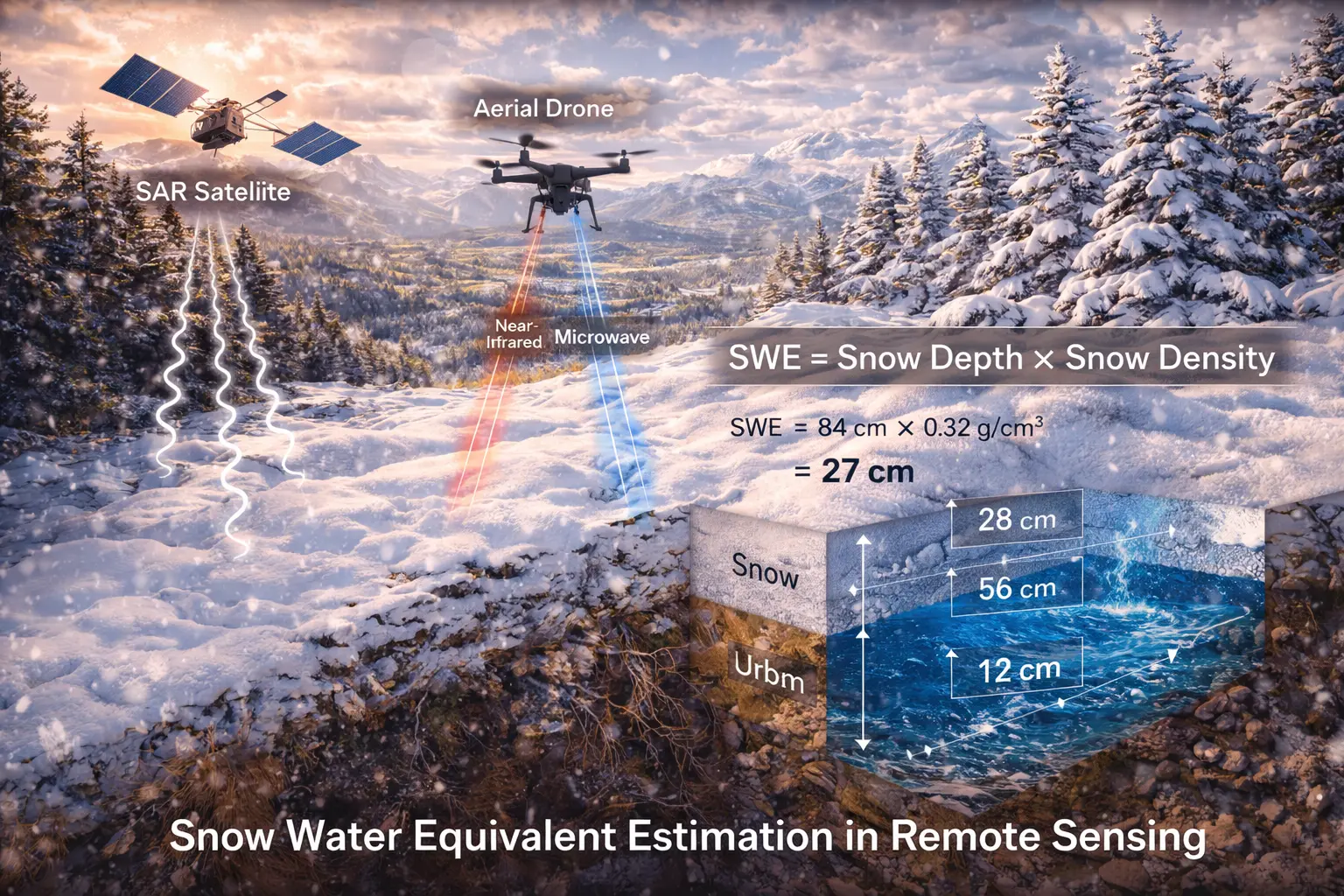
Snow Water Equivalent Estimation
How do we measure snow water equivalent across mountain basins? Ground observations (SNOTEL, snow courses) provide point measurements. Remote sensing (passive microwave, LiDAR) enables spatial coverage. This model derives microwave emission theory, implements snow depth-to-SWE conversion, and combines multi-sensor observations to map snowpack water content.
Prerequisites: microwave radiometry, snow depth density, sensor integration, uncertainty propagation
1. The Question
What’s the total water stored in snow across a 1000 km² mountain basin?
Three measurement approaches:
1. Ground observations (point data):
- SNOTEL stations (automated)
- Manual snow courses (monthly surveys)
- Snow pillows (weight measurement)
2. Remote sensing (spatial coverage):
- Passive microwave (AMSR-E, SSMIS)
- Active microwave (SAR)
- LiDAR (airborne snow depth)
- Optical (MODIS snow cover extent)
3. Model-data fusion:
- Combine observations with snow models
- Assimilation techniques
- Produce gridded SWE estimates
The mathematical question: How do we convert different measurements (microwave brightness temperature, snow depth, weight) into SWE, and how do we scale from points to basins?
2. The Conceptual Model
SWE From Snow Depth
Fundamental relationship:
\[\text{SWE} = \rho_{\text{snow}} \times d\]Where:
- $\rho_{\text{snow}}$ = bulk snow density (kg/m³)
- $d$ = snow depth (m)
Challenge: Density varies (100-500 kg/m³) → must estimate.
Typical approach:
\[\rho_{\text{snow}} = \rho_0 + k_1 \text{DOY} + k_2 d\]Where:
- DOY = day of year (snow gets denser over time)
- Coefficients calibrated regionally
Example (Colorado Rockies):
\[\rho = 250 + 0.5 \times \text{DOY} + 10 \times d\]For March 15 (DOY 74), depth 1.5m:
\[\rho = 250 + 0.5(74) + 10(1.5) = 302 \text{ kg/m}^3\] \[\text{SWE} = 0.302 \times 1.5 = 0.453 \text{ m} = 453 \text{ mm}\]Microwave Emission Theory
Snow emits microwave radiation based on:
- Temperature
- Depth
- Grain size
- Liquid water content
Brightness temperature:
\[T_B = T_{\text{snow}} \times (1 - e^{-\tau}) + T_{\text{ground}} \times e^{-\tau}\]Where:
- $T_B$ = brightness temperature measured by satellite (K)
- $\tau$ = optical depth (function of SWE)
- $T_{\text{snow}}$ = physical temperature of snow (K)
- $T_{\text{ground}}$ = ground temperature (K)
Optical depth depends on SWE:
\[\tau = \beta \times \text{SWE}\]Where $\beta$ = scattering coefficient (~0.002-0.005 m²/kg at 37 GHz).
Key insight: Deep snow → more scattering → lower $T_B$
Multi-Frequency Approach
Use two frequencies:
- 19 GHz (penetrates deep, insensitive to grain size)
- 37 GHz (scattered by snow grains)
Spectral gradient:
\[\Delta T_B = T_B(19\text{ GHz}) - T_B(37\text{ GHz})\]Empirical SWE retrieval:
\[\text{SWE} = a \times \Delta T_B\]Where $a \approx 3$ mm/K (calibration coefficient).
Positive $\Delta T_B$: Snow present (37 GHz scattered more)
Near zero: Little/no snow
3. Building the Mathematical Model
SNOTEL Snow Pillow
Measures weight of snowpack:
\[W = \rho_{\text{snow}} \times d \times A \times g\]Where:
- $W$ = weight (N)
- $A$ = pillow area (m²)
- $g$ = 9.81 m/s²
SWE directly:
\[\text{SWE} = \frac{W}{A \times \rho_w \times g}\]Advantage: Direct measurement (no density assumption)
Disadvantage: Point measurement, expensive infrastructure
Manual Snow Course
Federal sampler:
- Aluminum tube pushed through snowpack
- Extract core
- Weigh core
SWE calculation:
\[\text{SWE} = \frac{m_{\text{sample}}}{A_{\text{tube}} \times \rho_w}\]Where:
- $m_{\text{sample}}$ = mass of snow in tube (kg)
- $A_{\text{tube}}$ = tube cross-section area (m²)
Typical: 10-12 sampling points along transect, average for site SWE.
Uncertainty: ±5-10% from sampling variability.
Passive Microwave Algorithm
Chang et al. (1987) algorithm:
For dry snow:
\[\text{SWE} = c_1 \times (T_B^{19V} - T_B^{37V}) \times f_{\text{forest}}\]Where:
- $c_1$ = 1.59 mm/K
- $T_B^{19V}$ = 19 GHz vertical polarization (K)
- $T_B^{37V}$ = 37 GHz vertical polarization (K)
- $f_{\text{forest}}$ = forest correction factor
Forest correction:
\[f_{\text{forest}} = 1 - 0.8 \times f_c\]Where $f_c$ = forest cover fraction (0-1).
Limitations:
- Saturates at ~150mm SWE (deep snow)
- Fails with wet snow (liquid water absorbs microwaves)
- Coarse resolution (25 km pixels)
LiDAR Snow Depth
Airborne laser scanning:
Snow-on flight: Measure surface elevation $z_{\text{snow}}$
Snow-off flight: Measure bare ground elevation $z_{\text{ground}}$
Snow depth:
\[d = z_{\text{snow}} - z_{\text{ground}}\]Convert to SWE:
\[\text{SWE} = \rho(x,y) \times d(x,y)\]Density from:
- Regional relationships
- Interpolated from SNOTEL
- modelled
Resolution: 1-3 meters (excellent for terrain effects)
Cost: Expensive (aircraft), limited temporal coverage
4. Worked Example by Hand
Problem: Estimate basin-average SWE from multiple sources.
Data:
SNOTEL stations (3 sites):
- Low elevation (2000m): SWE = 300 mm
- Mid elevation (2500m): SWE = 450 mm
- High elevation (3000m): SWE = 600 mm
Passive microwave (basin average):
- $\Delta T_B = 50$ K
- SWE = $1.59 \times 50 = 79.5$ mm (underestimate due to saturation)
LiDAR (sample area, 2500m elevation):
- Average depth: 1.8 m
- Estimated density: 300 kg/m³
- SWE = $0.300 \times 1.8 = 540$ mm
Basin characteristics:
- Area: 500 km²
- Elevation range: 1800-3200 m
- Forest cover: 40%
Solution
Step 1: Elevation-based interpolation
Assume linear SWE-elevation relationship:
From SNOTEL:
- 2000m → 300mm
- 2500m → 450mm
- 3000m → 600mm
Gradient: $\frac{600 - 300}{3000 - 2000} = 0.30$ mm/m
SWE(z):
\[\text{SWE}(z) = 300 + 0.30(z - 2000)\]Step 2: Basin hypsometry
Assume elevation distribution:
- 1800-2200m: 20% of area
- 2200-2600m: 40% of area
- 2600-3000m: 30% of area
- 3000-3200m: 10% of area
Average SWE per band:
Band 1 (2000m): SWE = 300mm → 20% × 300 = 60 mm
Band 2 (2400m): SWE = 420mm → 40% × 420 = 168 mm
Band 3 (2800m): SWE = 540mm → 30% × 540 = 162 mm
Band 4 (3100m): SWE = 630mm → 10% × 630 = 63 mm
Basin average: 60 + 168 + 162 + 63 = 453 mm
Step 3: Validate with LiDAR
LiDAR at 2500m: 540mm
Predicted at 2500m: 450mm
Difference: 90mm (20% higher)
Possible reasons:
- Local accumulation pattern
- Density uncertainty
- Measurement error
Step 4: Final estimate
Best estimate: 453mm (from elevation interpolation)
Uncertainty: ±15% (±68mm)
Total water volume:
\[V = \text{SWE} \times A = 0.453 \text{ m} \times 500 \times 10^6 \text{ m}^2 = 226.5 \times 10^6 \text{ m}^3\]= 226,500 acre-feet or 279 million cubic meters
5. Computational Implementation
Below is an interactive SWE estimation tool combining multiple sensors.
Basin avg SWE: -- mm
Total volume: -- million m³
Uncertainty: --%
Try this:
- Red dots: SNOTEL station measurements
- Blue line: Interpolated SWE-elevation relationship
- Green bars: Elevation band SWE values
- Orange dashed: Microwave satellite estimate (underestimates deep snow)
- Adjust SNOTEL values: See gradient change
- Microwave ΔTB: Higher = more snow detected (saturates ~150mm)
- Notice: Microwave underestimates in deep snow (saturation issue)
- Basin average combines elevation bands weighted by area
Key insight: Multiple sensors needed—ground stations for accuracy, satellites for coverage, models to bridge gaps!
6. Interpretation
SNOTEL Network
Automated stations:
- Snow pillow (SWE)
- Snow depth (ultrasonic)
- Precipitation
- Air temperature
US Western mountains: ~800 sites
Real-time data at https://www.nrcs.usda.gov/wps/portal/wcc/home/
Uses:
- Water supply forecasting
- Avalanche prediction
- Climate monitoring
- Model validation
NASA SnowEx Campaign
Multi-sensor airborne campaign:
Sensors:
- Passive microwave radiometer
- Active microwave (SAR, scatterometer)
- LiDAR snow depth
- Ground-penetrating radar (snow stratigraphy)
Goals:
- Improve satellite algorithms
- Understand uncertainty sources
- Develop next-generation products
Findings:
- Forest significantly attenuates microwave signal
- Snow grain size affects scattering
- Wet snow problematic for all microwave sensors
SWOT Satellite Mission
Surface Water and Ocean Topography (2022 launch):
Ka-band radar interferometry:
- Measures water surface elevation
- Rivers, lakes, reservoirs
Snow applications:
- Seasonal water storage changes in reservoirs
- Flood wave propagation
- Groundwater-surface water exchange
Complements SWE observations for total water budget.
7. What Could Go Wrong?
Microwave Saturation
Deep snow (>150mm SWE):
Microwave signal saturates → underestimate.
Example:
- True SWE: 800mm
- Microwave estimate: 120mm
- Error: -85%!
Worse in: Maritime climates (deep, wet snow)
Solution:
- Combine with model
- Use passive + active microwave
- Assimilation techniques
Wet Snow
Liquid water absorbs microwaves.
Result: Brightness temperature increases (appears as less snow).
Example:
- Dry snow: SWE = 300mm, ΔTB = 40K
- After melt onset: Same SWE, ΔTB = 10K
- Appears as: SWE decreased to 80mm (false!)
Solution: Freeze/thaw detection, temperature thresholding.
Forest Masking
Dense canopy:
- Intercepts snow (different properties)
- Emits radiation (masks snow signal)
- Attenuates satellite view
Correction factors crude, uncertain.
Better: Higher frequency (e.g., 89 GHz) penetrates better, or use model.
Point-to-Grid Scaling
SNOTEL = point measurement (10m footprint)
Basin = 100s-1000s km²
Representativeness issues:
- SNOTEL in clearings (higher SWE than forest)
- Elevation bias (stations at accessible locations)
- Aspect not captured
Solution: Distributed modelling with data assimilation.
8. Extension: Data Assimilation
Combine model with observations optimally.
Ensemble Kalman Filter (EnKF):
Steps:
- Run snow model ensemble (100s of realizations with perturbed forcing)
- Forecast SWE at observation time
- Compare forecast to observations
- Update ensemble using Kalman gain:
Where:
- $\mathbf{K}$ = Kalman gain
- $\mathbf{P}^f$ = forecast error covariance
- $\mathbf{H}$ = observation operator
- $\mathbf{R}$ = observation error covariance
Analysis:
\[\mathbf{x}^a = \mathbf{x}^f + \mathbf{K}(\mathbf{y} - \mathbf{H}\mathbf{x}^f)\]Result: Gridded SWE estimate that:
- Respects physics (model)
- Matches observations (data)
- Quantifies uncertainty (ensemble spread)
Operational: NOAA National Water Model, NASA SWE reconstruction
9. Math Refresher: Electromagnetic Spectrum
Microwave Region
Frequency ranges:
| Band | Frequency | Wavelength | Use |
|---|---|---|---|
| L | 1-2 GHz | 15-30 cm | Soil moisture |
| C | 4-8 GHz | 3.75-7.5 cm | Soil moisture, ice |
| X | 8-12 GHz | 2.5-3.75 cm | SAR imaging |
| Ku | 12-18 GHz | 1.67-2.5 cm | Precipitation |
| K | 18-27 GHz | 1.11-1.67 cm | Snow, water vapor |
| Ka | 27-40 GHz | 0.75-1.11 cm | Clouds, rain |
Snow remote sensing: 19 GHz and 37 GHz most common
Why microwave?
- Penetrates clouds (all-weather)
- Sensitive to snow (grain scattering)
- Day/night capable (active radiation)
Planck’s Law
Blackbody emission:
\[B_\nu(T) = \frac{2h\nu^3}{c^2} \frac{1}{e^{h\nu/kT} - 1}\]Where:
- $B_\nu$ = spectral radiance (W/(m²·sr·Hz))
- $h$ = Planck constant
- $\nu$ = frequency
- $k$ = Boltzmann constant
- $T$ = temperature (K)
Rayleigh-Jeans approximation (microwave regime):
\[B_\nu(T) \approx \frac{2\nu^2 kT}{c^2}\]Brightness temperature: Temperature of blackbody that would produce observed radiance.
Summary
- SWE estimation requires converting diverse measurements to water equivalent
- Ground observations: SNOTEL (snow pillows), manual snow courses, direct SWE measurement
- Passive microwave: Uses brightness temperature difference (19-37 GHz) to infer SWE
- Microwave limitations: Saturates at ~150mm, fails with wet snow, forest attenuation
- LiDAR: Accurate snow depth from airborne laser, requires density assumption
- Scaling challenge: Point measurements to basin averages via elevation relationships
- Multi-sensor fusion: Combines strengths of different platforms
- Data assimilation: Optimal combination of models and observations (EnKF)
- Operational products: SNOTEL network, AMSR-E/AMSR2, NASA SnowEx
- Uncertainty: Typically ±15-25% for basin averages
- Critical for water resources management and flood forecasting