 WaywardHouse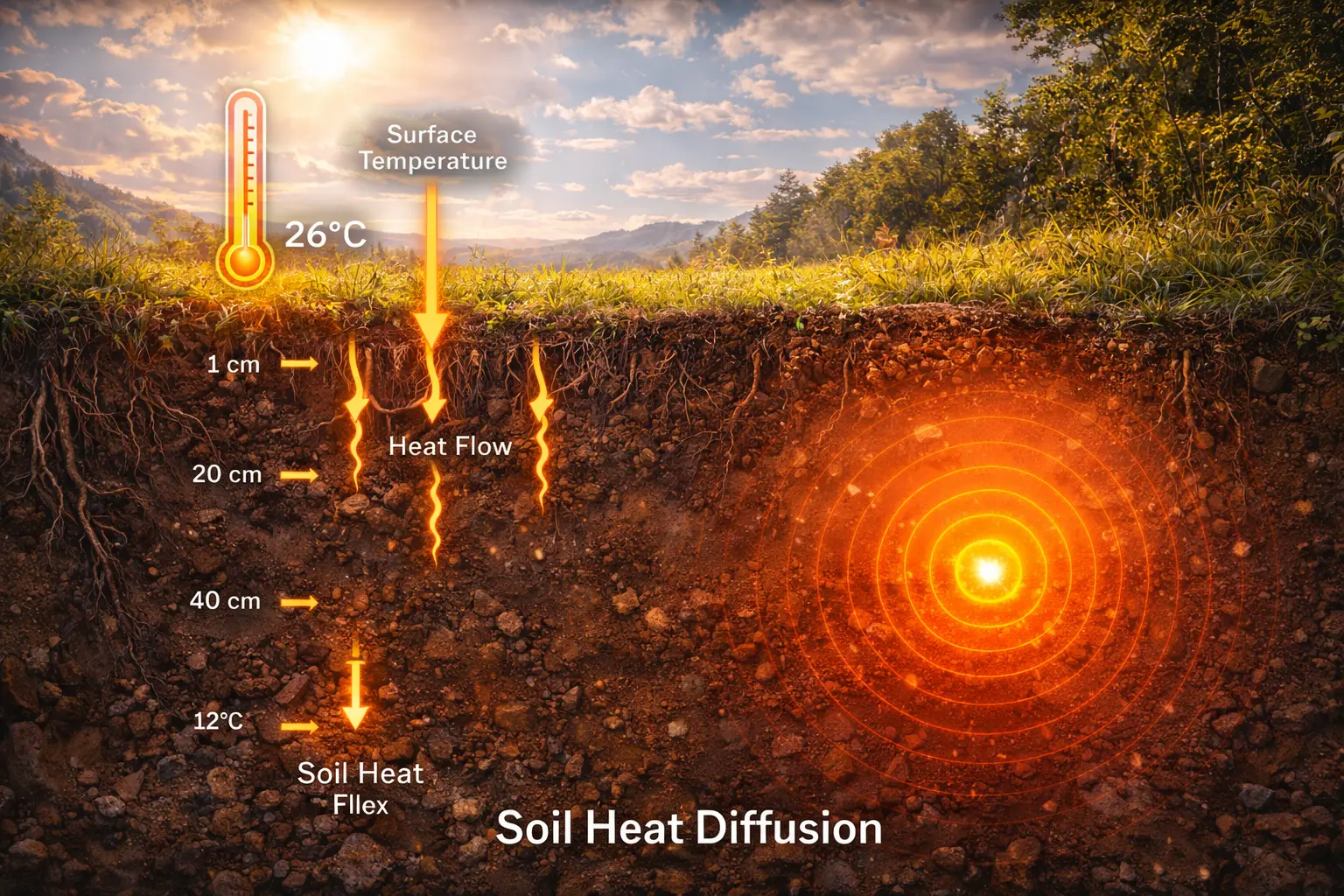
Soil Heat Diffusion
Surface temperature oscillates daily (day/night) and seasonally (summer/winter). These temperature waves propagate downward into the soil, getting weaker and more delayed with depth. This model derives the heat diffusion equation and solves it for sinusoidal forcing to find damping depth and phase lag.
Prerequisites: heat equation, diffusion, damping depth, phase lag, fourier analysis
1. The Question
Why does soil temperature lag behind air temperature, and why is the lag greater at depth?
Plant a thermometer at the surface and another at 1 meter depth. Watch them for 24 hours:
- Surface: Temperature swings wildly (10°C at night, 30°C at noon)
- 1 m depth: Temperature barely changes (stays near 20°C all day)
The same pattern occurs seasonally:
- Surface: Cold in winter, hot in summer
- 10 m depth: Constant year-round (permafrost boundary, wine cellars, geothermal)
The mathematical question: How do temperature oscillations at the surface propagate downward into the soil? How far do they penetrate, and how much are they delayed?
2. The Conceptual Model
Heat Diffusion
Heat flows from warm to cool regions. In soil, this happens by conduction — molecular-scale energy transfer through collisions.
Fick’s law analogy (from diffusion):
Heat flux is proportional to the temperature gradient:
Where:
- $q$ = heat flux (W/m²), positive downward
- $k$ = thermal conductivity (W/m/K)
- $\frac{\partial T}{\partial z}$ = temperature gradient (K/m)
The negative sign means heat flows from hot to cold (down the gradient).
Temperature Waves
The surface temperature oscillates:
\[T_{\text{surface}}(t) = T_{\text{mean}} + A \sin(\omega t)\]Where:
- $T_{\text{mean}}$ = average temperature
- $A$ = amplitude of oscillation
- $\omega = 2\pi / P$ = angular frequency (rad/s)
- $P$ = period (86400 s for daily, ~31.5×10⁶ s for annual)
This oscillation propagates downward as a damped, delayed wave.
Damping: Amplitude decreases exponentially with depth
Delay: Peak temperature occurs later at greater depths
3. Building the Mathematical Model
The Heat Diffusion Equation
Conservation of energy in a thin soil layer:
\[\rho c \frac{\partial T}{\partial t} = \frac{\partial}{\partial z}\left(k \frac{\partial T}{\partial z}\right)\]Where:
- $\rho$ = soil density (kg/m³)
- $c$ = specific heat capacity (J/kg/K)
- $k$ = thermal conductivity (W/m/K)
For constant properties (homogeneous soil):
\[\frac{\partial T}{\partial t} = \alpha \frac{\partial^2 T}{\partial z^2}\]Where $\alpha = k / (\rho c)$ is the thermal diffusivity (m²/s).
Physical interpretation:
- Left side: Rate of temperature change
- Right side: Curvature of temperature profile (how “bent” the profile is)
If the profile is concave up ($\partial^2 T/\partial z^2 > 0$), temperature increases. If concave down, temperature decreases.
Thermal Diffusivity
\[\alpha = \frac{k}{\rho c}\]Typical values:
| Material | $\alpha$ (m²/s) |
|---|---|
| Dry sand | 0.3 × 10⁻⁶ |
| Moist sand | 0.6 × 10⁻⁶ |
| Clay (dry) | 0.25 × 10⁻⁶ |
| Clay (wet) | 0.5 × 10⁻⁶ |
| Peat | 0.1 × 10⁻⁶ |
| Rock | 1.0 × 10⁻⁶ |
| Water | 1.4 × 10⁻⁶ |
| Air | 20 × 10⁻⁶ |
Key insight: Moist soil has higher diffusivity than dry soil (water conducts heat better than air).
Solution for Periodic Forcing
Boundary condition (surface oscillates):
\[T(z=0, t) = T_m + A_0 \sin(\omega t)\]Deep boundary (constant temperature):
\[T(z \to \infty, t) = T_m\]Solution (for $z > 0$):
\[T(z,t) = T_m + A_0 e^{-z/d} \sin\left(\omega t - \frac{z}{d}\right)\]Where $d$ is the damping depth (or e-folding depth):
\[d = \sqrt{\frac{2\alpha}{\omega}}\]Two key features:
- Amplitude decays exponentially: $A(z) = A_0 e^{-z/d}$
- Phase lags linearly: Phase lag = $z/d$ radians
Damping Depth
The damping depth is where amplitude drops to $1/e \approx 37\%$ of surface value.
Daily cycle ($P = 86400$ s, $\omega = 7.27 \times 10^{-5}$ rad/s):
For typical soil ($\alpha = 0.5 \times 10^{-6}$ m²/s):
\[d_{\text{daily}} = \sqrt{\frac{2 \times 0.5 \times 10^{-6}}{7.27 \times 10^{-5}}} = 0.12 \text{ m}\]At depth $d = 12$ cm, daily temperature swing is 37% of surface swing.
Annual cycle ($P = 365.25 \times 86400$ s, $\omega = 1.99 \times 10^{-7}$ rad/s):
\[d_{\text{annual}} = \sqrt{\frac{2 \times 0.5 \times 10^{-6}}{1.99 \times 10^{-7}}} = 2.2 \text{ m}\]Scaling rule:
\[\frac{d_{\text{annual}}}{d_{\text{daily}}} = \sqrt{\frac{P_{\text{annual}}}{P_{\text{daily}}}} = \sqrt{365.25} \approx 19\]Annual waves penetrate ~19 times deeper than daily waves.
Phase Lag
Time delay for temperature peak to reach depth $z$:
\[\Delta t = \frac{z}{d} \times \frac{P}{2\pi}\]Example: Daily cycle, $z = 0.5$ m, $d = 0.12$ m:
\[\Delta t = \frac{0.5}{0.12} \times \frac{86400}{2\pi} = 4.17 \times 13750 = 57,300 \text{ s} \approx 16 \text{ hours}\]Surface peaks at noon → 0.5 m depth peaks at 4 AM the next day.
4. Worked Example by Hand
Problem: A soil has thermal diffusivity $\alpha = 0.4 \times 10^{-6}$ m²/s. Surface temperature oscillates daily with mean 15°C and amplitude 10°C.
(a) What is the damping depth for the daily cycle?
(b) What is the temperature amplitude at 20 cm depth?
(c) When does the temperature peak at 20 cm if the surface peaks at noon?
Solution
(a) Damping depth
Daily period: $P = 86400$ s
\[\omega = \frac{2\pi}{P} = \frac{2\pi}{86400} = 7.27 \times 10^{-5} \text{ rad/s}\] \[d = \sqrt{\frac{2\alpha}{\omega}} = \sqrt{\frac{2 \times 0.4 \times 10^{-6}}{7.27 \times 10^{-5}}}\] \[= \sqrt{\frac{0.8 \times 10^{-6}}{7.27 \times 10^{-5}}} = \sqrt{1.1 \times 10^{-2}} = 0.105 \text{ m} = 10.5 \text{ cm}\](b) Amplitude at 20 cm
\[A(z) = A_0 e^{-z/d} = 10 \times e^{-0.20/0.105}\] \[= 10 \times e^{-1.90} = 10 \times 0.150 = 1.5°\text{C}\]Temperature swing at 20 cm depth is ±1.5°C (compared to ±10°C at surface).
(c) Phase lag
\[\phi = \frac{z}{d} = \frac{0.20}{0.105} = 1.90 \text{ radians}\]Convert to time:
\[\Delta t = \phi \times \frac{P}{2\pi} = 1.90 \times \frac{86400}{2\pi} = 1.90 \times 13750 = 26,125 \text{ s} \approx 7.3 \text{ hours}\]Surface peaks at noon (12:00) → 20 cm depth peaks at 19:18 (7:18 PM).
5. Computational Implementation
Below is an interactive soil temperature profile simulator.
Damping depth: cm
Temperature at 50 cm: °C
Try this:
- Animate the daily cycle: Watch the temperature wave propagate downward
- Switch to peat: Low diffusivity → shallow damping depth → surface insulation
- Switch to moist sand: Higher diffusivity → deeper penetration
- Observe phase lag: Surface peaks at noon, but 50 cm peaks hours later
- Notice damping: Temperature swing decreases rapidly with depth
Key insight: The ground acts as a low-pass filter — high-frequency oscillations (daily) are filtered out quickly, while low-frequency (annual) penetrate deep.
6. Interpretation
Why Basements Stay Cool in Summer
At 2–3 meters depth, daily temperature oscillations are negligible (amplitude < 1% of surface).
Annual oscillations still penetrate:
- Summer surface temperature: 30°C
- 3 m depth: Lags by ~3 months → peaks in fall
- Result: Basement cool in summer, relatively warm in winter
Permafrost and Active Layer
In Arctic regions, soil can be:
- Active layer (top ~0.5–2 m): Thaws in summer, freezes in winter
- Permafrost (below): Permanently frozen
Active layer thickness is approximately where annual temperature wave amplitude drops below the freezing point.
Climate warming → deeper summer thaw → thicker active layer → permafrost degradation.
Thermal Inertia and Climate
Ocean has very high thermal inertia (high $c$, high $\rho$):
- Slow to warm in spring
- Slow to cool in fall
- Moderates coastal climates
Desert soil (dry) has low thermal inertia:
- Heats quickly during day
- Cools quickly at night
- Large diurnal temperature range
Frost Penetration
Frost depth in winter depends on:
- Duration of freezing temperatures (how long the “cold wave” lasts)
- Soil thermal properties
- Snow cover (insulation)
Simplified estimate: Frost penetrates to depth where soil temperature stays above 0°C.
7. What Could Go Wrong?
Assuming Homogeneous Soil
Real soil has layers with different thermal properties:
- Organic litter (low diffusivity)
- Topsoil (medium)
- Subsoil (higher)
- Rock (high)
Boundary conditions at each interface complicate the solution.
Ignoring Latent Heat Effects
When soil freezes, latent heat of fusion is released:
\[L_f = 3.34 \times 10^5 \text{ J/kg}\]This slows the freezing front (energy must be extracted before temperature drops further).
Phase change creates a nonlinear problem — $\alpha$ changes abruptly at the freezing front.
Neglecting Water Movement
Moisture moves in soil (evaporation, drainage, capillary rise). Water carries heat (advection).
Our model assumes no water movement — pure conduction only.
In reality, evaporation at the surface cools the soil (latent heat), and infiltrating rainfall heats or cools deeper layers.
Forgetting Time Scale
The solution assumes sinusoidal forcing has been running for many periods (steady periodic state).
After a sudden change (e.g., tillage, snow removal), soil takes time to adjust (transient response, not covered by our periodic solution).
8. Extension: Annual Cycle and Superposition
Real soil temperature is a superposition of multiple cycles:
\[T(z,t) = T_m + A_d e^{-z/d_d} \sin(\omega_d t - z/d_d) + A_a e^{-z/d_a} \sin(\omega_a t - z/d_a)\]Where subscript $d$ = daily, $a$ = annual.
Daily component: Damping depth ~10 cm, negligible below 50 cm
Annual component: Damping depth ~2 m, significant to 10 m
Superposition works because the heat equation is linear.
9. Math Refresher: The Heat Equation
Derivation from Energy Conservation
Consider a thin layer of soil from depth $z$ to $z + \Delta z$.
Energy in:
Heat flux entering from above: $q(z)$
Energy out:
Heat flux leaving through bottom: $q(z + \Delta z)$
Storage:
Energy stored in the layer: $\rho c \Delta z \frac{\partial T}{\partial t}$
Balance:
\[q(z) - q(z + \Delta z) = \rho c \Delta z \frac{\partial T}{\partial t}\]Divide by $\Delta z$ and take limit $\Delta z \to 0$:
\[-\frac{\partial q}{\partial z} = \rho c \frac{\partial T}{\partial t}\]Substitute Fourier’s law $q = -k \frac{\partial T}{\partial z}$:
\[\frac{\partial}{\partial z}\left(k \frac{\partial T}{\partial z}\right) = \rho c \frac{\partial T}{\partial t}\]For constant $k$:
\[\frac{\partial T}{\partial t} = \alpha \frac{\partial^2 T}{\partial z^2}\]This is the diffusion equation (or heat equation).
Connection to Other Diffusion Processes
Same equation governs:
- Moisture diffusion in soil
- Chemical diffusion in fluids
- Pollutant spreading in groundwater
- Population spread in ecology
Universal form:
\[\frac{\partial \phi}{\partial t} = D \frac{\partial^2 \phi}{\partial z^2}\]Where $\phi$ is the diffusing quantity and $D$ is the diffusion coefficient.
Summary
- Heat diffusion equation: $\frac{\partial T}{\partial t} = \alpha \frac{\partial^2 T}{\partial z^2}$
- Thermal diffusivity: $\alpha = k / (\rho c)$, typical values 0.1–1.0 × 10⁻⁶ m²/s
- Damping depth: $d = \sqrt{2\alpha / \omega}$, where $\omega = 2\pi / P$
- Daily cycle: Damping depth ~10 cm (temperature swing reduced to 37% at this depth)
- Annual cycle: Damping depth ~2 m (penetrates ~19× deeper than daily)
- Phase lag: Temperature peak delayed by time $\Delta t = (z/d) \times (P/2\pi)$
- Temperature amplitude decays exponentially: $A(z) = A_0 e^{-z/d}$
- Moist soil has higher diffusivity than dry soil