 WaywardHouse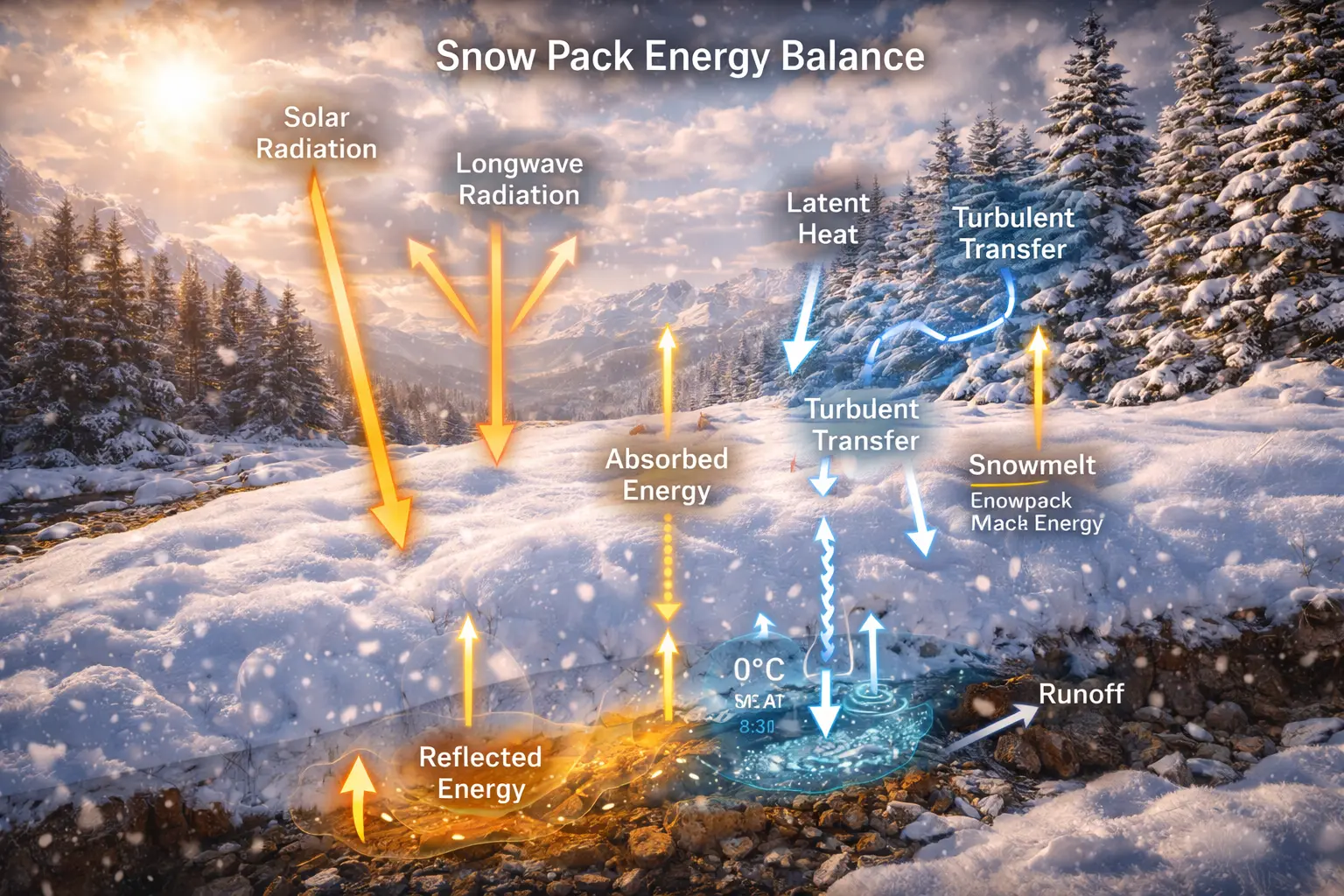
Snowpack Energy Balance
When does snow melt? How much water will the snowpack release? The snowpack energy balance governs accumulation, metamorphism, and melt. This model derives the full energy budget—shortwave and longwave radiation, sensible and latent heat, ground heat flux, and phase change energy—showing how each component drives snow evolution.
Prerequisites: energy balance, radiation transfer, heat flux, phase change
1. The Question
Why does snow melt faster on sunny spring days even when air temperature is below freezing?
Snow is a dynamic system that gains and loses energy through multiple pathways:
Energy inputs:
- ☀️ Shortwave radiation (solar)
- 🌥️ Longwave radiation (atmospheric/cloud)
- 🌡️ Sensible heat (warm air)
- 💧 Latent heat (condensation)
- 🌍 Ground heat flux (from soil below)
Energy outputs:
- ❄️ Longwave emission (snow surface)
- 🌡️ Sensible heat (to cold air)
- 💨 Latent heat (sublimation/evaporation)
- 💧 Melt (phase change requires 334 kJ/kg!)
The mathematical question: How do we quantify each energy flux and determine when the snowpack reaches 0°C and begins melting?
2. The Conceptual Model
Energy Balance Equation
At the snow surface:
\[Q_{\text{net}} = Q_{\text{SW}}^{\downarrow} - Q_{\text{SW}}^{\uparrow} + Q_{\text{LW}}^{\downarrow} - Q_{\text{LW}}^{\uparrow} + Q_H + Q_E + Q_G\]Where:
- $Q_{\text{SW}}^{\downarrow}$ = Incoming shortwave radiation (W/m²)
- $Q_{\text{SW}}^{\uparrow}$ = Reflected shortwave (high albedo!)
- $Q_{\text{LW}}^{\downarrow}$ = Incoming longwave (from atmosphere)
- $Q_{\text{LW}}^{\uparrow}$ = Outgoing longwave (snow emits strongly)
- $Q_H$ = Sensible heat flux (convection)
- $Q_E$ = Latent heat flux (sublimation/evaporation)
- $Q_G$ = Ground heat flux (from soil)
Net energy determines:
- $Q_{\text{net}} < 0$: Snowpack cools (energy loss)
- $Q_{\text{net}} > 0$ and $T_{\text{snow}} < 0°C$: Snowpack warms
- $Q_{\text{net}} > 0$ and $T_{\text{snow}} = 0°C$: Melt occurs
Phase Change
Melting requires latent heat of fusion:
\[L_f = 334 \text{ kJ/kg} = 334,000 \text{ J/kg}\]Melt rate:
\[M = \frac{Q_{\text{net}}}{L_f \rho_w}\]Where:
- $M$ = melt rate (m/s)
- $\rho_w$ = density of water (1000 kg/m³)
Example: $Q_{\text{net}} = 200$ W/m² → $M = 200 / (334000 \times 1000) = 6 \times 10^{-7}$ m/s = 0.05 mm/hour
Snow Albedo
Critical parameter: Fresh snow reflects 80-95% of solar radiation!
\[\alpha = \frac{Q_{\text{SW}}^{\uparrow}}{Q_{\text{SW}}^{\downarrow}}\]Typical values:
- Fresh snow: $\alpha = 0.80-0.95$
- Old snow: $\alpha = 0.60-0.75$
- Dirty snow: $\alpha = 0.40-0.60$
- Wet snow: $\alpha = 0.50-0.70$
Albedo decay:
\[\alpha(t) = \alpha_{\min} + (\alpha_0 - \alpha_{\min})e^{-kt}\]Where $k \approx 0.01-0.05$ day⁻¹ (aging rate).
Temperature effect:
\[\alpha = \alpha_{\text{cold}} - 0.008 \times T_{\text{surface}} \quad \text{(when } T > -10°C\text{)}\]3. Building the Mathematical Model
Shortwave Radiation Balance
Incoming at surface:
\[Q_{\text{SW}}^{\downarrow} = I_0 \cos(\theta_z) \tau_{\text{atm}}\]Where:
- $I_0$ = Solar constant (1361 W/m²)
- $\theta_z$ = Solar zenith angle
- $\tau_{\text{atm}}$ = Atmospheric transmissivity (~0.7)
Reflected:
\[Q_{\text{SW}}^{\uparrow} = \alpha \times Q_{\text{SW}}^{\downarrow}\]Net shortwave (absorbed):
\[Q_{\text{SW,net}} = (1 - \alpha) Q_{\text{SW}}^{\downarrow}\]Key insight: High albedo means most solar energy reflected → slow daytime melt.
Longwave Radiation Balance
Incoming from atmosphere:
\[Q_{\text{LW}}^{\downarrow} = \varepsilon_{\text{atm}} \sigma T_{\text{air}}^4\]Atmospheric emissivity (clear sky):
\[\varepsilon_{\text{atm}} = 0.605 + 0.048\sqrt{e_a}\]Where $e_a$ = vapor pressure (Pa).
Cloud effect:
\[\varepsilon_{\text{cloudy}} = \varepsilon_{\text{clear}} + 0.26 \times C\]Where $C$ = cloud fraction (0-1).
Outgoing from snow:
\[Q_{\text{LW}}^{\uparrow} = \varepsilon_{\text{snow}} \sigma T_{\text{surface}}^4\]Where $\varepsilon_{\text{snow}} \approx 0.97-0.99$ (snow is nearly a blackbody emitter!).
Net longwave:
\[Q_{\text{LW,net}} = Q_{\text{LW}}^{\downarrow} - Q_{\text{LW}}^{\uparrow}\]Typically: $Q_{\text{LW,net}} < 0$ at night (snow radiates energy, cools).
Sensible Heat Flux
Turbulent heat transfer from air to snow:
\[Q_H = \rho_{\text{air}} c_p C_H u (T_{\text{air}} - T_{\text{surface}})\]Where:
- $\rho_{\text{air}}$ = air density (1.25 kg/m³)
- $c_p$ = specific heat of air (1005 J/(kg·K))
- $C_H$ = bulk transfer coefficient (~0.002)
- $u$ = wind speed (m/s)
- $T_{\text{air}} - T_{\text{surface}}$ = temperature gradient
Positive when: Air warmer than snow → energy input
Negative when: Air colder than snow → energy loss
Wind effect: Higher wind → stronger turbulent transfer.
Latent Heat Flux
Phase change energy:
\[Q_E = \rho_{\text{air}} L_v C_E u (q_{\text{air}} - q_{\text{surface}})\]Where:
- $L_v$ = latent heat of vaporization/sublimation (2.5 MJ/kg)
- $C_E$ = moisture transfer coefficient (~0.002)
- $q$ = specific humidity (kg/kg)
Sublimation (solid → vapor): Requires $L_s = 2.834$ MJ/kg
Evaporation (liquid → vapor): Requires $L_v = 2.5$ MJ/kg
Condensation: $Q_E > 0$ (energy input when moist air condenses on snow)
Sublimation: $Q_E < 0$ (energy loss, snow mass lost to atmosphere)
Ground Heat Flux
Conduction from soil:
\[Q_G = -k_{\text{soil}} \frac{\partial T}{\partial z}\]Where $k_{\text{soil}} \approx 0.5-2$ W/(m·K).
Typical magnitude: 5-20 W/m² (small compared to radiation).
Direction:
- Early winter: Warm soil → energy input to snowpack
- Late winter: Cold soil → energy loss from base
4. Worked Example by Hand
Problem: Calculate net energy balance for snowpack on sunny spring day.
Conditions:
- Solar radiation: $Q_{\text{SW}}^{\downarrow} = 600$ W/m²
- Snow albedo: $\alpha = 0.75$ (old snow)
- Air temperature: $T_{\text{air}} = 5°C = 278$ K
- Snow surface temperature: $T_{\text{surface}} = 0°C = 273$ K
- Wind speed: $u = 3$ m/s
- Relative humidity: 60%
- Cloud cover: 20%
- Ground heat flux: $Q_G = 10$ W/m²
Calculate: Is snow melting? If so, how fast?
Solution
Step 1: Shortwave balance
\[Q_{\text{SW,net}} = (1 - 0.75) \times 600 = 0.25 \times 600 = 150 \text{ W/m}^2\]Step 2: Longwave balance
Vapor pressure (approximate): $e_a \approx 850$ Pa (60% RH at 5°C)
\[\varepsilon_{\text{clear}} = 0.605 + 0.048\sqrt{850} = 0.605 + 1.40 = 0.756\] \[\varepsilon_{\text{cloudy}} = 0.756 + 0.26 \times 0.2 = 0.808\] \[Q_{\text{LW}}^{\downarrow} = 0.808 \times 5.67 \times 10^{-8} \times 278^4 = 305 \text{ W/m}^2\] \[Q_{\text{LW}}^{\uparrow} = 0.98 \times 5.67 \times 10^{-8} \times 273^4 = 315 \text{ W/m}^2\] \[Q_{\text{LW,net}} = 305 - 315 = -10 \text{ W/m}^2\]Step 3: Sensible heat
\[Q_H = 1.25 \times 1005 \times 0.002 \times 3 \times (278 - 273)\] \[= 1.25 \times 1005 \times 0.002 \times 3 \times 5 = 37.7 \text{ W/m}^2\]Step 4: Latent heat (assume negligible for simplicity)
\[Q_E \approx 0 \text{ W/m}^2\]Step 5: Net energy
\[Q_{\text{net}} = 150 + (-10) + 37.7 + 0 + 10 = 187.7 \text{ W/m}^2\]Step 6: Melt rate
\[M = \frac{187.7}{334000 \times 1000} = 5.6 \times 10^{-7} \text{ m/s}\] \[M = 5.6 \times 10^{-7} \times 3600 = 0.002 \text{ m/hour} = 2 \text{ mm/hour}\]Conclusion: Snow IS melting at 2 mm/hour.
Energy breakdown:
- Absorbed solar: 150 W/m² (80% of total)
- Sensible heat: 38 W/m² (20%)
- Net longwave: -10 W/m² (radiative cooling)
- Ground heat: 10 W/m²
Key insight: Even though air is only 5°C, strong solar absorption drives melt!
5. Computational Implementation
Below is an interactive snowpack energy balance calculator.
Net energy: -- W/m²
Melt rate: -- mm/hour
Status: --
Try this:
- High solar + low albedo: Fast melt (dirty/old snow)
- High albedo: Most solar reflected, slow melt (fresh snow)
- Increase clouds: More longwave input → warmer conditions
- Increase wind: Stronger sensible heat transfer
- Cold air temp: Can still melt with strong solar!
- Watch arrows scale with energy magnitude
- Solid arrows = energy input, Dashed arrows = energy output
Key insight: Albedo is CRITICAL—fresh snow (α=0.9) reflects 90% of solar, while dirty snow (α=0.5) absorbs 50%!
6. Interpretation
Spring Melt Timing
Energy balance controls melt onset:
Early spring:
- Solar angle low → less SW radiation
- Cold air → negative sensible heat
- Clear nights → strong LW cooling
- Net: Diurnal melt/refreeze cycles
Late spring:
- Solar angle high → strong SW radiation
- Warm air → positive sensible heat
- Albedo decreasing (aging snow)
- Net: Sustained melt, rapid snowpack depletion
Rain-on-Snow Events
Liquid precipitation adds energy:
\[Q_{\text{rain}} = \rho_w c_w T_{\text{rain}} P\]Where:
- $c_w$ = specific heat of water (4186 J/(kg·K))
- $T_{\text{rain}}$ = temperature above 0°C
- $P$ = precipitation rate (kg/(m²·s))
Example: 10mm/hour rain at 5°C:
\[Q_{\text{rain}} = 1000 \times 4186 \times 5 \times (10/3600000) = 58 \text{ W/m}^2\]Combined with: Warm air, clouds (high LW), wind → Extreme melt rates!
Flood risk: Rain + rapid snowmelt = compounded runoff.
Forest Canopy Effects
Under trees:
- Reduced SW↓ (40-60% intercepted by canopy)
- Increased LW↓ (trees emit longwave)
- Reduced wind → lower turbulent fluxes
- Snow lasts longer in dense forest
Clearings:
- Full solar exposure
- Higher wind
- Earlier melt
Elevation Gradients
Lapse rate: Temperature decreases ~6.5°C per 1000m.
Higher elevations:
- Colder air → less sensible heat input
- More precipitation as snow
- Longer snow cover duration
Critical elevation: Snowline rises ~150m per 1°C warming.
7. What Could Go Wrong?
Ignoring Albedo Evolution
Fresh snow: α = 0.85
After 7 days: α = 0.65
Absorbed solar: 150 W/m² vs. 350 W/m² (2.3× difference!)
Solution: Model albedo decay with age and temperature.
Assuming Constant Surface Temperature
Reality: Surface temperature varies diurnally.
- Day: Warms toward 0°C (melt limit)
- Night: Cools below 0°C (refreezing)
Cold content: Energy required to warm snowpack to 0°C before melt:
\[Q_{\text{cold}} = \rho_{\text{snow}} c_{\text{ice}} d |T_{\text{snow}}|\]Where:
- $c_{\text{ice}}$ = 2100 J/(kg·K)
- $d$ = snow depth
- $T_{\text{snow}}$ = average temperature (< 0°C)
Must warm cold snowpack before melt occurs!
Neglecting Internal Energy
Solar penetration: SW radiation penetrates snow (especially thin/clean).
Subsurface warming: Energy absorbed below surface → internal melt.
Solution: Multi-layer snowpack model.
Ignoring Snowpack Structure
Layering:
- Fresh snow on old snow
- Ice layers from refreeze
- Depth hoar (weak layer)
Each layer: Different density, albedo, thermal properties.
Simple models: Single-layer bulk properties (acceptable for water balance, not avalanche).
8. Extension: Degree-Day Method
Simplified melt model (empirical):
\[M = f \times (T_{\text{air}} - T_{\text{threshold}}) \quad \text{when } T_{\text{air}} > T_{\text{threshold}}\]Where:
- $M$ = melt (mm/day)
- $f$ = degree-day factor (2-6 mm/(°C·day))
- $T_{\text{threshold}}$ = 0°C
Example: Air temp = 5°C, $f = 3$ mm/(°C·day)
\[M = 3 \times (5 - 0) = 15 \text{ mm/day}\]Advantages:
- Simple (only needs air temperature)
- Calibrate $f$ to observations
Disadvantages:
- No physics (black box)
- Fails when: Sunny + cold air (still melts) or cloudy + warm (less melt)
- No albedo effect
Use: Quick estimates, ungauged basins.
9. Math Refresher: Stefan-Boltzmann Law
Blackbody Radiation
All objects emit electromagnetic radiation based on temperature.
Stefan-Boltzmann Law:
\[Q = \varepsilon \sigma T^4\]Where:
- $Q$ = radiant flux (W/m²)
- $\varepsilon$ = emissivity (0-1, dimensionless)
- $\sigma$ = Stefan-Boltzmann constant = 5.67 × 10⁻⁸ W/(m²·K⁴)
- $T$ = absolute temperature (K)
Blackbody: $\varepsilon = 1$ (perfect emitter/absorber)
Snow: $\varepsilon \approx 0.98$ (nearly blackbody in longwave!)
Temperature Effect
Small temperature changes → large emission changes:
At 273 K (0°C):
\[Q = 0.98 \times 5.67 \times 10^{-8} \times 273^4 = 315 \text{ W/m}^2\]At 263 K (-10°C):
\[Q = 0.98 \times 5.67 \times 10^{-8} \times 263^4 = 283 \text{ W/m}^2\]Difference: 32 W/m² for 10°C change.
Why $T^4$: Fourth power makes emission very sensitive to temperature.
Summary
- Snowpack energy balance determines warming, cooling, and melt
- Five major fluxes: Shortwave, longwave, sensible, latent, ground heat
- Albedo is critical: Fresh snow (α=0.9) reflects 90% of solar radiation
- Melt requires 334 kJ/kg: Latent heat of fusion is large (slow process)
- Net energy > 0 at 0°C: Snow melts at rate proportional to energy input
- Longwave radiation: Snow is nearly a blackbody (ε≈0.98), strong nighttime cooling
- Sensible heat: Wind and temperature gradient drive turbulent transfer
- Applications: Flood forecasting, water supply, avalanche prediction, climate change
- Challenges: Albedo evolution, cold content, internal energy, layering
- Simplified models: Degree-day methods use only temperature (empirical)
- Foundation for understanding snowmelt timing and water release