 WaywardHouse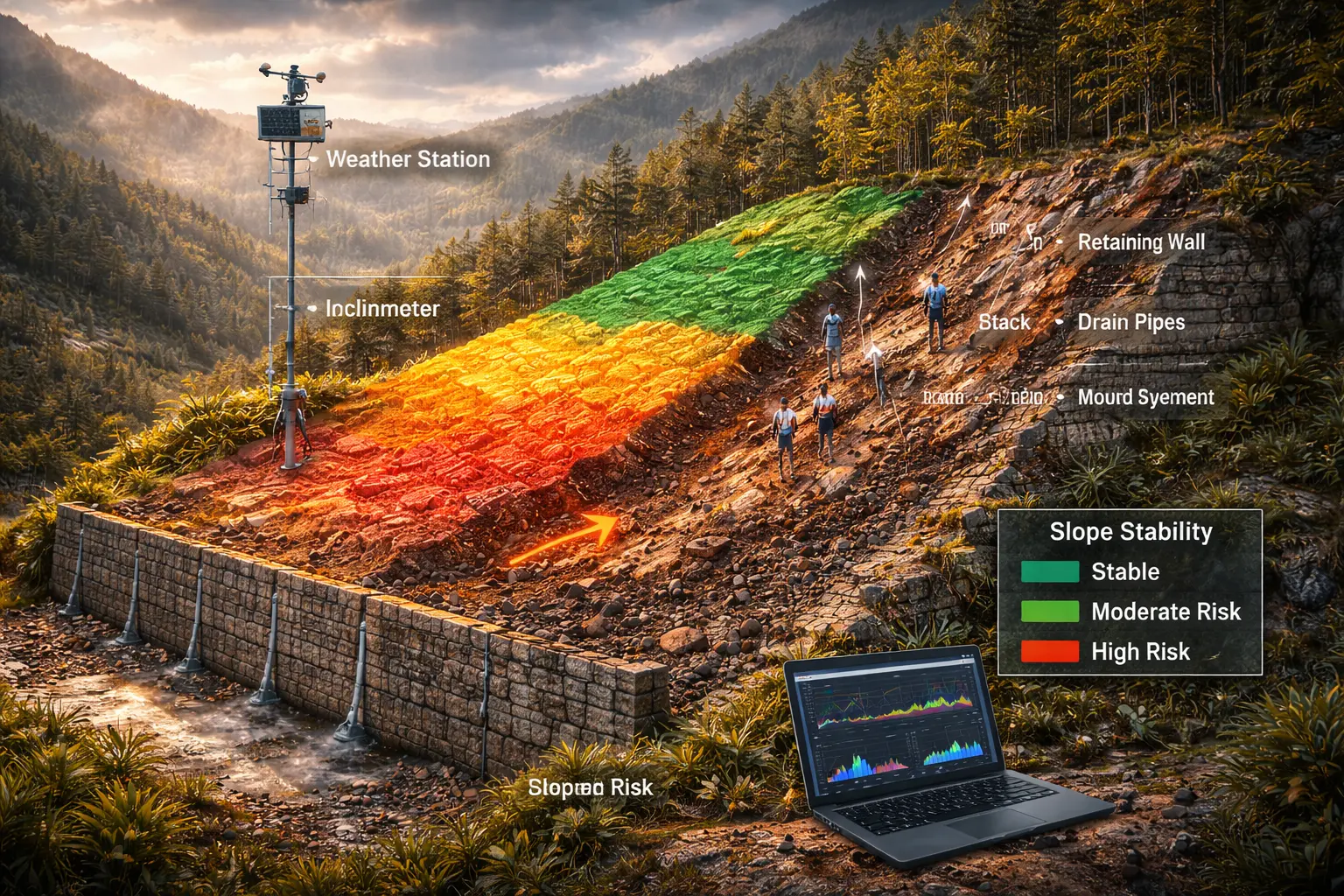
Slope Stability Analysis
Which slopes are stable, and which will fail? Slope stability analysis balances driving forces (gravity) against resisting forces (friction, cohesion). This model derives the infinite slope model, implements factor of safety calculations, shows how water pressure and earthquakes reduce stability, and maps landslide susceptibility.
Prerequisites: force balance, mohr coulomb, factor of safety, limit equilibrium
1. The Question
After heavy rain, which hillslopes will fail as landslides?
Slope stability determines whether soil/rock remains in place or slides downslope.
Driving forces:
- Gravity (weight component parallel to slope)
- Water pressure (reduces effective stress)
- Earthquakes (dynamic loading)
- External loads (buildings, traffic)
Resisting forces:
- Friction (depends on normal stress)
- Cohesion (soil/rock strength)
- Vegetation (root reinforcement)
Critical question: Does resistance exceed driving force?
Applications:
- Landslide hazard mapping
- Cut/fill slope design (roads, buildings)
- Dam stability
- Mine pit walls
- Post-earthquake assessment
2. The Conceptual Model
Landslide Types
By material:
- Rock slide: Bedrock failure
- Debris slide: Soil + rock fragments
- Earth slide: Predominantly soil
By mechanism:
- Rotational: Curved failure surface
- Translational: Planar failure surface
- Complex: Multiple failure modes
By movement:
- Slide: Mass moves as coherent unit
- Flow: Fluid-like behavior
- Fall: Free-fall from cliff
- Topple: Forward rotation
Mohr-Coulomb Failure Criterion
Shear strength:
\[\tau_f = c + \sigma' \tan\phi\]Where:
- $\tau_f$ = shear strength (kPa)
- $c$ = cohesion (kPa)
- $\sigma’$ = effective normal stress (kPa)
- $\phi$ = friction angle (degrees)
Effective stress:
\[\sigma' = \sigma - u\]Where:
- $\sigma$ = total stress
- $u$ = pore water pressure
Key insight: Water reduces effective stress → reduces shear strength!
Factor of Safety
\[FS = \frac{\text{Resisting Forces}}{\text{Driving Forces}} = \frac{\tau_f}{\tau}\]Interpretation:
- $FS > 1.5$: Stable (safe)
- $FS = 1.0-1.5$: Marginal (monitor)
- $FS < 1.0$: Failure (landslide occurs)
Design criterion: Typically require $FS > 1.5$ for permanent slopes.
3. Building the Mathematical Model
Infinite Slope Model
Assumptions:
- Uniform slope angle $\theta$
- Failure parallel to surface
- Infinite extent (no edge effects)
Forces on soil element:
Weight: $W = \gamma z b L$
Where:
- $\gamma$ = unit weight of soil (kN/m³)
- $z$ = depth to failure plane (m)
- $b$ = width (m)
- $L$ = length along slope (m)
Weight components:
Parallel to slope (driving):
\[W_\parallel = W \sin\theta = \gamma z b L \sin\theta\]Perpendicular (normal):
\[W_\perp = W \cos\theta = \gamma z b L \cos\theta\]Normal stress:
\[\sigma = \frac{W_\perp}{b L / \cos\theta} = \gamma z \cos^2\theta\]Shear stress (driving):
\[\tau = \frac{W_\parallel}{b L / \cos\theta} = \gamma z \sin\theta \cos\theta\]Shear strength (resisting):
\[\tau_f = c + \sigma' \tan\phi = c + \gamma z \cos^2\theta \tan\phi\](Assuming dry slope: $\sigma’ = \sigma$)
Factor of Safety:
\[FS = \frac{\tau_f}{\tau} = \frac{c + \gamma z \cos^2\theta \tan\phi}{\gamma z \sin\theta \cos\theta}\]Simplified:
\[FS = \frac{c}{\gamma z \sin\theta \cos\theta} + \frac{\tan\phi}{\tan\theta}\]For cohesionless soil ($c = 0$):
\[FS = \frac{\tan\phi}{\tan\theta}\]Critical slope angle: $\theta_{\text{crit}} = \phi$ (where $FS = 1$)
Effect of Water
Saturated slope with seepage parallel to surface:
Pore pressure: $u = \gamma_w z_w \cos^2\theta$
Where:
- $\gamma_w$ = unit weight of water (9.81 kN/m³)
- $z_w$ = depth to water table
Effective stress:
\[\sigma' = \gamma z \cos^2\theta - \gamma_w z_w \cos^2\theta\]If fully saturated ($z_w = z$):
\[\sigma' = (\gamma - \gamma_w) z \cos^2\theta = \gamma' z \cos^2\theta\]Where $\gamma’ = \gamma - \gamma_w$ = buoyant unit weight
Factor of Safety (saturated):
\[FS = \frac{c}{\gamma z \sin\theta \cos\theta} + \frac{\gamma'}{\gamma} \frac{\tan\phi}{\tan\theta}\]Key result: $\gamma’/\gamma \approx 0.5$ for typical soils → FS reduced by ~50% when saturated!
Seismic Loading
Earthquake adds horizontal force:
Pseudo-static approach:
\[F_h = k_h W\]Where $k_h$ = horizontal seismic coefficient (~0.1-0.3 for strong shaking)
Modified driving stress:
\[\tau_{\text{seismic}} = \gamma z (\sin\theta + k_h \cos\theta) \cos\theta\]Factor of Safety:
\[FS_{\text{seismic}} = \frac{c + \gamma z \cos^2\theta \tan\phi}{\gamma z (\sin\theta + k_h \cos\theta) \cos\theta}\]Earthquake reduces FS by increasing driving force.
4. Worked Example by Hand
Problem: Calculate factor of safety for hillslope.
Slope conditions:
- Angle: $\theta = 30°$
- Soil depth to bedrock: $z = 3$ m
- Unit weight: $\gamma = 18$ kN/m³
- Cohesion: $c = 5$ kPa
- Friction angle: $\phi = 35°$
Calculate FS for:
- Dry slope
- Fully saturated slope
- Saturated slope with earthquake ($k_h = 0.15$)
Solution
Case 1: Dry slope
\[\tau = \gamma z \sin\theta \cos\theta = 18 \times 3 \times \sin(30°) \times \cos(30°)\] \[= 18 \times 3 \times 0.5 \times 0.866 = 23.4 \text{ kPa}\] \[\sigma = \gamma z \cos^2\theta = 18 \times 3 \times (0.866)^2 = 40.5 \text{ kPa}\] \[\tau_f = c + \sigma \tan\phi = 5 + 40.5 \times \tan(35°) = 5 + 40.5 \times 0.700 = 33.4 \text{ kPa}\] \[FS = \frac{33.4}{23.4} = 1.43\]Marginal stability (just below typical design criterion of 1.5)
Case 2: Saturated slope
Buoyant unit weight: $\gamma’ = 18 - 9.81 = 8.19$ kN/m³
\[\sigma' = \gamma' z \cos^2\theta = 8.19 \times 3 \times 0.75 = 18.4 \text{ kPa}\] \[\tau_f = 5 + 18.4 \times 0.700 = 17.9 \text{ kPa}\] \[FS = \frac{17.9}{23.4} = 0.76\]FAILURE! (FS < 1.0)
Case 3: Saturated + earthquake
\[\tau_{\text{eq}} = \gamma z (\sin\theta + k_h\cos\theta) \cos\theta\] \[= 18 \times 3 \times (0.5 + 0.15 \times 0.866) \times 0.866\] \[= 18 \times 3 \times (0.5 + 0.130) \times 0.866 = 29.4 \text{ kPa}\] \[FS = \frac{17.9}{29.4} = 0.61\]Catastrophic failure (FS well below 1.0)
Summary:
- Dry: FS = 1.43 (marginal)
- Saturated: FS = 0.76 (fails)
- Saturated + earthquake: FS = 0.61 (catastrophic)
This explains why landslides often occur during/after heavy rain or earthquakes!
5. Computational Implementation
Below is an interactive slope stability calculator.
Factor of Safety: --
Status: --
Driving stress: -- kPa
Resisting stress: -- kPa
Try this:
- Increase slope angle: FS drops (steeper = less stable)
- Lower water table (0m = saturated): FS drops dramatically!
- Add seismic loading: FS drops further
- Increase friction angle: Higher FS (stronger soil)
- Add cohesion: Raises FS curve (especially at steep angles)
- Green area: Stable (FS > 1.5)
- Yellow area: Marginal (FS 1.0-1.5)
- Red area: Failure (FS < 1.0)
- Pink dot: Current slope condition
- Watch FS cross failure threshold!
Key insight: Water + earthquakes = catastrophic combination for slope stability!
6. Interpretation
Rainfall-Induced Landslides
Mechanism:
- Rain infiltrates soil
- Water table rises
- Pore pressure increases
- Effective stress decreases
- Shear strength drops
- Failure when FS < 1.0
Threshold rainfall:
- Short duration, high intensity: Shallow slides
- Long duration, moderate intensity: Deep-seated slides
Example - Pacific Northwest:
- Threshold: ~200mm in 3 days
- Thousands of landslides triggered
Earthquake-Induced Landslides
Case study - 2015 Nepal:
- Magnitude 7.8 earthquake
- 25,000+ landslides triggered
- Some on slopes previously stable (FS > 1.5 dry)
- Liquefaction in saturated soils
Newmark displacement:
- Permanent downslope movement during shaking
- Depends on: Peak acceleration, critical acceleration, duration
Cut Slope Design
Road construction:
Typical criterion: FS > 1.5 for permanent cuts
Design strategies:
- Flatten slope (reduce $\theta$)
- Improve drainage (keep dry)
- Soil nails/anchors (add resistance)
- Retaining walls
Cost trade-off:
- Steeper → less excavation → cheaper
- BUT steeper → lower FS → higher failure risk
7. What Could Go Wrong?
Assuming Homogeneous Soil
Reality: Soil has layers with different properties.
Weak layer controls failure (lowest strength).
Example:
- Strong surface soil (c=10 kPa, φ=40°)
- Weak clay layer at depth (c=2 kPa, φ=25°)
- Failure occurs along clay
Solution: Multilayer analysis, find critical surface.
Ignoring Time-Dependent Strength
Creep: Slow downslope movement
Residual strength: After movement starts, strength drops to residual value (< peak).
Progressive failure: Small movements → strength reduction → more movement
Solution: Use residual strength for long-term stability.
2D vs 3D Effects
Infinite slope = 2D (no edge effects)
Real slopes: 3D geometry matters
- Converging topography (gullies) → less stable
- Diverging topography (ridges) → more stable
Solution: 3D limit equilibrium or FEM analysis.
Vegetation Effects
Roots: Add tensile strength (resistance)
But: Trees add weight (driving force) + wind loading
Net effect: Usually stabilizing for shallow slides, destabilizing for deep slides
Deforestation: Increases landslide risk (roots decay in 2-5 years)
8. Extension: Landslide Susceptibility Mapping
Combine factors spatially:
From DEM:
- Slope angle
- Aspect (wetness)
- Curvature (convergent topography)
- Upslope contributing area (water accumulation)
From soils:
- Soil type (strength parameters)
- Depth to bedrock
From land cover:
- Vegetation (root strength)
- Land use
Statistical model (logistic regression):
\[P(\text{landslide}) = \frac{1}{1 + e^{-(\beta_0 + \beta_1 \theta + \beta_2 c + \cdots)}}\]Or physically-based (SHALSTAB, SINMAP):
Apply infinite slope model to every pixel, calculate FS.
Output: Landslide susceptibility map (high/medium/low)
9. Math Refresher: Free Body Diagrams
Force Resolution
Vector components:
Force $F$ at angle $\alpha$:
\(F_x = F \cos\alpha\) \(F_y = F \sin\alpha\)
Equilibrium Conditions
Translational equilibrium:
\(\sum F_x = 0\) \(\sum F_y = 0\)
Rotational equilibrium:
\[\sum M = 0\](Sum of moments about any point)
Slope Forces
Weight $W$ on slope angle $\theta$:
Parallel to slope:
\[W_\parallel = W \sin\theta\]Normal to slope:
\[W_\perp = W \cos\theta\]These satisfy: $W_\parallel^2 + W_\perp^2 = W^2$
Summary
- Slope stability: Balance of driving forces (gravity) vs resisting forces (friction + cohesion)
- Mohr-Coulomb criterion: $\tau_f = c + \sigma’ \tan\phi$ (shear strength)
- Factor of Safety: FS = resisting/driving, failure when FS < 1.0
- Infinite slope model: Simplified analysis for uniform slopes
- Water effect: Reduces effective stress by ~50%, can drop FS from 1.5 to 0.75
- Earthquake effect: Adds horizontal force, further reduces FS
- Critical slope angle: $\theta_{crit} = \phi$ for cohesionless soils
- Applications: Landslide hazard, road cuts, dam stability, earthquake response
- Challenges: Heterogeneous soils, 3D geometry, time-dependent strength
- Susceptibility mapping: Combine DEM + soils + vegetation for spatial risk
- Foundation for understanding when and where landslides occur