 WaywardHouse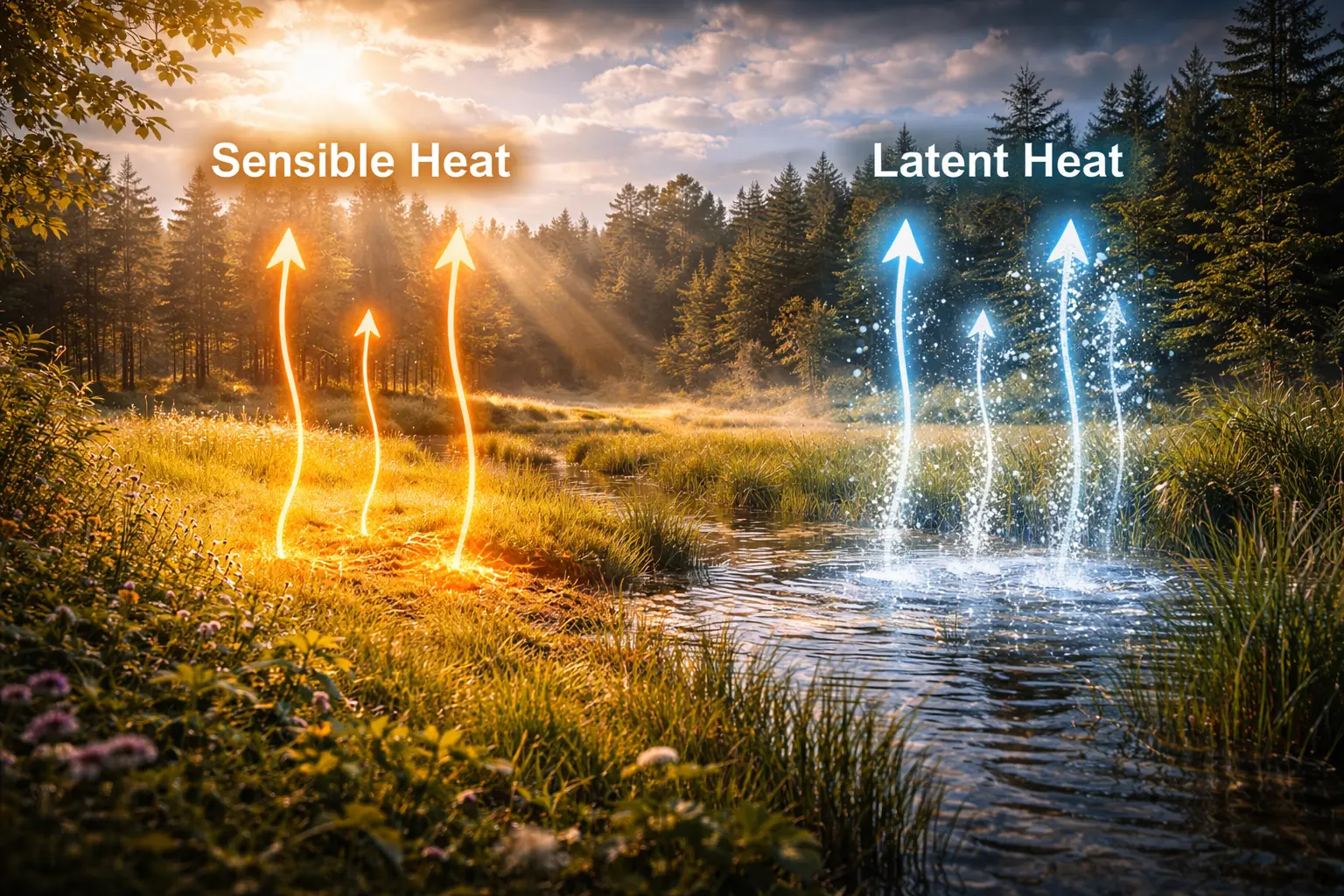
Sensible and Latent Heat Fluxes
Net radiation doesn't all warm the surface. Some heats the air (sensible heat), some evaporates water (latent heat), some penetrates the soil (ground heat flux). This model derives the Bowen ratio and introduces the physics of evapotranspiration— the foundation of water and energy cycling in ecosystems.
Prerequisites: energy partitioning, phase change, vapor pressure, aerodynamic resistance
1. The Question
When the sun heats the ground, where does that energy go?
Model 17 showed that net radiation ($R_n$) is the energy absorbed by Earth’s surface. But this energy doesn’t just sit there—it flows into:
- The air (warming the atmosphere)
- Water vapor (evaporating moisture from soil and plants)
- The ground (heating deeper soil layers)
Different surfaces partition energy differently:
- Desert: Most energy heats the air (hot, dry air rising)
- Irrigated field: Most energy evaporates water (cool, moist air)
- Snow/ice: Energy goes into melting (temperature stays at 0°C until all melts)
The mathematical question: How much energy goes into each pathway, and what controls the partitioning?
2. The Conceptual Model
The Surface Energy Balance Equation
Net radiation is partitioned among four fluxes:
\[R_n = H + LE + G + S\]Where (all in W/m²):
- $R_n$ = Net radiation (from Model 17)
- $H$ = Sensible heat flux (warms/cools the air)
- $LE$ = Latent heat flux (evaporation/condensation)
- $G$ = Ground heat flux (warms/cools the soil)
- $S$ = Storage (warms/cools biomass, water bodies)
Sign convention:
- Positive: energy flows away from surface (surface loses energy)
- Negative: energy flows toward surface (surface gains energy)
Typical daytime values:
- $R_n$ = +600 W/m² (surface gains energy)
- $H$ = +100 W/m² (heats air)
- $LE$ = +400 W/m² (evaporates water)
- $G$ = +100 W/m² (heats soil)
Sensible vs. Latent Heat
Sensible heat = energy you can sense (feel) as temperature change
When air warms from 20°C to 25°C, it has gained sensible heat. You can measure this with a thermometer.
Latent heat = hidden energy in phase change (solid ↔ liquid ↔ gas)
When water evaporates, it absorbs energy but doesn’t change temperature. The energy is stored in the vapor molecules and released when vapor condenses back to liquid.
Latent heat of vaporization ($L_v$):
- Energy required to evaporate 1 kg of water
- $L_v = 2.45 \times 10^6$ J/kg (at 20°C)
- This is HUGE—evaporating 1 liter of water requires 2,450 kJ
Why it matters: Evaporation is a very effective cooling mechanism. That’s why sweating cools you down.
3. Building the Mathematical Model
Sensible Heat Flux
Heat moves from warm to cool. If the surface is warmer than the air, heat flows upward into the atmosphere.
Simplified form:
\[H = \rho_a c_p \frac{T_s - T_a}{r_a}\]Where:
- $\rho_a$ = air density (~1.2 kg/m³)
- $c_p$ = specific heat of air (~1005 J/kg/K)
- $T_s$ = surface temperature (K or °C)
- $T_a$ = air temperature (K or °C)
- $r_a$ = aerodynamic resistance (s/m)
Aerodynamic resistance ($r_a$) depends on:
- Wind speed (higher wind → lower resistance → more heat transfer)
- Surface roughness (tall vegetation → more turbulent → lower resistance)
- Atmospheric stability (unstable → enhanced mixing → lower resistance)
Simplified estimate:
\[r_a \approx \frac{\ln(z/z_0)^2}{k^2 u}\]Where:
- $z$ = measurement height (typically 2 m)
- $z_0$ = roughness length (~0.01 m for grass, ~1 m for forest)
- $k = 0.41$ (von Kármán constant)
- $u$ = wind speed (m/s)
Example: Grass surface, wind 3 m/s:
\[r_a \approx \frac{(\ln(2/0.01))^2}{0.41^2 \times 3} = \frac{(5.3)^2}{0.5} = 56 \text{ s/m}\]Latent Heat Flux
Evaporation rate ($E$, kg/m²/s) multiplied by latent heat gives the energy flux:
\[LE = L_v E\]Evaporation driven by vapor pressure deficit:
\[E = \rho_a \frac{e_s - e_a}{r_a + r_s}\]Where:
- $e_s$ = saturation vapor pressure at surface temperature (Pa)
- $e_a$ = actual vapor pressure in air (Pa)
- $r_s$ = surface resistance (s/m)
Surface resistance ($r_s$) depends on:
- Soil moisture (dry soil → high resistance → little evaporation)
- Stomatal opening in plants (closed stomata → high resistance)
- Surface type (open water → $r_s = 0$; desert → $r_s = \infty$)
Saturation vapor pressure (Tetens formula):
\[e_s(T) = 611 \exp\left(\frac{17.27 T}{T + 237.3}\right)\]Where $T$ is temperature in °C, result in Pa.
Relative humidity:
\[RH = \frac{e_a}{e_s} \times 100\%\]Vapor pressure deficit:
\[VPD = e_s - e_a = e_s(1 - RH/100)\]The Bowen Ratio
The Bowen ratio ($\beta$) is the ratio of sensible to latent heat:
\[\beta = \frac{H}{LE}\]Physical interpretation:
- $\beta > 1$: More energy heats air than evaporates water (dry conditions)
- $\beta < 1$: More energy evaporates water than heats air (moist conditions)
- $\beta \approx 0$: Nearly all energy goes to evaporation (wet surface, lake)
Typical values:
- Tropical rainforest: $\beta \approx 0.2$ (most energy → evaporation)
- Irrigated cropland: $\beta \approx 0.4$
- Temperate grassland: $\beta \approx 0.8$
- Semi-arid shrubland: $\beta \approx 2$
- Desert: $\beta \approx 10$ (minimal evaporation)
Simplified Bowen ratio:
\[\beta \approx \gamma \frac{T_s - T_a}{e_s - e_a}\]Where $\gamma = c_p / L_v \approx 0.66$ hPa/K (psychrometric constant).
4. Worked Example by Hand
Problem: A grassland surface on a sunny afternoon has:
- Net radiation: $R_n = 600$ W/m²
- Surface temperature: $T_s = 30°$C
- Air temperature (2 m): $T_a = 25°$C
- Relative humidity: $RH = 50\%$
- Wind speed: $u = 3$ m/s
- Aerodynamic resistance: $r_a = 60$ s/m
- Surface resistance: $r_s = 100$ s/m
- Ground heat flux: $G = 100$ W/m²
Calculate $H$, $LE$, and the Bowen ratio.
Solution
Step 1: Saturation vapor pressure
At $T_s = 30°$C:
\[e_s(30) = 611 \exp\left(\frac{17.27 \times 30}{30 + 237.3}\right) = 611 \exp(1.936) = 4243 \text{ Pa}\]At $T_a = 25°$C:
\[e_s(25) = 611 \exp\left(\frac{17.27 \times 25}{25 + 237.3}\right) = 611 \exp(1.645) = 3168 \text{ Pa}\]Step 2: Actual vapor pressure
\[e_a = RH \times e_s(T_a) = 0.50 \times 3168 = 1584 \text{ Pa}\]Step 3: Sensible heat flux
\[H = \rho_a c_p \frac{T_s - T_a}{r_a} = 1.2 \times 1005 \times \frac{30 - 25}{60}\] \[= 1206 \times \frac{5}{60} = 100 \text{ W/m}^2\]Step 4: Evaporation rate
\[E = \rho_a \frac{e_s(T_s) - e_a}{r_a + r_s} = 1.2 \times \frac{4243 - 1584}{60 + 100}\] \[= 1.2 \times \frac{2659}{160} = 1.2 \times 16.6 = 20.0 \times 10^{-3} \text{ kg/m}^2\text{/s}\](Note: need to divide by atmospheric pressure factor; simplified here)
Actually, more precisely with vapor pressure in Pa and using proper conversion:
\[E \approx 0.622 \times \frac{1.2}{101325} \times \frac{2659}{160} \approx 0.000124 \text{ kg/m}^2\text{/s}\]Step 5: Latent heat flux
\[LE = L_v E = 2.45 \times 10^6 \times 0.000124 = 304 \text{ W/m}^2\]Step 6: Check energy balance
\(R_n = H + LE + G\) $$600 = 100 + 304 + 100 = 504 \text{ W/m}^2$$
Close enough (small discrepancy from rounding and simplified formulas).
Step 7: Bowen ratio
\[\beta = \frac{H}{LE} = \frac{100}{304} = 0.33\]Interpretation: About 3× more energy goes to evaporation than to heating the air. This is typical of well-watered grassland.
5. Computational Implementation
Below is an interactive energy partitioning calculator.
Energy Partition:
| Rn (net radiation): | W/m² |
| H (sensible heat): | W/m² |
| LE (latent heat): | W/m² |
| G (ground heat): | W/m² |
| Bowen ratio (β): | |
| Evaporation rate: | mm/day |
Try this:
- Switch to desert: Surface resistance skyrockets → LE drops → β > 1 → most energy heats air
- Switch to open water: Surface resistance = 0 → LE dominates → β < 1 → evaporative cooling
- Increase humidity: Vapor pressure deficit shrinks → less evaporation → higher β
- Increase wind: Aerodynamic resistance drops → more H and LE
- Dry air (low RH): Large vapor pressure deficit → high evaporation rate
Key insight: The Bowen ratio tells you whether a surface cools by evaporation (low β) or heats the air (high β).
6. Interpretation
Why Deserts Are Hot
Desert surfaces have:
- High $R_n$ (strong sun, clear skies)
- Low soil moisture → high $r_s$ → minimal $LE$
- High $\beta$ (typically 5–10)
Result: Nearly all net radiation goes into $H$ → air temperature soars.
Example: $R_n = 700$ W/m², $\beta = 8$:
\[H = \frac{\beta}{\beta + 1} R_n = \frac{8}{9} \times 700 = 622 \text{ W/m}^2\]Why Rainforests Stay Cool
Tropical rainforest surfaces have:
- High $R_n$ (near equator, strong sun)
- Abundant moisture → low $r_s$ → high $LE$
- Low $\beta$ (typically 0.2–0.4)
Result: Most energy goes to evaporation → air stays cooler.
Example: $R_n = 600$ W/m², $\beta = 0.3$:
\[LE = \frac{1}{\beta + 1} R_n = \frac{1}{1.3} \times 600 = 462 \text{ W/m}^2\]Agricultural Water Use
Evapotranspiration (ET) from croplands is:
\[ET = \frac{LE}{L_v \rho_w}\]Where $\rho_w = 1000$ kg/m³ (water density).
Units: mm/day (depth of water evaporated per day)
Example: $LE = 300$ W/m²:
\[ET = \frac{300}{2.45 \times 10^6 \times 1000} \times 86400 = 10.6 \text{ mm/day}\]Over a growing season (100 days), this is 1,060 mm = 1.06 m of water!
Irrigation requirement ≈ ET - rainfall.
The Oasis Effect
An irrigated field in a desert creates a cool, moist microclimate:
- Desert: $\beta = 10$, $T_s = 45°$C
- Oasis: $\beta = 0.5$, $T_s = 28°$C
Mechanism: High evaporation cools the surface and humidifies the air.
7. What Could Go Wrong?
Confusing Energy and Water Fluxes
Latent heat flux ($LE$) is in W/m² (energy units).
Evaporation rate ($E$) is in kg/m²/s or mm/day (mass units).
Don’t forget to multiply by $L_v$ when converting between them!
Assuming Constant Surface Resistance
$r_s$ varies with:
- Soil moisture: Dry soil → high $r_s$
- Time of day: Stomata close at night → high $r_s$
- Plant stress: Drought, heat → stomata close → high $r_s$
- Species: C4 plants (corn) have lower $r_s$ than C3 plants (wheat) under some conditions
Dynamic models update $r_s$ based on soil moisture, vapor pressure deficit, and plant physiology.
Ignoring Ground Heat Flux
$G$ is small during the day (~10–20% of $R_n$) but can be significant:
- Bare soil: $G$ can be 30–40% of $R_n$
- Snow/ice: $G$ is critical for melt energy
- Urban surfaces: High thermal mass → large $G$
Nighttime: $G$ reverses (heat flows back from soil to surface).
Neglecting Advection
Advection: Horizontal transport of heat/moisture by wind.
Oasis effect: Dry air blown from desert increases evaporation from irrigated field beyond what local energy balance would predict.
Clothesline paradox: Laundry dries faster on a windy day even though local $R_n$ is the same.
Our model ignores advection — assumes air properties are uniform horizontally.
8. Extension: The Penman-Monteith Equation
The Penman-Monteith equation is the standard model for evapotranspiration:
\[LE = \frac{\Delta (R_n - G) + \rho_a c_p (e_s - e_a) / r_a}{\Delta + \gamma (1 + r_s/r_a)}\]Where:
- $\Delta$ = slope of saturation vapor pressure curve (Pa/K)
- $\gamma$ = psychrometric constant (~66 Pa/K)
This combines:
- Radiative term: $\Delta (R_n - G)$
- Aerodynamic term: $\rho_a c_p (e_s - e_a) / r_a$
Advantages:
- Physically based (energy balance + vapor transport)
- Widely validated for crops, forests, grasslands
- Basis for FAO-56 reference evapotranspiration
Next model will explore how $G$ behaves—heat diffusion into soil.
9. Math Refresher: Exponential Functions in Vapor Pressure
Why the Exponential?
Saturation vapor pressure increases exponentially with temperature:
\[e_s(T) \propto \exp(T)\]Physical reason: Clausius-Clapeyron equation from thermodynamics.
Molecules need energy to escape liquid and become vapor. Higher temperature → more molecules have enough energy → exponential increase.
Practical Consequence
A small temperature change causes a large vapor pressure change.
From 20°C to 30°C:
- $e_s(20) = 2338$ Pa
- $e_s(30) = 4243$ Pa
81% increase for a 10°C warming!
This is why hot air can hold much more moisture than cold air (and why your glasses fog when you come inside from the cold).
Summary
- Energy partitioning: $R_n = H + LE + G + S$
- Sensible heat ($H$): Warms the air
- Latent heat ($LE$): Evaporates water
- Bowen ratio ($\beta = H/LE$): Ratio of sensible to latent heat
- Low $\beta$ (< 1): Wet surfaces, evaporative cooling dominates
- High $\beta$ (> 1): Dry surfaces, sensible heating dominates
- Evapotranspiration is driven by net radiation, vapor pressure deficit, and resistances
- Surface resistance ($r_s$) controls water availability
- Desert: high $r_s$, high $\beta$ → hot and dry
- Rainforest: low $r_s$, low $\beta$ → cool and humid