 WaywardHouse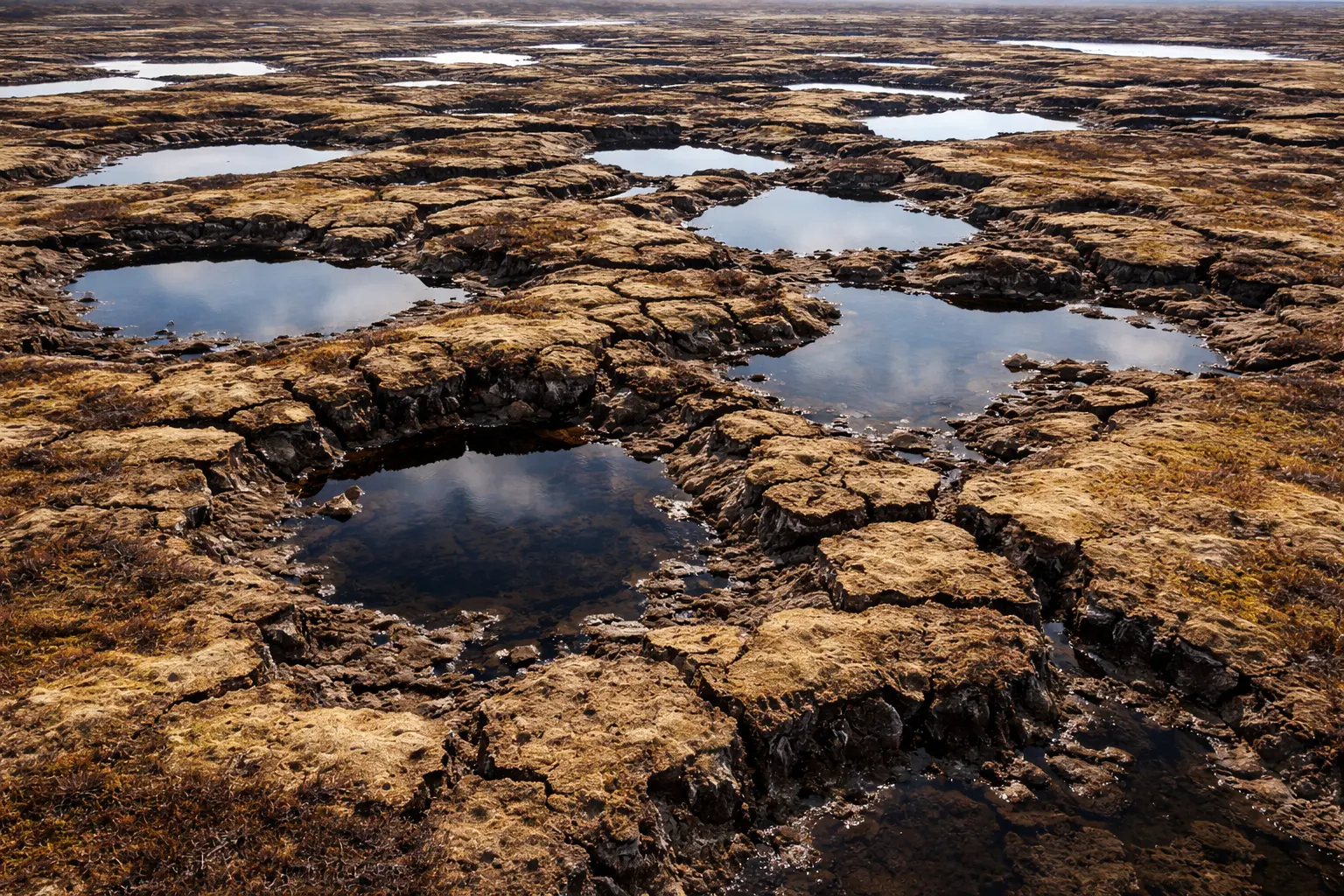
Permafrost Thaw and Geohazards
What happens when permanently frozen ground thaws? Permafrost contains massive ice volumes that, when melted, cause ground subsidence, slope failures, and infrastructure damage. This model derives thaw depth equations, implements active layer models, calculates settlement from ice-rich permafrost thaw, and maps permafrost degradation hazards under climate warming scenarios.
Prerequisites: heat transfer, phase change, thaw settlement, thermal modelling
1. The Question
How deep will permafrost thaw this century, and what will collapse?
Permafrost definition:
Ground remaining below 0°C for two or more consecutive years.
Global extent:
- 24% of Northern Hemisphere land
- 14 million km² in Arctic regions
- Thickness: 1-1000+ meters
Characteristics:
- Contains massive ground ice (10-90% by volume)
- Stores 1600 Gt of organic carbon
- Underlies critical infrastructure (buildings, pipelines, roads)
Thaw consequences:
- Ground subsidence (thermokarst)
- Slope instability (active layer detachment slides)
- Infrastructure damage (buildings tilt, pipelines rupture)
- Carbon release (permafrost carbon feedback)
- Coastal erosion acceleration
Climate sensitivity:
Arctic warming at 2-3× global rate drives rapid permafrost degradation.
2. The Conceptual Model
Permafrost Structure
Active layer:
- Surface layer that thaws each summer, refreezes each winter
- Depth: 0.3-3 m (varies with climate, vegetation, soil)
- Maximum thaw depth = active layer thickness (ALT)
Permafrost table:
- Top of permanently frozen ground
- Depth = ALT (end of summer)
Permafrost body:
- Continuously frozen ground below permafrost table
- May contain massive ice (pure ice lenses, wedges)
- Temperature: -10°C to 0°C
Talik:
- Unfrozen zone within permafrost
- Occurs under lakes, rivers (thermal disturbance)
Thermal Regime
Temperature profile with depth:
Summer:
- Surface: +10 to +20°C (diurnal variation)
- Active layer: +5 to 0°C (seasonal thaw)
- Permafrost: Below 0°C (stable)
Winter:
- Surface: -30 to -40°C
- Active layer: -10 to 0°C (seasonal freeze)
- Permafrost: Below 0°C (warming from below)
Mean annual ground temperature (MAGT):
Critical parameter: permafrost stable when MAGT < 0°C
Warming trend:
MAGT increasing 0.3-0.5°C per decade in Arctic regions.
Ice Content
Massive ice:
- Ice wedges (polygonal patterns)
- Ice lenses (horizontal layers)
- Pore ice (filling voids)
Volumetric ice content:
\[\theta_i = \frac{V_{\text{ice}}}{V_{\text{total}}}\]Typical values:
- Sandy soils: 20-40%
- Silty soils: 40-70%
- Organic-rich: 60-90%
Excess ice:
Ice volume exceeding pore space when thawed.
\[\theta_{\text{excess}} = \theta_i - \theta_{\text{porosity}}\]Controls settlement upon thaw.
3. Building the Mathematical Model
Stefan Equation (Thaw Depth)
One-dimensional heat conduction with phase change:
Assumptions:
- Uniform soil properties
- Step change in surface temperature
- Semi-infinite domain
Stefan solution:
\[X(t) = \lambda \sqrt{\alpha t}\]Where:
- $X$ = thaw depth (m)
- $\alpha$ = thermal diffusivity (m²/s)
- $t$ = time (s)
- $\lambda$ = dimensionless parameter
Dimensionless parameter:
\[\lambda = \sqrt{\frac{2(T_s - T_f)}{\pi L_f / c}}\]Where:
- $T_s$ = surface temperature (°C)
- $T_f$ = freezing point (0°C)
- $L_f$ = latent heat of fusion (334 kJ/kg)
- $c$ = volumetric heat capacity (MJ/m³/K)
Simplified empirical (degree-day model):
\[X = k \sqrt{\text{TDD}}\]Where:
- TDD = thawing degree days (°C·days)
- $k$ = empirical coefficient (0.01-0.05 m/(°C·day)^{0.5})
Example:
Summer with TDD = 1200 °C·days, k = 0.03:
\[X = 0.03 \sqrt{1200} = 0.03 \times 34.6 = 1.04 \text{ m}\]Active layer thickness = 1.04 m
Thaw Settlement
Excess ice melt causes subsidence:
Thaw strain:
\[\varepsilon_t = \frac{\Delta h}{h} = \frac{\theta_{\text{excess}}}{1 - \theta_{\text{excess}}}\]Where:
- $\Delta h$ = settlement (m)
- $h$ = original thickness (m)
For layer with 60% ice content, 40% porosity:
\[\theta_{\text{excess}} = 0.60 - 0.40 = 0.20\] \[\varepsilon_t = \frac{0.20}{1 - 0.20} = 0.25 = 25\%\]Massive settlement from ice-rich permafrost!
Total settlement:
\[S = \sum_{i=1}^{n} h_i \varepsilon_{t,i}\]Sum over all thawed layers.
Temperature Change with Depth
Thermal diffusion equation:
\[\frac{\partial T}{\partial t} = \alpha \frac{\partial^2 T}{\partial z^2}\]Steady-state geothermal gradient:
\[\frac{dT}{dz} = \frac{q}{k}\]Where:
- $q$ = geothermal heat flux (~50-70 mW/m²)
- $k$ = thermal conductivity (W/m/K)
Typical gradient: 0.02-0.03°C/m
At 100 m depth: Temperature ~2-3°C warmer than surface MAGT
Climate change signal:
Propagates downward at rate $\sim\sqrt{\alpha/t}$
Takes decades to centuries to reach depth.
Active Layer Detachment Slides
Failure when:
Thawed active layer slides on ice-rich permafrost table.
Critical condition:
\[FS = \frac{\tau_f}{\tau_d} < 1\]Active layer on slope $\theta$:
Driving stress:
\[\tau_d = \gamma z \sin\theta \cos\theta\]Resisting stress (active layer - permafrost interface):
Very low friction when ice-rich: $\phi \approx 5-15°$
\[\tau_f = c + \gamma z \cos^2\theta \tan\phi\]Failure common when:
- ALT increases rapidly (climate warming)
- Heavy rainfall (increases weight, pore pressure)
- Slopes > 5° (even gentle slopes!)
4. Worked Example by Hand
Problem: Calculate active layer thickness increase and settlement under warming scenario.
Site conditions:
- Current MAGT: -2°C
- Current ALT: 0.8 m
- Soil: Silty with 55% ice content, 35% porosity
- Thaw index coefficient: k = 0.025 m/(°C·day)^{0.5}
Current climate:
- Thawing degree days: 900 °C·days
Warming scenario (+3°C summer):
- Increased TDD: 1350 °C·days
Calculate new ALT and settlement if permafrost thaws to new depth.
Solution
Step 1: Current active layer thickness
\[X_{\text{current}} = 0.025 \sqrt{900} = 0.025 \times 30 = 0.75 \text{ m}\](Close to observed 0.8 m - within uncertainty)
Step 2: Future active layer thickness
\[X_{\text{future}} = 0.025 \sqrt{1350} = 0.025 \times 36.7 = 0.92 \text{ m}\]Increase: 0.92 - 0.80 = 0.12 m
Step 3: Calculate excess ice
\[\theta_{\text{excess}} = 0.55 - 0.35 = 0.20\]Step 4: Thaw strain
\[\varepsilon_t = \frac{0.20}{1 - 0.20} = \frac{0.20}{0.80} = 0.25 = 25\%\]Step 5: Settlement from new thaw
Additional thaw depth: 0.12 m
\[S = 0.12 \times 0.25 = 0.03 \text{ m} = 30 \text{ mm}\]Summary:
- ALT increases from 0.80 m to 0.92 m
- Additional 12 cm of permafrost thaws
- Ground surface subsides 30 mm
- Impact: Differential settlement damages buildings on variable permafrost
Note: This is single-season response. Multi-decadal warming produces cumulative deepening and greater settlement.
5. Computational Implementation
Below is an interactive permafrost thaw simulator.
Active layer depth: -- m
Thaw settlement: -- mm
Status: --
Years to 3m thaw: --
Observations:
- Higher summer temperature increases active layer thickness
- RCP 8.5 scenario shows accelerating thaw over century
- High ice content produces greater settlement
- 3m threshold marks approximate permafrost base at shallow sites
- Current trajectory suggests complete thaw within decades at many sites
- Settlement proportional to excess ice volume
Key findings:
- Temperature increases directly drive active layer deepening
- Ice-rich permafrost experiences massive settlement upon thaw
- Climate warming scenarios project multi-meter thaw by 2100
- Infrastructure on permafrost faces severe damage risk
6. Interpretation
Infrastructure Impacts
Trans-Alaska Pipeline:
- 1300 km crosses permafrost
- Elevated on vertical support members
- Thermosyphons prevent thaw
- Maintenance cost: $100s millions annually
Arctic communities:
- Buildings tilting, cracking
- Roads buckling
- Airport runways settling
- Water/sewer systems rupturing
Mitigation strategies:
- Thermosyphons (passive cooling)
- Insulation layers
- Ventilated foundations
- Geotextile reinforcement
Cost:
- Permafrost-safe design: 2-5× normal construction
- Repair/replacement: Billions USD across Arctic
Coastal Erosion
Mechanism:
Permafrost stabilizes coastal bluffs.
Thaw → bluff collapse → rapid erosion
Alaska North Slope:
- Erosion rate: 1-2 m/year historically
- Accelerating to 10-20 m/year at some sites
- Villages relocating (Kivalina, Shishmaref)
Driver combination:
- Permafrost thaw (weakens bluffs)
- Sea ice decline (longer wave action season)
- Storm intensity increase
Carbon Feedback
Permafrost carbon pool:
- 1600 Gt organic carbon stored
- 2× atmospheric carbon
Thaw release mechanisms:
- Microbial decomposition (CO₂, CH₄)
- Thermokarst lake formation (CH₄ hotspots)
- Wildfire in newly thawed terrain
Emission estimates:
- RCP 8.5: 150-200 Gt C release by 2100
- Positive feedback (warming → thaw → emissions → warming)
Methane particularly concerning:
- 25× warming potential vs CO₂
- Anaerobic decomposition in wet thaw areas
7. What Could Go Wrong?
Assuming Uniform Thaw
Reality: Highly variable spatially
Factors causing variation:
- Vegetation (insulates)
- Snow depth (insulates)
- Soil moisture (latent heat)
- Aspect (solar radiation)
- Microtopography (drainage)
Result: Differential settlement
Example:
- North side of building: 2 cm settlement
- South side: 15 cm settlement
- Building rotates, cracks
Solution: Site-specific investigation, account for heterogeneity
Ignoring Talik Development
Talik: Unfrozen zone within permafrost
Forms under:
- Lakes (thermal disturbance)
- Rivers
- Disturbed areas (cleared vegetation)
Consequence:
- Throughflow of groundwater
- Accelerated lateral thaw
- Sudden drainage (catastrophic lake loss)
Solution: Monitor subsurface temperature, model 3D heat flow
Ground Ice Distribution Unknown
Difficult to characterize without drilling
Geophysical methods:
- Ground-penetrating radar (GPR)
- Electrical resistivity tomography (ERT)
- Seismic surveys
Problem: Expensive, time-consuming
Risk: Build on assumed conditions, discover massive ice after construction
Solution: Conservative design, expect worst case
Abrupt Thaw Not Captured
Gradual thaw models miss:
- Thermokarst collapse (sudden subsidence)
- Retrogressive thaw slumps (headwall retreat 10s m/year)
- Active layer detachments (slope failures)
These processes:
- Localized but severe
- Triggered by extreme events
- Difficult to predict
Solution: Identify susceptible areas, plan for rapid change
8. Extension: Permafrost-Carbon Models
Coupled permafrost-carbon-climate:
Temperature forcing:
\[T_{\text{air}}(t) = T_0 + \Delta T_{\text{climate}}(t) + \Delta T_{\text{feedback}}(t)\]Active layer response:
\[\frac{\partial T}{\partial t} = \alpha \frac{\partial^2 T}{\partial z^2} - \frac{L_f}{\rho c} \frac{\partial \theta_i}{\partial t}\]Carbon decomposition:
\[\frac{dC}{dt} = -k(T) C\]Where $k(T) = k_0 e^{-E_a/RT}$ (Arrhenius)
Emissions:
\[E_{\text{CO}_2} = k_{\text{aerobic}} C_{\text{thawed}}\] \[E_{\text{CH}_4} = k_{\text{anaerobic}} C_{\text{wet}}\]Climate feedback:
\[\Delta T_{\text{feedback}} = \lambda (E_{\text{CO}_2} + 25 E_{\text{CH}_4})\]Integrated models:
- Community Land Model (CLM)
- Permafrost Carbon Network models
- Earth System Models with permafrost
9. Math Refresher: Heat Conduction with Phase Change
Fourier’s Law
Heat flux:
\[q = -k \frac{\partial T}{\partial z}\]Where:
- $q$ = heat flux (W/m²)
- $k$ = thermal conductivity (W/m/K)
- Negative sign: heat flows from hot to cold
Heat Equation
Conservation of energy:
\[\rho c \frac{\partial T}{\partial t} = \frac{\partial}{\partial z}\left(k \frac{\partial T}{\partial z}\right)\]For constant properties:
\[\frac{\partial T}{\partial t} = \alpha \frac{\partial^2 T}{\partial z^2}\]Where $\alpha = k/(\rho c)$ = thermal diffusivity
Phase Change
Latent heat release/absorption:
When ice melts or water freezes, temperature remains at 0°C until phase change complete.
Energy required to melt ice:
\[Q = L_f m = L_f \rho_i V\]Where:
- $L_f$ = 334 kJ/kg (latent heat of fusion)
- $\rho_i$ = 917 kg/m³ (ice density)
This energy must come from heat conduction → slows thaw front propagation.
Summary
- Permafrost contains massive ground ice that causes settlement upon thaw
- Active layer thickness increases with warming following square-root relationship with thawing degree days
- Excess ice content controls settlement magnitude via thaw strain calculation
- Ice-rich permafrost can experience 25-50% settlement upon complete thaw
- Infrastructure damage severe due to differential settlement and foundation failure
- Active layer detachment slides occur on gentle slopes when ice-rich permafrost table exposed
- Climate scenarios project 1-3m active layer deepening by 2100 in many regions
- Carbon feedback from permafrost thaw represents significant climate forcing
- Coastal erosion accelerating where permafrost stabilization lost
- Mitigation requires specialized engineering and substantial additional cost
-
Critical challenge for Arctic infrastructure, communities, and global climate system