 WaywardHouse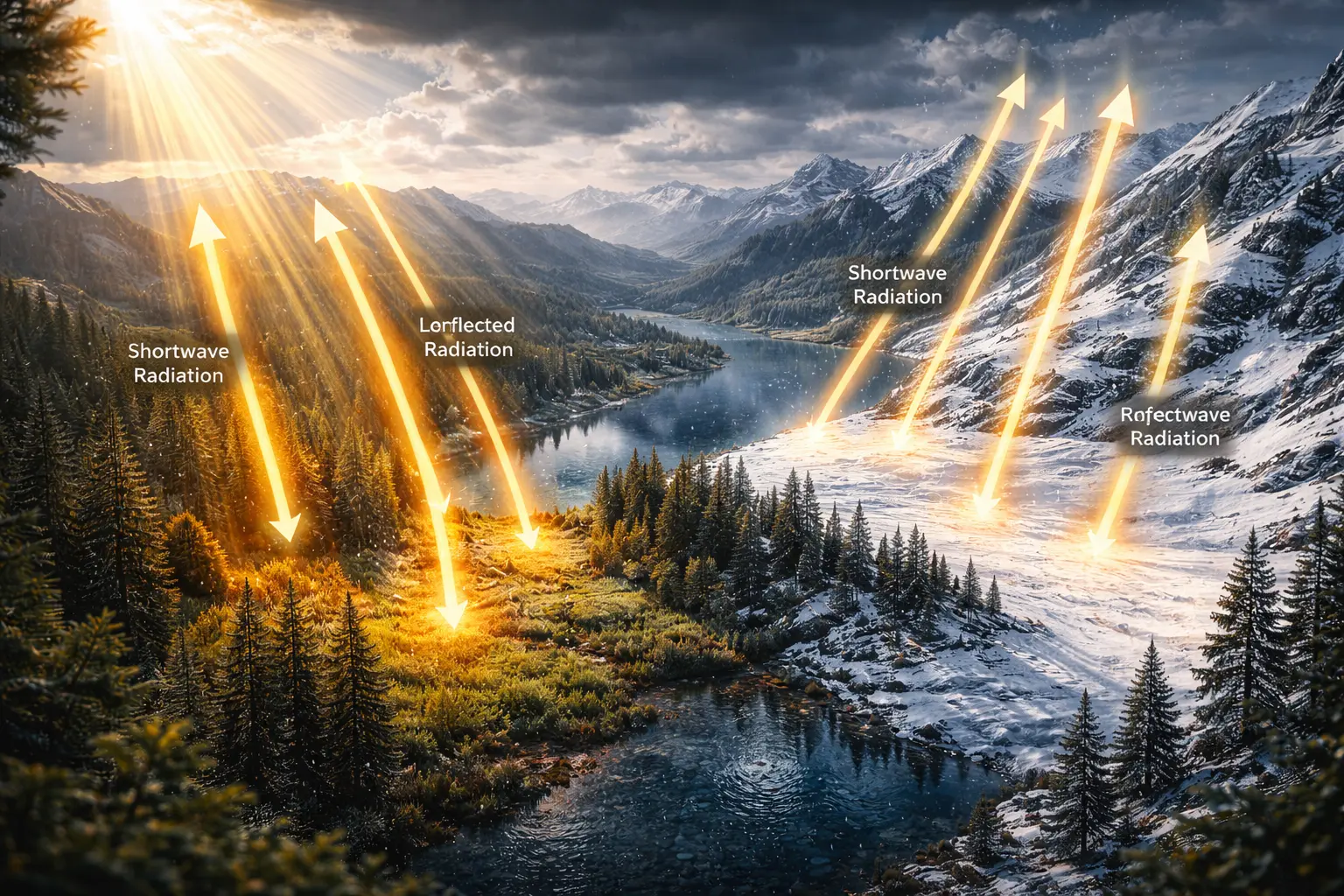
Net Radiation and Albedo
Not all incoming solar radiation stays at Earth's surface. Some reflects back to space (determined by albedo), some is absorbed and warms the ground. This model builds the net radiation budget: incoming shortwave, reflected shortwave, incoming longwave, and outgoing longwave. The balance determines surface heating.
Prerequisites: energy balance, radiative transfer, conservation of energy
1. The Question
How much solar energy actually warms the ground?
Sunlight arrives at Earth’s surface. Some bounces off (reflection). Some is absorbed and heats the surface. The surface also radiates energy back to the atmosphere as infrared heat.
The net radiation is the difference between energy absorbed and energy lost. This net radiation drives all surface processes:
- Heating the soil and air
- Evaporating water
- Melting snow
- Photosynthesis
The mathematical question: How do we calculate net radiation from incoming solar radiation, surface properties, and temperature?
2. The Conceptual Model
Four Radiation Streams
At Earth’s surface, four radiation streams matter:
-
Incoming shortwave ($S_{\downarrow}$): Direct and diffuse solar radiation from the sun (visible and near-infrared, 0.3–3 μm wavelength)
-
Reflected shortwave ($S_{\uparrow}$): Solar radiation bounced back by the surface (same wavelengths)
-
Incoming longwave ($L_{\downarrow}$): Infrared radiation emitted downward by the atmosphere (thermal radiation, 3–100 μm wavelength)
-
Outgoing longwave ($L_{\uparrow}$): Infrared radiation emitted upward by the surface (thermal radiation)
Net radiation:
\[R_n = (S_{\downarrow} - S_{\uparrow}) + (L_{\downarrow} - L_{\uparrow})\]Or equivalently:
\[R_n = \text{Net shortwave} + \text{Net longwave}\]Shortwave vs. Longwave
Shortwave (solar):
- Originates from the sun (temperature ~5,800 K)
- Peak wavelength ~0.5 μm (green visible light)
- Intensity varies with time of day, season, cloudiness
- Measured in W/m² (watts per square meter)
Longwave (thermal infrared):
- Originates from Earth’s surface and atmosphere (temperature ~200–300 K)
- Peak wavelength ~10 μm (thermal infrared, invisible to the eye)
- Present day and night (doesn’t require sunlight)
- Measured in W/m²
Why separate them? Different physics. Shortwave is controlled by albedo (surface color). Longwave is controlled by temperature (Stefan-Boltzmann law).
3. Building the Mathematical Model
Net Shortwave Radiation
Albedo ($\alpha$) is the fraction of incoming solar radiation that is reflected:
\[\alpha = \frac{S_{\uparrow}}{S_{\downarrow}}\]Albedo ranges from 0 (perfectly absorbing, black) to 1 (perfectly reflecting, mirror).
Reflected shortwave:
\[S_{\uparrow} = \alpha \cdot S_{\downarrow}\]Net shortwave (absorbed):
\[S_{\text{net}} = S_{\downarrow} - S_{\uparrow} = S_{\downarrow}(1 - \alpha)\]Examples of albedo:
| Surface | Albedo ($\alpha$) |
|---|---|
| Fresh snow | 0.80–0.95 |
| Old snow | 0.40–0.70 |
| Sea ice | 0.50–0.70 |
| Desert sand | 0.30–0.40 |
| Grassland | 0.15–0.25 |
| Deciduous forest | 0.15–0.20 |
| Conifer forest | 0.05–0.15 |
| Ocean | 0.06–0.10 |
| Asphalt | 0.05–0.10 |
Key insight: Dark surfaces (forests, oceans) absorb most solar radiation. Light surfaces (snow, ice) reflect most.
Stefan-Boltzmann Law
The Stefan-Boltzmann Law relates temperature to thermal radiation emitted by a surface:
\[E = \sigma T^4\]Where:
- $E$ is emitted radiation (W/m²)
- $\sigma = 5.67 \times 10^{-8}$ W/m²/K⁴ (Stefan-Boltzmann constant)
- $T$ is absolute temperature (Kelvin)
Example: A surface at 15°C = 288 K emits:
\[E = 5.67 \times 10^{-8} \times (288)^4 = 390 \text{ W/m}^2\]This is a LOT of energy — comparable to incoming solar radiation!
Emissivity Correction
Real surfaces are not perfect “blackbodies.” They emit less than the theoretical maximum.
Emissivity ($\varepsilon$) is the ratio of actual emission to blackbody emission (0 ≤ ε ≤ 1).
Actual emission:
\[L_{\uparrow} = \varepsilon \sigma T_s^4\]Where $T_s$ is the surface temperature.
Typical emissivities:
- Water: ε ≈ 0.95–0.98
- Vegetation: ε ≈ 0.95–0.99
- Soil: ε ≈ 0.90–0.95
- Snow: ε ≈ 0.98–0.99
Most natural surfaces have high emissivity (ε > 0.9) in the thermal infrared.
Incoming Longwave from Atmosphere
The atmosphere emits downward infrared radiation. This depends on:
- Air temperature (warmer air emits more)
- Water vapor content (water vapor is a strong greenhouse gas)
- Cloud cover (clouds emit strongly; cloudy nights are warmer)
Simple approximation (clear sky):
\[L_{\downarrow} = \varepsilon_a \sigma T_a^4\]Where:
- $\varepsilon_a$ is the effective emissivity of the atmosphere (typically 0.7–0.9)
- $T_a$ is air temperature (K)
With clouds: $L_{\downarrow}$ increases, approaching $\sigma T_a^4$ for complete overcast.
Net Radiation Formula
Combining all four streams:
\[R_n = S_{\downarrow}(1 - \alpha) + L_{\downarrow} - \varepsilon \sigma T_s^4\]Interpretation:
- First term: absorbed solar radiation
- Second term: atmospheric infrared warming
- Third term: surface infrared cooling
Day vs. Night:
- Daytime: $S_{\downarrow}$ large → $R_n$ typically positive (surface gains energy)
- Nighttime: $S_{\downarrow} = 0$ → $R_n = L_{\downarrow} - L_{\uparrow}$ typically negative (surface loses energy)
4. Worked Example by Hand
Problem: A grassland surface has:
- Albedo: $\alpha = 0.20$
- Emissivity: $\varepsilon = 0.96$
- Surface temperature: $T_s = 25°\text{C} = 298$ K
- Air temperature: $T_a = 20°\text{C} = 293$ K
- Atmospheric emissivity: $\varepsilon_a = 0.80$ (clear sky)
- Incoming solar radiation: $S_{\downarrow} = 800$ W/m² (midday sun)
Calculate the net radiation.
Solution
Net shortwave:
\[S_{\text{net}} = S_{\downarrow}(1 - \alpha) = 800 \times (1 - 0.20) = 800 \times 0.80 = 640 \text{ W/m}^2\]Incoming longwave:
\[L_{\downarrow} = \varepsilon_a \sigma T_a^4 = 0.80 \times 5.67 \times 10^{-8} \times (293)^4\] \[= 0.80 \times 5.67 \times 10^{-8} \times 7.357 \times 10^9 = 334 \text{ W/m}^2\]Outgoing longwave:
\[L_{\uparrow} = \varepsilon \sigma T_s^4 = 0.96 \times 5.67 \times 10^{-8} \times (298)^4\] \[= 0.96 \times 5.67 \times 10^{-8} \times 7.880 \times 10^9 = 429 \text{ W/m}^2\]Net longwave:
\[L_{\text{net}} = L_{\downarrow} - L_{\uparrow} = 334 - 429 = -95 \text{ W/m}^2\](Negative because surface radiates more than it receives from atmosphere)
Total net radiation:
\[R_n = S_{\text{net}} + L_{\text{net}} = 640 + (-95) = 545 \text{ W/m}^2\]Interpretation: The surface gains 545 W/m² during midday. This energy heats the ground, the air, and drives evaporation.
5. Computational Implementation
Below is an interactive radiation balance calculator.
Energy Balance:
| S↓ (incoming solar): | W/m² |
| S↑ (reflected): | W/m² |
| Net shortwave: | W/m² |
| L↓ (atmospheric IR): | W/m² |
| L↑ (surface IR): | W/m² |
| Net longwave: | W/m² |
| Net radiation (Rn): | W/m² |
Try this:
- Switch to snow: Albedo jumps to 0.85 → most solar radiation reflects → low net shortwave
- Set solar to 0 (nighttime): Net radiation goes negative (surface cools by IR emission)
- Add clouds: Incoming longwave increases → net radiation less negative at night
- Ocean vs. forest: Dark surfaces absorb more solar → higher net radiation
Key insight: Albedo dominates daytime energy balance. Temperature dominates nighttime balance.
6. Interpretation
Daytime Energy Gain
During the day, $S_{\downarrow}$ is large. For most surfaces:
\[R_n \approx S_{\downarrow}(1 - \alpha) + (L_{\downarrow} - L_{\uparrow})\]Net radiation is positive → surface warms.
Example: Grassland at solar noon ($S_{\downarrow} = 1000$ W/m², $\alpha = 0.20$):
\[S_{\text{net}} = 1000 \times 0.80 = 800 \text{ W/m}^2\]Even with longwave cooling (−100 W/m²), net radiation is ~700 W/m².
Nighttime Energy Loss
At night, $S_{\downarrow} = 0$. Net radiation simplifies to:
\[R_n = L_{\downarrow} - L_{\uparrow}\]Typically negative (surface cools).
Clear night (low $L_{\downarrow}$): Strong cooling → frost possible
Cloudy night (high $L_{\downarrow}$): Weak cooling → warmer
This is why frost forms on clear nights! Clouds act like a blanket, re-radiating surface heat back down.
Albedo Feedback
Snow-albedo feedback is a major climate amplifier:
- Warming melts snow
- Dark ground exposed (lower albedo)
- More solar absorption
- More warming
- More melting (positive feedback loop)
Arctic amplification: Polar regions warm faster than tropics partly due to this feedback.
Global Energy Balance
Earth’s average albedo: $\alpha \approx 0.30$ (clouds 0.50, oceans 0.08, land ~0.15 average)
Incoming solar (top of atmosphere): ~1361 W/m²
After reflection: $1361 \times 0.70 = 953$ W/m² absorbed
This absorbed energy must be balanced by outgoing longwave radiation to maintain stable temperature.
Greenhouse effect: Atmosphere absorbs some $L_{\uparrow}$, emits $L_{\downarrow}$ back → surface warmer than it would be without an atmosphere.
7. What Could Go Wrong?
Confusing Albedo and Emissivity
Albedo ($\alpha$) applies to shortwave (solar) radiation (0.3–3 μm).
Emissivity ($\varepsilon$) applies to longwave (thermal IR) radiation (3–100 μm).
A surface can have low albedo (dark, absorbs solar) but high emissivity (efficient IR radiator).
Example: Vegetation is dark (α ~ 0.15) but radiates efficiently (ε ~ 0.97).
Neglecting Spectral Variation
Real albedo varies with wavelength. Snow reflects visible light (appears white) but absorbs some near-infrared.
Broadband albedo (used here) is the average over all solar wavelengths. More sophisticated models use spectral albedo (albedo as a function of wavelength).
Assuming Constant Albedo
Albedo changes with:
- Sun angle: Ocean albedo increases when sun is low (more glint reflection)
- Moisture: Wet soil is darker than dry soil
- Snow age: Fresh snow (α = 0.9) → old snow (α = 0.5) as it compacts and collects dirt
- Vegetation state: Green leaves (α ~ 0.20) → dry leaves (α ~ 0.30)
Ignoring 3D Geometry
Our model assumes a flat, horizontal surface. Real terrain has:
- Slopes: Affect solar angle (Model 6 covered this)
- Shading: Mountains cast shadows
- Multiple reflections: Light bounces between surfaces (canyon walls, forest canopy)
Forgetting Units
Temperature must be in Kelvin for Stefan-Boltzmann:
\[L_{\uparrow} = \varepsilon \sigma T^4\]If you use Celsius, you’ll get nonsense results!
Conversion: $T_K = T_C + 273.15$
8. Extension: Surface Energy Partitioning
Net radiation doesn’t all go into warming the ground. It’s partitioned among:
\[R_n = H + LE + G + S\]Where:
- $H$ = Sensible heat flux (heating the air)
- $LE$ = Latent heat flux (evaporating water; $E$ is evaporation rate, $L$ is latent heat)
- $G$ = Ground heat flux (heating the soil)
- $S$ = Storage (heating biomass, water bodies)
Next model will explore how $R_n$ is partitioned between sensible and latent heat — the foundation of evapotranspiration modelling.
9. Math Refresher: Fourth Powers
Why T⁴?
The Stefan-Boltzmann law comes from Planck’s law integrated over all wavelengths.
Physical origin: Hotter objects emit:
- More total energy (T⁴ dependence)
- At shorter wavelengths (peak shifts to blue for hot objects, red for cool)
Wien’s displacement law: Peak wavelength $\lambda_{\text{max}} \propto 1/T$
Sun (T ≈ 5800 K): peaks at 0.5 μm (green visible light)
Earth (T ≈ 288 K): peaks at 10 μm (thermal infrared)
Computing Fourth Powers
$$288^4 = 288 \times 288 \times 288 \times 288$$
Easier method:
$$288^4 = (288^2)^2 = (82944)^2 = 6,879,707,136$$
Then multiply by $\sigma = 5.67 \times 10^{-8}$:
\[E = 5.67 \times 10^{-8} \times 6.88 \times 10^9 = 390 \text{ W/m}^2\]Small Temperature Changes
For a small change $\Delta T$ around temperature $T$:
\[\Delta E \approx 4\sigma T^3 \Delta T\]Example: At T = 288 K, a 1 K increase:
\[\Delta E = 4 \times 5.67 \times 10^{-8} \times (288)^3 \times 1 = 5.4 \text{ W/m}^2\]Surface emission increases by 5.4 W/m² per degree warming.
Summary
- Net radiation: $R_n = (S_{\downarrow} - S_{\uparrow}) + (L_{\downarrow} - L_{\uparrow})$
- Albedo ($\alpha$): Fraction of solar radiation reflected (0.05 for forests, 0.90 for fresh snow)
- Stefan-Boltzmann law: $E = \varepsilon \sigma T^4$ relates temperature to thermal emission
- Daytime: Net radiation usually positive (surface gains energy)
- Nighttime: Net radiation usually negative (surface cools by IR emission)
- Clouds increase $L_{\downarrow}$ → reduce nighttime cooling
- Net radiation drives all surface energy processes (heating, evaporation, photosynthesis)