 WaywardHouse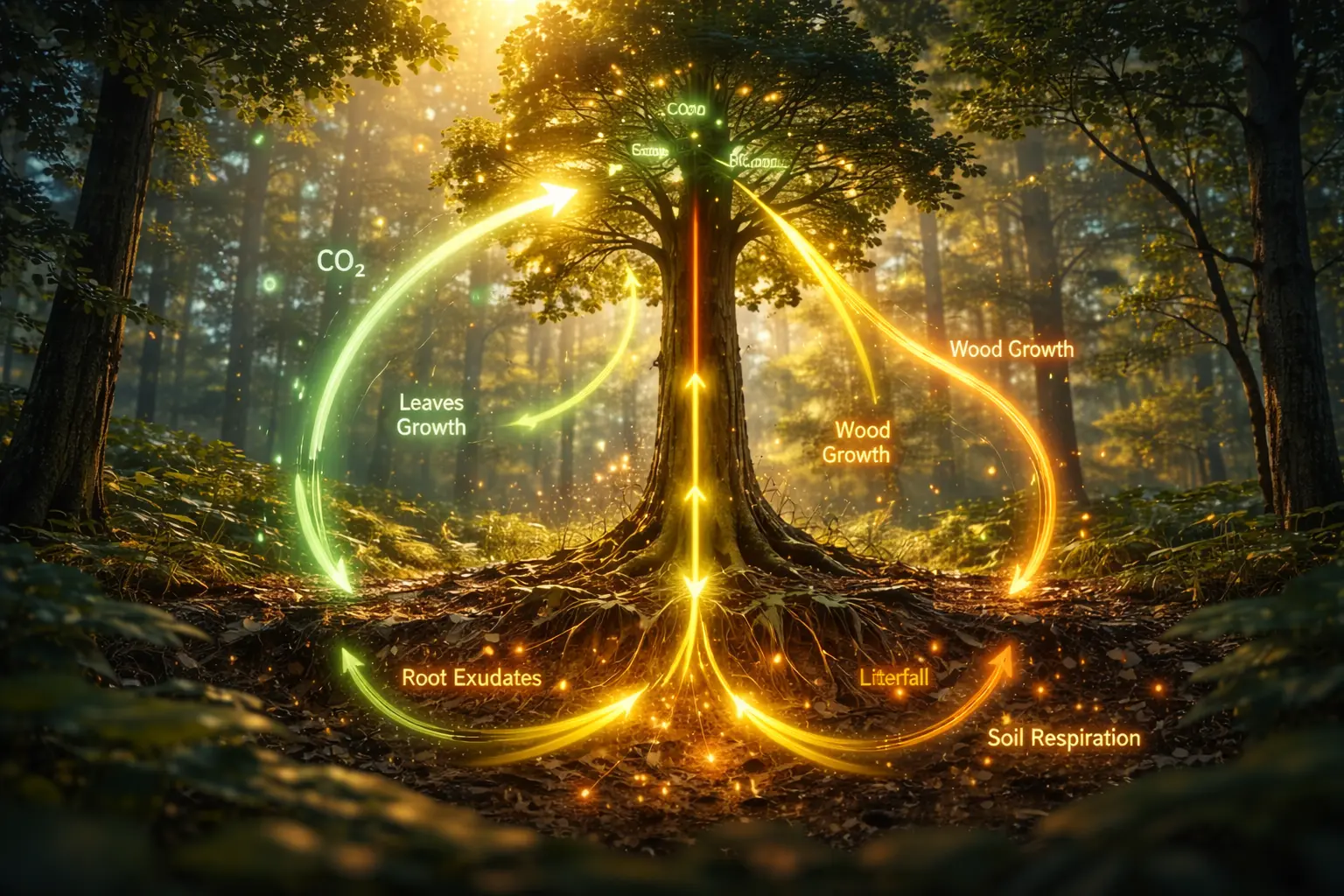
Carbon Allocation and Net Primary Productivity
Photosynthesis fixes carbon. But not all of it becomes biomass—plants burn carbon for energy (respiration), and allocate the remainder among leaves, stems, and roots. This model models carbon flow from GPP through allocation to NPP, and tracks biomass accumulation in different plant pools.
Prerequisites: carbon balance, allocation coefficients, turnover rates, pool dynamics
1. The Question
Where does the carbon go after photosynthesis fixes it?
A forest canopy captures sunlight and converts CO₂ to sugars (Gross Primary Productivity, GPP). But the forest uses carbon for:
- Maintaining existing tissues — respiring sugars for energy
- Building new leaves — to capture more light
- Growing roots — to access water and nutrients
- Adding wood — structural support and long-term storage
The difference between carbon fixed (GPP) and carbon burned (respiration) is Net Primary Productivity (NPP) — the actual carbon available for growth.
The mathematical question: How do we model carbon flow from GPP to biomass pools, accounting for respiration and turnover?
2. The Conceptual Model
Carbon Flow in Ecosystems
Gross Primary Productivity (GPP):
Total carbon fixed by photosynthesis (Model 20).
Autotrophic Respiration ($R_a$):
Carbon burned by plants for energy (maintenance + growth respiration).
Net Primary Productivity (NPP):
\[\text{NPP} = \text{GPP} - R_a\]Carbon Allocation:
NPP is allocated among plant parts:
- Leaves (foliage): $a_L \times \text{NPP}$
- Stems (wood): $a_S \times \text{NPP}$
- Roots: $a_R \times \text{NPP}$
Where $a_L + a_S + a_R = 1$ (allocation fractions sum to 1).
Biomass Pools:
Each pool accumulates carbon but also loses it through turnover (death, litterfall).
Where:
- $C_L$ = leaf carbon (kg C/m²)
- $k_L$ = turnover rate (year⁻¹)
Respiration Components
Maintenance respiration ($R_m$):
Energy to maintain existing tissues (proportional to biomass).
Where $r_m$ is specific maintenance rate (kg C respired per kg C biomass per year).
Growth respiration ($R_g$):
Energy cost of synthesizing new tissue (proportional to NPP).
Where $r_g$ is growth respiration fraction (typically 0.2–0.3).
Total autotrophic respiration:
\[R_a = R_m + R_g = R_m + r_g(\text{GPP} - R_m)\]Solve for $R_a$:
\[R_a = \frac{R_m + r_g \cdot \text{GPP}}{1 + r_g}\]3. Building the Mathematical Model
Three-Pool Carbon Model
State variables:
- $C_L$ = leaf carbon (kg C/m²)
- $C_S$ = stem (wood) carbon (kg C/m²)
- $C_R$ = root carbon (kg C/m²)
Dynamics:
\[\frac{dC_L}{dt} = a_L \cdot \text{NPP} - k_L C_L\] \[\frac{dC_S}{dt} = a_S \cdot \text{NPP} - k_S C_S\] \[\frac{dC_R}{dt} = a_R \cdot \text{NPP} - k_R C_R\]Turnover rates (typical values):
- Leaves: $k_L = 1$ year⁻¹ (leaves live 1 year average)
- Fine roots: $k_R = 1$ year⁻¹ (similar to leaves)
- Wood: $k_S = 0.02$ year⁻¹ (50-year lifespan)
Allocation fractions (vary by ecosystem):
- Young forest: $a_L = 0.3$, $a_S = 0.4$, $a_R = 0.3$ (building structure)
- Mature forest: $a_L = 0.25$, $a_S = 0.50$, $a_R = 0.25$ (less leaf, more wood)
- Grassland: $a_L = 0.4$, $a_S = 0.0$, $a_R = 0.6$ (no wood, deep roots)
Steady State
At equilibrium (mature ecosystem):
\[\frac{dC_L}{dt} = 0 \implies C_L^* = \frac{a_L \cdot \text{NPP}}{k_L}\]Example: NPP = 1 kg C/m²/year, $a_L = 0.3$, $k_L = 1$ year⁻¹:
\[C_L^* = \frac{0.3 \times 1}{1} = 0.3 \text{ kg C/m}^2\]Total steady-state carbon:
\[C_{\text{total}}^* = \frac{a_L}{k_L} \text{NPP} + \frac{a_S}{k_S} \text{NPP} + \frac{a_R}{k_R} \text{NPP}\] \[= \text{NPP} \left(\frac{a_L}{k_L} + \frac{a_S}{k_S} + \frac{a_R}{k_R}\right)\]Wood dominates because $k_S$ is small (low turnover).
4. Worked Example by Hand
Problem: A temperate forest has:
- GPP = 2.5 kg C/m²/year
- Maintenance respiration: $R_m = 0.8$ kg C/m²/year
- Growth respiration fraction: $r_g = 0.25$
- Allocation: $a_L = 0.25$, $a_S = 0.50$, $a_R = 0.25$
- Turnover: $k_L = 1$, $k_S = 0.02$, $k_R = 1$ year⁻¹
(a) Calculate NPP.
(b) Find steady-state carbon in each pool.
(c) What is total ecosystem carbon at equilibrium?
Solution
(a) NPP
\[R_a = \frac{R_m + r_g \cdot \text{GPP}}{1 + r_g} = \frac{0.8 + 0.25 \times 2.5}{1 + 0.25}\] \[= \frac{0.8 + 0.625}{1.25} = \frac{1.425}{1.25} = 1.14 \text{ kg C/m}^2\text{/year}\] \[\text{NPP} = \text{GPP} - R_a = 2.5 - 1.14 = 1.36 \text{ kg C/m}^2\text{/year}\](b) Steady-state carbon
Leaves:
\[C_L^* = \frac{a_L \cdot \text{NPP}}{k_L} = \frac{0.25 \times 1.36}{1} = 0.34 \text{ kg C/m}^2\]Stems:
\[C_S^* = \frac{a_S \cdot \text{NPP}}{k_S} = \frac{0.50 \times 1.36}{0.02} = \frac{0.68}{0.02} = 34 \text{ kg C/m}^2\]Roots:
\[C_R^* = \frac{a_R \cdot \text{NPP}}{k_R} = \frac{0.25 \times 1.36}{1} = 0.34 \text{ kg C/m}^2\](c) Total carbon
\[C_{\text{total}}^* = 0.34 + 34 + 0.34 = 34.68 \text{ kg C/m}^2\]Interpretation: Wood (stems) stores 98% of total carbon, even though only 50% of NPP goes to wood. This is because wood lives ~50 years while leaves/roots live ~1 year.
Convert to biomass: Assuming carbon is ~50% of dry biomass:
\[\text{Biomass} = \frac{34.68}{0.5} = 69.4 \text{ kg dry mass/m}^2 = 694 \text{ tonnes/ha}\]Typical for a mature temperate forest.
5. Computational Implementation
Below is an interactive carbon allocation simulator.
NPP: kg C/m²/year
Ra/GPP:
Final total carbon: kg C/m²
Equilibrium reached:
Try this:
- Young forest: Higher wood allocation → rapid stem growth
- Mature forest: Stem carbon accumulates to ~30-40 kg C/m² over 100 years
- Grassland: No wood allocation → only leaves and roots, reaches equilibrium quickly
- Cropland: Annual harvest (high turnover) → low steady-state carbon
- Increase GPP: More NPP → faster accumulation
- Notice: Stems take decades to reach equilibrium (slow turnover), leaves equilibrate in ~2-3 years
Key insight: Long-lived pools (wood) dominate ecosystem carbon storage, even if allocation is similar to short-lived pools.
6. Interpretation
Forest Carbon Sequestration
Young forest (0–50 years):
- Rapid growth
- NPP high
- Carbon accumulation ~0.5–2 kg C/m²/year
- Carbon sink
Mature forest (> 100 years):
- Near equilibrium
- Growth balanced by mortality
- NPP still positive but slower accumulation
- Weak carbon sink or neutral
Old-growth debate: Do old forests continue to sequester carbon?
Evidence suggests some continued net uptake (~0.1–0.2 kg C/m²/year).
NPP/GPP Ratio
Carbon use efficiency:
\[\text{CUE} = \frac{\text{NPP}}{\text{GPP}}\]Typical values:
- Young forest: 0.60 (low respiration costs)
- Mature forest: 0.50 (higher maintenance from large biomass)
- Stressed ecosystem: 0.30 (high respiration, drought, heat)
Global average: CUE ≈ 0.47 (forests), 0.55 (grasslands), 0.60 (croplands)
Harvest and Regrowth
Clear-cut harvest:
- Removes most aboveground biomass ($C_L$, $C_S$)
- Roots partially remain ($C_R$)
- Regrowth from sprouts/seeds
- Carbon rebounds over 20–50 years
modelling:
Reset $C_L = 0.1$, $C_S = 0.1$, keep $C_R$ reduced, simulate regrowth.
7. What Could Go Wrong?
Assuming Constant Allocation
Real allocation changes with:
- Tree age: Young trees allocate more to leaves/roots, mature trees to wood
- Resource availability: Nutrient-limited → more roots, light-limited → more leaves
- CO₂ fertilization: Elevated CO₂ may shift allocation toward roots
Dynamic allocation models: Make $a_L$, $a_S$, $a_R$ functions of resource status.
Ignoring Litterfall Fate
Dead leaves/roots don’t disappear—they become soil organic matter (SOM).
Complete carbon cycle:
\[\text{GPP} \to \text{NPP} \to \text{Biomass} \to \text{Litter} \to \text{SOM} \to \text{Respiration (decomposition)}\]Our model stops at biomass. Full model needs soil carbon pools (next-level complexity).
Constant Turnover Rates
Turnover varies with:
- Temperature: Faster decomposition in tropics
- Moisture: Slow in deserts (dry) and peat bogs (waterlogged)
- Disturbance: Fire, insects, disease accelerate mortality
Q₁₀ rule: Decomposition doubles per 10°C warming.
Neglecting Allocation to Reproduction
Plants allocate carbon to seeds, flowers, fruits—our model lumps this into “leaves” or ignores it.
For crops: Grain yield is a separate allocation pool.
8. Extension: Net Ecosystem Productivity
Net Ecosystem Productivity (NEP):
\[\text{NEP} = \text{NPP} - R_h\]Where $R_h$ is heterotrophic respiration (decomposition of dead organic matter by microbes).
NEP > 0: Ecosystem is a carbon sink
NEP < 0: Ecosystem is a carbon source
NEP ≈ 0: Ecosystem at steady state
Global NEP:
Terrestrial ecosystems sequester ~2–3 Pg C/year (about 1/4 of fossil fuel emissions).
Next model will shift to atmospheric interactions—wind profiles and turbulent mixing that transport heat, moisture, and CO₂ between surface and atmosphere.
9. Math Refresher: Compartment Models
General Form
A multi-compartment model has:
- State variables: $C_1, C_2, …, C_n$ (pool sizes)
- Flows: $F_{ij}$ from pool $i$ to pool $j$
- Inputs/outputs: External sources/sinks
Matrix Representation
For linear flows ($F_{ij} = k_{ij} C_i$):
\[\frac{d\mathbf{C}}{dt} = \mathbf{A} \mathbf{C} + \mathbf{u}\]Where:
- $\mathbf{C}$ = vector of pool sizes
- $\mathbf{A}$ = transfer matrix
- $\mathbf{u}$ = input vector
Steady state: $\mathbf{A} \mathbf{C}^* + \mathbf{u} = 0$
Our model:
\[\mathbf{C} = \begin{pmatrix} C_L \\ C_S \\ C_R \end{pmatrix}, \quad \mathbf{A} = \begin{pmatrix} -k_L & 0 & 0 \\ 0 & -k_S & 0 \\ 0 & 0 & -k_R \end{pmatrix}, \quad \mathbf{u} = \text{NPP} \begin{pmatrix} a_L \\ a_S \\ a_R \end{pmatrix}\]Summary
- NPP = GPP - autotrophic respiration (carbon available for growth)
- Autotrophic respiration has two components: maintenance + growth
- Carbon allocation: NPP distributed among leaves, stems, roots
- Biomass dynamics: Each pool accumulates new growth and loses carbon through turnover
- Turnover rates: Fast for leaves/roots (~1 year), slow for wood (~50 years)
- Steady state: Pool size = (allocation × NPP) / turnover rate
- Wood dominates ecosystem carbon despite similar allocation because of low turnover
- Carbon use efficiency (NPP/GPP) typically 0.4–0.6
- Young forests are strong carbon sinks; mature forests approach equilibrium