 WaywardHouse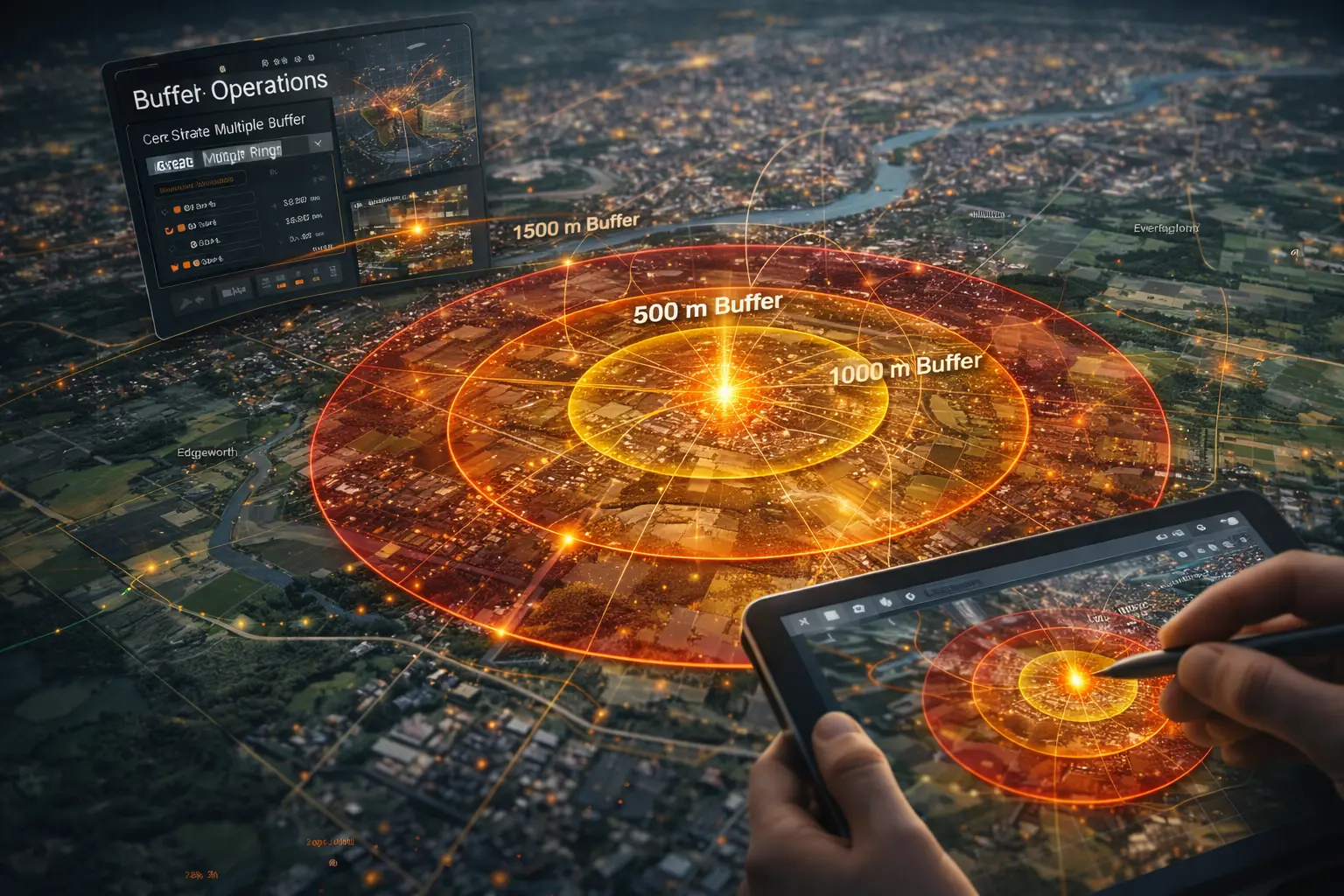
Buffer Operations and Distance Fields
Buffer zones define proximity: 500m around a stream, 1km around a fire station, 100m from a road. This model derives Euclidean distance calculations, builds distance fields, and shows how to create buffer polygons around points, lines, and polygons. Essential for proximity analysis, environmental setbacks, and service area mapping.
Prerequisites: euclidean distance, offset curves, distance fields, analytical geometry
1. The Question
How far is this location from the nearest protected stream?
Buffer zones appear everywhere in spatial analysis:
- Environmental: 100m riparian buffer along streams (no development)
- Public safety: 1km evacuation zone around chemical plants
- Urban planning: 400m walkable distance to transit stops
- Epidemiology: 2km contact tracing radius from infection case
- Retail: 5km delivery service area around store
The mathematical question: Given a geographic feature (point, line, or polygon), create a new polygon representing all locations within distance $d$.
Variations:
- Point buffer → circle
- Line buffer → “stadium” shape (rounded rectangle)
- Polygon buffer → offset boundary (larger or smaller)
2. The Conceptual Model
Euclidean Distance
Distance from point $(x_1, y_1)$ to point $(x_2, y_2)$:
\[d = \sqrt{(x_2 - x_1)^2 + (y_2 - y_1)^2}\]This is the Pythagorean theorem in coordinate form.
Buffer definition: All points within distance $d$ from a feature.
\[\text{Buffer} = \{(x, y) : \text{distance}(x, y, \text{feature}) \leq d\}\]Three Cases
1. Point buffer:
Distance from point to center equals $d$ → circle of radius $d$
\[x^2 + y^2 = d^2\]2. Line buffer:
All points within distance $d$ from any point on the line.
For horizontal line segment from $(x_1, y)$ to $(x_2, y)$:
- Points above/below: parallel lines at $y \pm d$
- Points at ends: semicircles of radius $d$
- Result: “stadium” or “racetrack” shape
3. Polygon buffer:
Outward buffer (positive): Expand boundary by distance $d$
Inward buffer (negative): Shrink boundary by distance $d$
Each edge moves perpendicular to itself, circular arcs at vertices.
3. Building the Mathematical Model
Point Buffer (Circle)
Center at $(c_x, c_y)$, radius $r$:
\[\{(x, y) : (x - c_x)^2 + (y - c_y)^2 \leq r^2\}\]Parametric form (for drawing):
\(x = c_x + r\cos\theta\) \(y = c_y + r\sin\theta\)
Where $\theta \in [0, 2\pi]$.
Discretization (for polygon representation):
for i = 0 to n-1:
    theta = 2π * i / n
    x = cx + r * cos(theta)
    y = cy + r * sin(theta)
    add (x, y) to buffer polygon
Typically $n = 32$ or $64$ points for smooth circle.
Line Segment Buffer
For segment from $A = (x_1, y_1)$ to $B = (x_2, y_2)$ with buffer distance $d$:
Step 1: Calculate perpendicular direction
Direction vector: $\mathbf{v} = (x_2 - x_1, y_2 - y_1)$
Length: $L = \sqrt{(x_2-x_1)^2 + (y_2-y_1)^2}$
Unit vector: $\hat{v} = \mathbf{v}/L = \left(\frac{x_2-x_1}{L}, \frac{y_2-y_1}{L}\right)$
Perpendicular (rotate 90°): $\hat{n} = \left(-\frac{y_2-y_1}{L}, \frac{x_2-x_1}{L}\right)$
Step 2: Offset parallel edges
Left edge:
- $A’ = A + d\hat{n}$
- $B’ = B + d\hat{n}$
Right edge:
- $A’’ = A - d\hat{n}$
- $B’’ = B - d\hat{n}$
Step 3: Add semicircular caps
At $A$: semicircle from $A’’$ to $A’$ (radius $d$, center $A$)
At $B$: semicircle from $B’$ to $B’’$ (radius $d$, center $B$)
Buffer polygon: $A’ \to B’ \to$ [arc] $\to B’’ \to A’’ \to$ [arc] $\to A’$
Polygon Buffer (Offset)
Minkowski sum approach:
Buffer of polygon $P$ by distance $d$ = Minkowski sum of $P$ and disk of radius $d$.
Intuitive: Slide a disk of radius $d$ around the polygon boundary.
Implementation strategy:
For each edge:
- Offset edge outward by $d$ (perpendicular direction)
- At each vertex, add circular arc connecting adjacent offset edges
- Handle intersections (offset edges may cross)
Challenges:
- Convex vertices: Circular arc expands outward
- Concave vertices: May cause self-intersection → requires clipping
- Negative buffers: May eliminate small features entirely
Robust implementation: Use computational geometry libraries (GEOS, Clipper).
4. Worked Example by Hand
Problem: Create a 50-meter buffer around a line segment from $A = (0, 0)$ to $B = (300, 400)$ (meters).
Solution
Step 1: Calculate length
\[L = \sqrt{300^2 + 400^2} = \sqrt{90000 + 160000} = \sqrt{250000} = 500 \text{ m}\]Step 2: Unit direction vector
\[\hat{v} = \left(\frac{300}{500}, \frac{400}{500}\right) = (0.6, 0.8)\]Step 3: Perpendicular (rotate 90° CCW)
\[\hat{n} = (-0.8, 0.6)\]Step 4: Offset edges by $d = 50$ m
Left edge (outward):
\(A' = (0, 0) + 50(-0.8, 0.6) = (-40, 30)\) \(B' = (300, 400) + 50(-0.8, 0.6) = (260, 430)\)
Right edge (inward):
\(A'' = (0, 0) - 50(-0.8, 0.6) = (40, -30)\) \(B'' = (300, 400) - 50(-0.8, 0.6) = (340, 370)\)
Step 5: Circular caps
At $A$: Semicircle from $(40, -30)$ to $(-40, 30)$, radius 50, center $(0, 0)$
At $B$: Semicircle from $(260, 430)$ to $(340, 370)$, radius 50, center $(300, 400)$
Buffer polygon vertices (approximate with 8 points per semicircle):
$A’(-40, 30) \to B’(260, 430) \to$ [8 arc points] $\to B’‘(340, 370) \to A’‘(40, -30) \to$ [8 arc points] $\to A’$
Total: ~20 vertices defining the buffer polygon.
5. Computational Implementation
Below is an interactive buffer generator.
Buffer area: -- px²
Buffer perimeter: -- px
Try this:
- Point buffer: Perfect circle around point
- Line buffer: “Stadium” shape with semicircular caps
- Polygon buffer: Offset boundary with rounded corners
- Show construction: See the parallel edges and perpendicular offsets
- Adjust distance: Watch buffer grow/shrink
- Notice: Line buffer = rectangle + two semicircles (area formula confirms)
Key insight: Buffer is the Minkowski sum of the feature and a disk—equivalent to sweeping a circle along the boundary.
6. Interpretation
Distance Fields
Distance field = raster where each cell contains distance to nearest feature.
Algorithm (Euclidean Distance Transform):
for each cell (x, y):
    min_dist = infinity
    for each feature point (fx, fy):
        dist = sqrt((x - fx)² + (y - fy)²)
        if dist < min_dist:
            min_dist = dist
    distance_field[x, y] = min_dist
Optimization: Use sweep algorithms (Danielsson, Chamfer) for $O(n)$ instead of $O(n \times m)$.
Application: Iso-distance contours from distance field = buffer boundaries at different distances.
Multiple Feature Buffers
Union of buffers:
Buffer around rivers = union of all individual stream buffers.
Algorithm:
- Buffer each feature independently
- Compute polygon union (overlay operation)
- Result: Single merged buffer polygon
Example: 100m buffers around all streams in watershed → riparian protection zone.
Negative Buffers (Inward)
Erosion: Shrink polygon by distance $d$.
Use cases:
- Create “core areas” (remove edge effects)
- Model sea-level rise (coastline moves inland)
- Setbacks (building must be 10m inside property line)
Challenge: Polygon may disappear entirely if $d$ exceeds half the minimum width.
Example: 50m buffer on 80m-wide forest strip → 80m - 2(50m) = -20m → vanishes!
7. What Could Go Wrong?
Buffer Overlaps and Gaps
Multiple features close together:
Buffers overlap → merged area may not be simple sum of individual buffers.
Example: Two points 60m apart, each with 50m buffer:
- Individual areas: $2 \times \pi(50^2) = 15,708$ m²
- Merged area: < 15,708 m² (overlap region counted once)
Solution: Use union operation, calculate area from merged polygon.
Self-Intersecting Buffers
Concave polygon + large buffer:
Offset edges may cross each other.
Example: U-shaped polygon with buffer larger than gap width → buffer fills the gap.
Handling:
- Detect self-intersections
- Remove invalid portions (keep outermost boundary)
- Use robust geometry libraries (GEOS, Shapely)
Precision Issues
Very small buffers (< 1 pixel):
May produce degenerate polygons or disappear entirely in raster representation.
Very large buffers:
May exceed coordinate system bounds or cause numerical overflow.
Solution: Validate buffer distance is reasonable for coordinate system and scale.
Topology Preservation
Buffer may change polygon topology:
Original: Single polygon
After negative buffer: May split into multiple polygons (if narrow connections < 2d)
Example: Dumbbell-shaped polygon with narrow neck. Inward buffer may sever the neck → two separate polygons.
8. Extension: Geodetic Buffers
Problem: Euclidean distance is inaccurate over large areas (Earth is curved).
Geodetic buffer: Uses great-circle distance on ellipsoid (WGS84).
Difference:
At equator, 1° longitude ≈ 111 km
At 60°N, 1° longitude ≈ 55 km
Euclidean buffer at 60°N: Would be elliptical (stretched E-W)
Geodetic buffer: Remains circular in ground distance
Implementation: Project to equal-area projection (e.g., Albers), buffer, project back.
When to use:
- Features spanning > 1° latitude/longitude
- Polar regions (extreme distortion)
- Global or continental analysis
When Euclidean is fine:
- Local analysis (< 100 km²)
- Projected coordinates (UTM, State Plane)
9. Math Refresher: Perpendicular Vectors
2D Rotation
To rotate vector $(x, y)$ by 90° counter-clockwise:
\[(x, y) \to (-y, x)\]Why: Rotation matrix for 90°:
\[\begin{pmatrix} \cos 90° & -\sin 90° \\ \sin 90° & \cos 90° \end{pmatrix} = \begin{pmatrix} 0 & -1 \\ 1 & 0 \end{pmatrix}\] \[\begin{pmatrix} 0 & -1 \\ 1 & 0 \end{pmatrix} \begin{pmatrix} x \\ y \end{pmatrix} = \begin{pmatrix} -y \\ x \end{pmatrix}\]Perpendicular to Line Segment
Given segment from $A$ to $B$:
Direction vector: $\mathbf{v} = B - A$
Two perpendiculars (90° rotations):
- Left: $\mathbf{n}_L = (-v_y, v_x)$
- Right: $\mathbf{n}_R = (v_y, -v_x)$
Unit perpendicular (length 1):
\[\hat{n} = \frac{1}{\|\mathbf{v}\|}(-v_y, v_x)\]Offset point by distance $d$:
\[P_{\text{offset}} = P + d\hat{n}\]This moves point $P$ perpendicular to line direction by distance $d$.
Summary
- Buffer operation creates proximity zones around geographic features
- Point buffer → circle of radius $d$
- Line buffer → offset parallel lines + semicircular caps (“stadium” shape)
- Polygon buffer → offset boundary with circular arcs at vertices
- Distance field = raster of distance to nearest feature
- Buffer = Minkowski sum of feature and disk
- Applications: Environmental setbacks, service areas, evacuation zones, proximity analysis
- Challenges: Self-intersection, topology changes, overlapping buffers
- Geodetic buffers needed for large areas (accounts for Earth curvature)
- Perpendicular offset: rotate direction vector 90°, scale to buffer distance