 WaywardHouse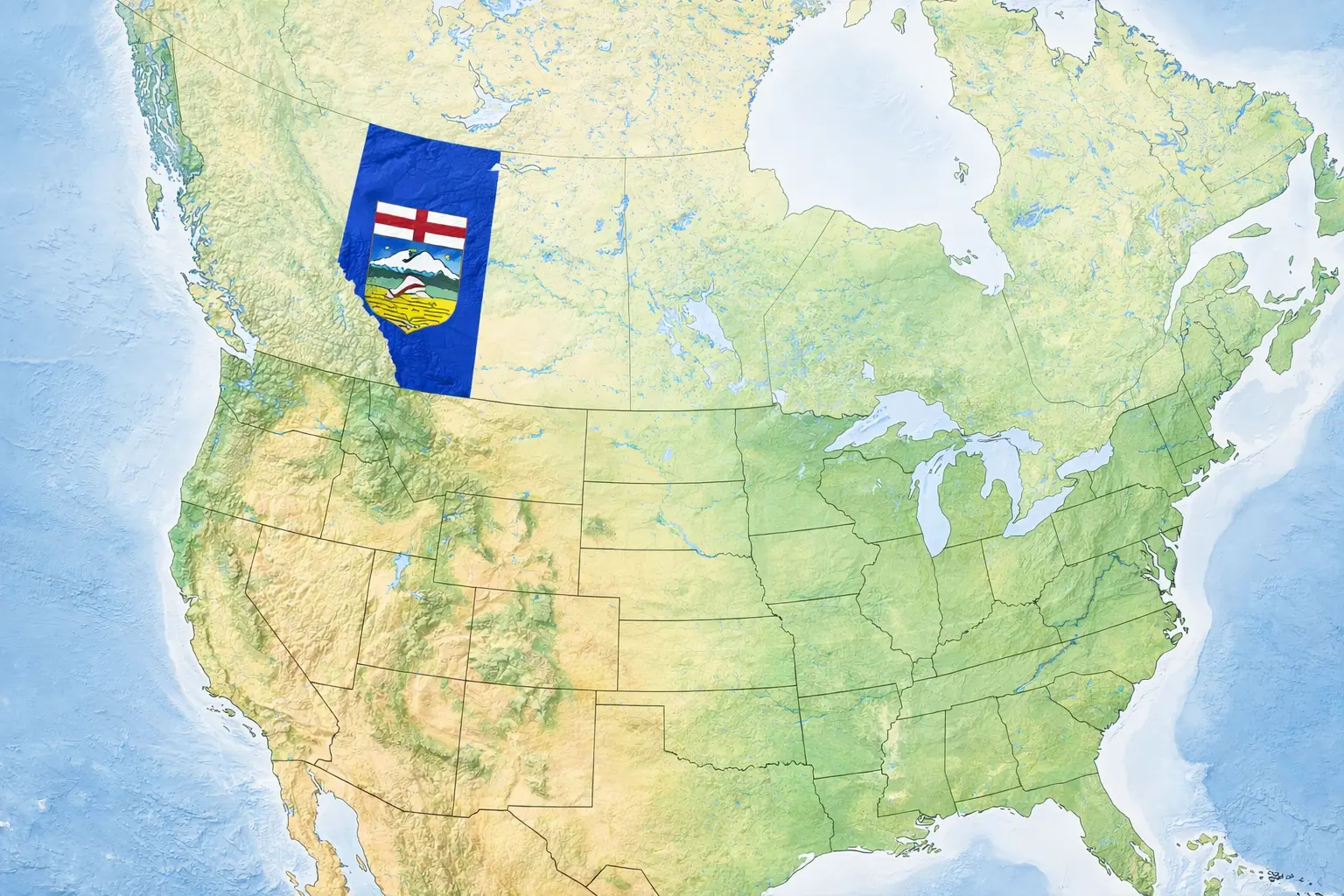
Two Front Doors and a Mountain
Every year, roughly 35 million visits land on Alberta — most through two airports, most headed toward a narrow band of mountain terrain. This is the geography of that arrival: where visitors come from, where they go, what they spend, and what their presence costs the places that receive them.
Every July morning at the Trans-Canada Highway junction outside Canmore, the traffic stops. Not briefly — for an hour, sometimes two. The vehicles waiting to turn west into Banff National Park stretch back through the Bow Valley in a line long enough to read as a geographic statement: this is where one of the world’s great mountain landscapes meets a distribution network that was not designed for the load it now carries.
The traffic jam is not a failure of park management. It is the physical expression of a tourism economy that has grown faster than the infrastructure available to serve it, and that concentrates itself, by geography and by choice, in a corridor that cannot expand. Alberta’s tourism industry is large, valuable, and structurally constrained in ways that mirror — with striking precision — the patterns visible in the province’s energy and food supply chains. The same geographic logic that makes pipeline export capacity a binding constraint on oil prices makes the Banff townsite a binding constraint on mountain tourism. Both are problems of throughput in a fixed corridor.
This essay maps the geography of Alberta tourism: where visitors come from, through which airports, in which seasons, where they go and what they spend, and what their presence costs the places that receive them.
The Two Front Doors
Alberta’s visitor economy enters through two airports. Calgary International (YYC) is the larger — handling roughly 17 million passengers annually before COVID disruptions, recovering to approximately 16.5 million by 2023. Edmonton International (YEG) handles around 7.5 million. The asymmetry matters. YYC is a hub for Rocky Mountain leisure tourism: the dominant market is Vancouver–Calgary (the busiest domestic route in Canada), with Toronto–Calgary a close second. International leisure traffic — from the UK, Germany, Japan, Australia, and the US — enters almost exclusively through YYC. YEG serves a different function: more business travel, more oil sands worker rotation (the Fort McMurray commuter traffic is its own ecosystem), and more VFR (visiting friends and relatives) traffic tied to Edmonton’s diverse immigrant communities.
Source: Travel Alberta, Destination Canada visitor research, 2022–2023. BC dominance reflects proximity and the Vancouver–Calgary air corridor; Ontario share reflects population mass and the Rocky Mountain bucket-list draw.
British Columbia accounts for roughly 43% of overnight leisure visitors — a proportion that reflects both geographic proximity and the raw size of the Vancouver-to-Calgary travel market. The figure is so large it distorts the picture: much of this BC traffic is not international-style tourism but quasi-residential travel — British Columbians with family in Alberta, Albertans who moved west but return regularly, recreational travellers doing the mountain circuit on long weekends. Ontario at 18% represents the long-haul Canadian leisure market: the Banff–Jasper trip is an established Canadian bucket-list item, and Toronto-to-Calgary is one of Air Canada’s most commercially important routes precisely because of that leisure demand.
International visitors represent approximately 17% of overnight leisure visitors — smaller than the cultural visibility of international tourism suggests. They are, however, disproportionately high-spending: the average international visitor to Alberta spends roughly 3.5–4x as much per trip as a domestic visitor, reflecting longer stays, higher accommodation tiers, guided tours, and the economics of a trip that requires a transatlantic or transpacific flight to reach.
The Calendar of Arrivals
Alberta’s tourism is one of the most seasonally concentrated in Canada. The Rocky Mountain experience — the one that defines Alberta’s international brand — is emphatically a summer product. The high alpine trails open in late June. The iconic photography conditions (wildflower meadows, clear lake reflections, long evening light) peak in July and August. Banff and Jasper have defined what “summer in the mountains” looks like for generations of visitors.
Source: Travel Alberta, Parks Canada visitation data, YYC/YEG passenger statistics. July index reflects Stampede week in Calgary (approximately +25% for the city) layered on peak mountain season. November is the structural trough.
July is the dominant month — roughly 92% above the annual average — partly because of summer mountain conditions and partly because of the Calgary Stampede, which injects roughly 1.2 million visitors into the Calgary metropolitan area over ten days and creates a hospitality demand spike that reverberates across the province. The Stampede’s economic footprint is roughly $540 million annually and it functions as a de facto international marketing event for Alberta tourism broadly, not just for Calgary.
The ski season (December through March) creates a secondary peak concentrated at Banff, Lake Louise, and Sunshine Village. This is a qualitatively different visitor profile: higher per-night spend, longer average stays, lower environmental impact per visitor (lift-served terrain versus fragile alpine ecosystems), and a more international mix — European and Japanese ski tourists make Banff’s ski season a distinct demographic event from the summer backpacker crowd.
The structural vulnerability in this calendar is the shoulder seasons — April, May, October, November. These are chronically low-occupancy periods when accommodation infrastructure that was capitalised for summer peaks sits underutilised, when seasonal workers have departed, and when the natural environment has its best recovery window. Travel Alberta’s long-running “shoulder season” campaigns have made limited progress against the fundamental reality that the mountain experience is perceived as a summer experience by the dominant visitor markets.
The Map: Where Alberta Tourism Concentrates
The geography of where visitors go within Alberta is as skewed as the geography of where they come from. Alberta has 661,848 square kilometres. The vast majority of overnight leisure tourism revenue concentrates in a corridor roughly 250 kilometres long and 50 kilometres wide, running along the front ranges of the Rockies from Waterton in the south through Banff, Canmore, Lake Louise, Icefields Parkway, and Jasper in the north.
The provincial picture
Alberta has six UNESCO World Heritage Sites, two national parks that anchor the Rocky Mountain tourism system, a network of provincial parks, and two major cities with distinct event calendars. From the air, the province looks like it should distribute tourism broadly.
It does not. Roughly 65% of provincial tourism revenue concentrates in a mountain corridor covering less than 5% of the province's land area.
The mountain corridor
Banff National Park alone generates approximately 30% of all provincial tourism revenue. Add Lake Louise, Canmore, and Kananaskis, and this southwestern mountain corridor accounts for roughly half the provincial total — from a geography that holds a small fraction of Alberta's population.
The Icefields Parkway connecting Banff to Jasper is one of the most scenically dramatic drives on earth. It is also a two-lane road with no passing lanes, limited turnouts, and cell coverage that drops entirely for long stretches.
Banff: capacity without room to grow
Banff townsite sits inside a national park. There is no land available for hotel development. The accommodation stock is essentially fixed. When visitor numbers grow — as they have, roughly doubling since 2010 — the fixed supply of rooms means prices rise and the visitor experience degrades simultaneously.
On a peak July day, approximately 14,000 people are in the townsite. The resident population is 8,500. Every car that enters the park must pass through a gate.
Jasper: after the fire
In late July 2024, wildfire reached the Jasper townsite — an event that had been considered possible but not imminent by park managers. The fire destroyed 1,113 structures, roughly 30% of the townsite's buildings, and forced the evacuation of 25,000 people.
The rebuilding is underway. The question the 2024 fire poses is not whether Jasper will recover — it will — but whether the rebuild will address the housing and infrastructure deficits the fire exposed, or simply reconstruct the same constrained system at higher cost.
Beyond the mountains: the heritage circuit
Alberta's badlands — centred on Drumheller and Dinosaur Provincial Park — are one of the world's great palaeontological landscapes. The Royal Tyrrell Museum in Drumheller is among Canada's most visited museums.
This corridor is also home to Writing-on-Stone and Head-Smashed-In Buffalo Jump, two of Alberta's four UNESCO World Heritage Sites. These are globally significant places. They receive a fraction of the visitor attention the mountain parks command, partly because they require deliberate detours from the major highway corridors.
The urban anchors
Calgary and Edmonton together account for roughly 37% of provincial tourism revenue — a share that understates their importance as gateways. Almost all international visitors pass through one of the two cities before heading to the mountains or the badlands.
Both cities have developed event-driven tourism strategies precisely because their natural assets cannot compete with the mountain corridor. The Stampede, the Fringe Festival, the Folk Music Festival, and the Edmonton river valley trail network are all attempts to create reasons to stay that do not depend on mountains.
The Geography of Spend
Visitor spending follows the geography of concentration with some important distortions. The mountain parks generate outsized revenue relative to their visitor numbers because the average nightly rate and average daily spend in Banff significantly exceeds that in Calgary or Edmonton. A visitor who sleeps at the Fairmont Banff Springs generates more hospitality revenue than three visitors sleeping at a mid-market Calgary hotel.
Source: Travel Alberta economic impact estimates; Tourism HR Canada; author calculations. Mountain corridor (Banff/Lake Louise + Jasper + Canmore/Kananaskis) = approximately 45% of revenue from roughly 4% of provincial area.
The per-visitor spend differential between the mountain parks and the rest of the province is approximately 2.5:1. This is a compound effect of higher accommodation pricing (driven by supply constraint, not service superiority), higher guided activity pricing, and a visitor profile that skews toward international and high-income domestic travellers who have specifically budgeted for a premium mountain experience.
What this means in practice is that the communities absorbing the highest visitor volumes — Banff, Lake Louise, Field in BC — are generating tourism revenue that flows substantially to publicly traded hotel corporations and international booking platforms, while the local workforce is paid wages that cannot sustain housing in the same geography. The revenue is concentrated at the top of the value chain. The costs — housing pressure, infrastructure wear, environmental impact — are borne locally.
The Pressure Points
Banff: The Arithmetic of Arrival
Banff National Park is a fixed land area. The townsite has strict development boundaries. Hotel rooms cannot be built. The workforce cannot expand unless it can be housed. And the number of people who want to experience the place has grown continuously since the park opened.
Source: Parks Canada attendance data; Banff municipal census. Resident population ~8,500 year-round. July peak day estimates from Parks Canada gate counts and parking utilisation surveys.
The visitor-to-resident ratio is not inherently a problem — Venice runs 500:1 on peak days. The problem is the absence of mechanisms to manage the ratio. Banff’s mandatory park entry reservation system (Parks Canada’s “Parks Passes” during peak season) was implemented in 2021 and provides some flow management on the busiest days. But it does not address the fundamental infrastructure constraint: one highway in, one highway out, no transit connections to Calgary that can absorb overflow demand.
The Workforce Housing Crisis
The workers who staff Banff’s hotels, restaurants, parks infrastructure, and retail sector cannot, in most cases, afford to live in Banff. The median one-bedroom rental in the Banff townsite runs approximately $2,300 per month. A full-time hospitality worker at the provincial minimum wage of $15/hour (rising to $17.50 by 2026) earns approximately $2,600 gross per month — which, after deductions, leaves housing consuming more than 100% of take-home pay at minimum wage.
Source: Government of Alberta minimum wage schedule; Tourism HR Canada wage survey; Canada Mortgage and Housing Corporation rental market data, Banff townsite, 2023. Gross-to-take-home assumes standard deductions, no dependents.
The result is a workforce housing model built on shared accommodation, employer-owned dormitory beds (several large hotels maintain staff accommodation), long commutes from Canmore (where rents are lower but still above $1,800 for a one-bedroom), and high worker turnover that creates a structural service quality problem. The Banff and Lake Louise Hospitality Association estimates that the region runs a chronic workforce deficit of 1,000–1,500 positions through peak season, with unfilled roles directly constraining the capacity to serve the visitor volumes that arrive.
This is not a Banff-specific problem. Jasper, Canmore, and Whistler (BC) have all documented similar dynamics. The mountain tourism industry has created a geography where the high-value experiences are provided by a workforce that cannot afford to live near the work, in communities that cannot add housing because they are surrounded by protected land.
Highway 1 and the Wildlife Corridor
The Trans-Canada Highway through Banff National Park was built across one of the continent’s most important wildlife movement corridors. Wolves, grizzly bears, elk, deer, and cougars all used the Bow Valley as a seasonal migration route for thousands of years before the highway divided it. In the pre-mitigation era, the stretch of Trans-Canada through the park was recording 100 or more large mammal deaths per year from vehicle collisions.
Source: Parks Canada Highway 1 Twinning Project monitoring data; Clevenger et al. wildlife crossing research; Banff National Park annual reports. 38 wildlife crossings (6 overpasses, 32 underpasses) with associated fencing have reduced large mammal mortality by approximately 80%.
The 38 wildlife crossings built between 1996 and 2014 — six overpasses and 32 underpasses, accompanied by 2-metre high fencing along the twinned highway — represent one of the most successful infrastructure interventions in conservation history. Grizzly bear genetic connectivity across the highway has been documented. Wolf packs cross regularly. The crossings are textbook cases of infrastructure design that accommodates both human use and ecosystem function.
The problem is that the crossing infrastructure was designed for highway traffic volumes in the 1990s. Peak summer visitor volumes on the Trans-Canada through Banff now regularly exceed 20,000 vehicles per day. The additional noise, light, and disturbance associated with that volume affects animal behaviour near crossing structures even when animals are physically capable of using them. The wildlife biologists who monitor crossing use note that high-traffic days correlate with reduced crossing frequency by the most disturbance-sensitive species.
What Tourism Leaves Behind
The economics of Alberta tourism look, in aggregate, strongly positive. Travel Alberta estimates the industry generates roughly $9–10 billion in direct and indirect economic activity annually and supports approximately 200,000 jobs province-wide. These are real and significant numbers. They fund municipal infrastructure, national park maintenance, cultural programs, and Indigenous tourism enterprises that are among the sector’s fastest-growing components.
The distributional picture is less clean. The revenue generated at the top of the accommodation market — the Fairmonts, the luxury lodges, the high-end guided experiences — flows substantially to corporate balance sheets rather than to the mountain communities where the economic activity occurs. Parks Canada collects entry fees (rising to $11.50 per adult per day, $23 per family) that fund operating costs; the parks do not retain a share of the commercial revenue generated within their boundaries. Municipal property taxes in Banff are capped by provincial policy. The net result is that the communities bearing the highest density of visitors have the fewest fiscal tools to manage the consequences.
The structural parallel to the rest of the Alberta economy is precise. The province extracts world-class natural resources — petroleum from the oil sands, sublime mountain scenery — and exports the value through supply chains that capture most of the margin outside the province. The oil exits through pipelines to US refineries at a discount. The tourist experience is priced, packaged, and distributed by multinational booking platforms, global hotel chains, and international tour operators. The royalty — in the literal tax sense and in the economic sense of value retention — is modest relative to the asset being depleted.
For the mountain landscapes, “depleted” is not yet the right word. The Rockies are not running out. But the experience of Banff in July 2024 — traffic queues to the park gate measured in hours, Lake Louise parking overflow onto the highway, Jasper still smelling of the fire — is the beginning of a depletion curve. The asset is not exhausted. It is being consumed faster than it can recover.
Visitor data: Travel Alberta, Destination Canada Tourism Snapshot series. Airport statistics: Statistics Canada air carrier traffic data. Parks Canada visitation: Parks Canada Visitor Use Statistics. Wage data: Tourism HR Canada; Government of Alberta. Housing data: CMHC Rental Market Survey. Wildlife crossings: Parks Canada Highway 1 Twinning Project monitoring reports; Clevenger & Waltho (2000, 2005) wildlife crossing research.
References
Calgary Airport Authority. 2024. 2023 Annual Report. https://www.yyc.com/Portals/0/2024_ANNUAL_REPORT_FINAL.pdf
Canada Mortgage and Housing Corporation. 2024. Rental Market Report, January 2024 Edition. https://assets.cmhc-schl.gc.ca/sites/cmhc/professional/housing-markets-data-and-research/market-reports/rental-market-report/rental-market-report-2023-en.pdf
Calgary Stampede. 2019. “Calgary’s Stampede Puts Horsepower Behind Economy.” Stampede Newsroom. https://news.calgarystampede.com/releases/calgarys-stampede-puts-horsepower-behind-economy
Clevenger, Anthony P., and Nigel Waltho. 2000. “Factors Influencing the Effectiveness of Wildlife Underpasses in Banff National Park, Alberta, Canada.” Conservation Biology 14 (1): 47–56. https://doi.org/10.1046/j.1523-1739.2000.00099-085.x
Clevenger, Anthony P., and Nigel Waltho. 2005. “Performance Indices to Identify Attributes of Highway Crossing Structures Facilitating Movement of Large Mammals.” Biological Conservation 121 (3): 453–464. https://doi.org/10.1016/j.biocon.2004.04.017
Destination Canada. 2024. “Quarterly Tourism Snapshot — Q4 2023.” https://archives.destinationcanada.com/sites/default/files/archive/1921-Quarterly%20Tourism%20Snapshot%20-%20Q4%202023/DC_QuarterlyTourismSnapshot_Q4%202023_FINAL_EN.pdf
Destination Canada. 2024. “Tourism Spend.” https://www.destinationcanada.com/en-ca/tourism-spend
Government of Alberta. 2024. “Minimum Wage.” Employment Standards Rules. https://www.alberta.ca/minimum-wage
Parks Canada. 2024. “Attendance Data for National Parks and Historic Sites, 2023–24.” Open Government Portal. https://open.canada.ca/data/en/dataset/f3288c4d-a273-440e-8693-268ce876fec1
Parks Canada. 2024. “Wildlife Crossing Structures and Research — Banff National Park.” https://parks.canada.ca/pn-np/ab/banff/nature/conservation/transport/tch-rtc/passages-crossings
Statistics Canada. 2024. “Consumer Price Index, Monthly, Not Seasonally Adjusted.” Table 18-10-0004-01. https://www150.statcan.gc.ca/t1/tbl1/en/tv.action?pid=1810000401
Statistics Canada. 2024. “Population Estimates, Quarterly.” Table 17-10-0009-01. https://www150.statcan.gc.ca/t1/tbl1/en/tv.action?pid=1710000901
Statistics Canada. 2024. “Travel Survey of Residents of Canada (TSRC).” Survey record 3810. https://www23.statcan.gc.ca/imdb/p2SV.pl?Function=getSurvey&SDDS=3810
Statistics Canada. 2024. “Air Passenger Traffic at Canadian Airports, Annual.” Table 23-10-0253-01. https://www150.statcan.gc.ca/t1/tbl1/en/tv.action?pid=2310025301
Tourism HR Canada. 2024. “Tourism Sector Compensation.” https://tourismhr.ca/labour-market-information/tourism-sector-compensation/
Travel Alberta. 2024. “Economic Impact.” Travel Alberta Industry Hub. https://industry.travelalberta.com/research/tourism-indicators/economic-impact