 WaywardHouse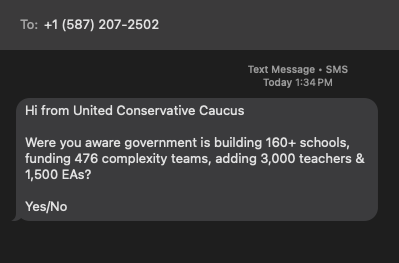
The Classroom Arithmetic
Alberta's school capacity crisis is not just a budgeting problem. It is a population geography problem: a large cohort moving through the system, migration-driven growth, and school construction timelines that lag far behind the students already here.
In March 2026, a text message landed from the United Conservative Caucus. Three claims, a yes/no prompt, the unmistakable cadence of a party that wants credit before the reckoning arrives.
The numbers weren't fabricated. But they were carefully chosen — and what they didn't say is the actual story.
Part A: The Claims
The UCP caucus text opened with a simple question. Were you aware government is building 160+ schools, funding 476 complexity teams, adding 3,000 teachers & 1,500 EAs?
A prompt to reply Yes or No. The design of the message matters: it requests agreement, not scrutiny.
Claim one: 160+ schools.
This is the headline number and the shakiest of the three. The government's own Schools Now program targets up to 90 new schools over three years, plus modernizations and modulars. Getting to 161 requires counting every project at every stage — pre-planning, planning, design, and construction — as a "school being built."
A 2024 audit of UCP school announcements found this practice had become routine: in 2023, the government announced 58 school projects; 13 had construction funding. The gap between announced and shovels-in-ground has never been formally acknowledged.
Claim two: 476 complexity teams.
This one is real. In February 2026, the government committed $143 million to deploy 476 teams — each consisting of one teacher and two EAs — into K–6 schools identified as high-need.
What's absent from the claim: this announcement came four months after a provincewide teacher strike called over exactly the classroom conditions these teams address. In 2023, UCP MLAs voted down an NDP bill addressing class size and complexity. The teams are real. The timeline is telling.
Claim three: 3,000 teachers and 1,500 EAs.
This is the most technically accurate and most politically misleading of the three. The 3,000 teacher commitment was in the March 2025 budget — passed months before the October strike. The ATA has filed a labour complaint alleging the government implied these were net-new positions at the bargaining table, when they were already funded.
The 1,500 EAs came via the Back to School Act — legislation passed with the notwithstanding clause to end the strike. Two cabinet ministers later confirmed a key reason for invoking it: avoiding arbitration that might have cost "billions more."
The claim is silent on a proportionality question the migration data makes unavoidable. In 2023/24 alone, Alberta absorbed 30,120 new international school-age children — the majority arriving with English language learning needs. The same government that ran Alberta is Calling and actively recruited that growth is now offering 1,500 EAs system-wide, with no public accounting of how many are designated for ELL support versus other classroom complexity needs. Across roughly 2,400 Alberta schools, 1,500 EAs is 0.6 per school before the allocation question is even asked.
Part B: The Arithmetic
Three claims. Three numbers. None of them answer the question that matters: is Alberta’s school system keeping pace with growth?
Start with what the government knows. Alberta is adding roughly 33,000 new students per year — the equivalent of 35 new schools of 600 students each, arriving annually without pause.
At an average class size of 25 students, holding that ratio flat requires ~1,320 new teachers per year simply to accommodate enrollment growth. Not to reduce class sizes. Not to address the ACOL targets from 2003. Just to tread water.
The 3,000-teacher commitment delivers roughly 1,000 net new positions per year over three years. That gap — 1,320 needed, 1,000 committed — means class sizes continue to grow, slowly but structurally, in every year of the commitment.
Now add attrition. Alberta doesn't publish a formal teacher departure rate, but roughly 21% of the education workforce is aged 55 or older. Conservative estimates suggest 800–1,200 teachers retire or leave annually. If retirements absorb the majority of new hires, the net addition to classroom capacity is close to zero.
The government counts gross hires. Nobody is publishing net capacity growth. The data to verify the claim simply isn't available — by design or omission.
Part C: The Teacher Pipeline
The missing question behind the hiring arithmetic is whether Alberta’s postsecondary system can actually supply the teachers implied by the numbers above.
Statistics Canada’s postsecondary student data make clear that this is a measurable pipeline, not an abstraction. The Postsecondary Student Information System tracks both enrolments and graduates by field of study, including education programs, while the Elementary-Secondary Education Survey tracks the school-side demand that those graduates are meant to meet. In other words: we can observe both ends of the system, even if the province rarely places them in the same frame.
What that frame shows is a lag problem. Alberta recorded the fastest public-school enrolment growth in Canada in 2023/24, at +3.6%, according to Statistics Canada’s school-sector release. Teacher preparation, by contrast, operates on multi-year cycles: enrolment growth in faculties of education does not become classroom capacity until those students complete their programs, clear certification, and actually enter the profession. Even in the optimistic case, supply responds more slowly than migration-driven demand.
On the provincial funding side, the evidence is thinner than the rhetoric. Alberta’s main seat-creation instrument is the Targeted Enrolment Expansion program. Budget pages describe it as creating spaces in high-demand programs including education, but the published TEE allocation tables show almost no expansion of teacher preparation capacity: no new undergraduate Bachelor of Education seats are listed in rounds 1 or 2, and the only clearly teacher-training allocation I could identify was 50 Master of Education seats at St. Mary’s University in round 2. Nursing, business, computing, and allied health, by contrast, receive large, explicitly enumerated seat increases.
That is the core supply-chain problem. Alberta is trying to hire into the fastest-growing school system in the country while the publicly documented seat-expansion funding barely touches undergraduate teacher training. I have not found an official Alberta government source proving a province-wide reduction in teacher-education places, so that stronger claim would overreach. The narrower claim is still serious enough: the province’s published discrete expansion funding has not been materially directed at the part of the tertiary system responsible for producing new teachers.
Part D: The Wave
The numbers above assume a static problem. The actual problem is dynamic — and the shape of it is visible in Alberta’s own grade-by-grade enrollment data.
Source: Alberta Education student population by grade, December 2025 preliminary count. ACOL recommended targets shown as reference lines.
The most visible problem in the current data is at Grade 12: 83,431 students in 2025/26, up from 66,052 in 2021/22. A 26% increase in four years. Calgary's CBE board chair confirmed high schools are at 108% capacity.
But Grade 12 students leave. This pressure, real as it is, is partially self-correcting over a 2–3 year horizon.
The structural story is in Grades 3 through 9. Every one of those grades grew by 6,000–8,000 students between 2021/22 and 2025/26. This cohort doesn't leave — it advances. Grades 4–6 today are Grade 12 in 2031, 2032, and 2033 respectively. The wave doesn't crest — it widens.
The secondary school pressure currently being reported as a crisis is the leading edge. The cohorts now in Grades 4–8 will peak secondary enrollment between 2031 and 2036.
The engine behind all of it is migration. In 2023/24 alone, Alberta absorbed a net 30,120 new international school-age children and 6,771 interprovincial arrivals — nearly 37,000 new students from migration in a single year.
Even at 2024/25's more modest rate of ~18,800 net arrivals, migration alone generates the equivalent of 750 new classrooms annually at 25 students each. The Schools Now program targets 90 new schools over three years — roughly one new school for every 40 new classrooms of migrants.
The ACOL recommendations — 17 students for K–3, 23 for Grades 4–6, 25 for Grades 7–9 — were set in 2003, when Alberta was in a period of stable or declining enrollment. They have never been met. They are now receding further into the distance.
Grade 12 alone has more students than ACOL would ever have imagined requiring separate secondary capacity for. The system is not operating near its design envelope. It is operating outside it.
Part E: Where the Schools Are
The 161 active school projects are not evenly distributed across Alberta. They are clustered where growth is most acute: the suburban peripheries of Calgary and Edmonton, with a smaller cluster in Airdrie and satellite communities.
This matters for two reasons. First, rural Alberta is growing too — Grande Prairie, Red Deer, Fort McMurray — but receives a fraction of the capital investment relative to its growth rate. Second, the clustering around new suburban developments means schools are being planned for communities that don't yet have the students, while communities that already have them wait.
School projects by funding stage. Construction = shovels in ground. Design = approved and being designed. Planning = approved for planning funding only. Source: Alberta Education Schools Now program, March 2026.
The planning-to-construction ratio is the tell. Of the 40 projects newly announced in Budget 2026, all are in planning or design. The government's own count of "161 active projects" includes projects that won't break ground for 2–4 years. Meanwhile, CBE reports 108% capacity at high schools today.
What the Text Message Didn’t Ask
The UCP text asked: were you aware? A yes or no question with only one politically useful answer.
The questions it didn’t ask:
- Were you aware that the 3,000 teachers were budgeted before the strike, not in response to it?
- Were you aware that 33,000 new students arrive every year, and the hiring commitment barely covers that growth before accounting for retirements?
- Were you aware that Alberta’s Grade 3 cohort today will be in Grade 11 in 2033 — and there is no three-year plan for that?
- Were you aware that 21% of Alberta’s education workforce is over 55, and the province doesn’t publish net teacher capacity growth?
- Were you aware that “161 active projects” includes schools in planning stages that won’t open until after the current hiring commitment expires?
- Were you aware that the same government ran Alberta is Calling — actively recruiting the international migration that brought 30,120 new school-age children in a single year — and that the 1,500 EAs offer no breakdown of how many are designated for the English language learning needs that migration created?
The numbers in the text are real. The problem they describe is larger, older, and more structural than any three-year commitment addresses. It is the accumulated consequence of funding an education system on weighted moving averages during a decade of unprecedented population growth — and then being surprised when it breaks.
The arithmetic isn’t complicated. It just requires asking different questions than the ones on offer.
References
- Alberta Education and Childcare. Student population statistics. Accessed March 27, 2026.
- Government of Alberta. Schools Now. Accessed March 27, 2026.
- Government of Alberta. Planning school projects. Accessed March 27, 2026.
- Government of Alberta. Capital Plan. Accessed March 27, 2026.
- Government of Alberta. Taking action on classroom complexity. Accessed March 27, 2026.
- Government of Alberta. Targeted enrolment expansion. Accessed March 27, 2026.
- Government of Alberta. Investing in Alberta’s post-secondary system. Accessed March 27, 2026.
- Statistics Canada. The Daily: Rising enrolment drives compensation growth and capital investments in elementary and secondary schools in 2023/2024. February 3, 2026.
- Statistics Canada. Elementary-Secondary Education Survey (ESES). Updated 2025.
- Statistics Canada. Canadian postsecondary enrolments and graduates, 2023/2024. November 20, 2025.
- Statistics Canada. Postsecondary enrolments, by detailed field of study, institution, and program and student characteristics. Table 37-10-0277-01.
- Statistics Canada. Postsecondary graduates, by detailed field of study and International Standard Classification of Education. Table 37-10-0276-01.
- Alberta Teachers’ Association. Research Briefs. Accessed March 27, 2026.
- Alberta Teachers’ Association. Bad faith bargaining complaint and grievances filed. December 12, 2025.