 WaywardHouse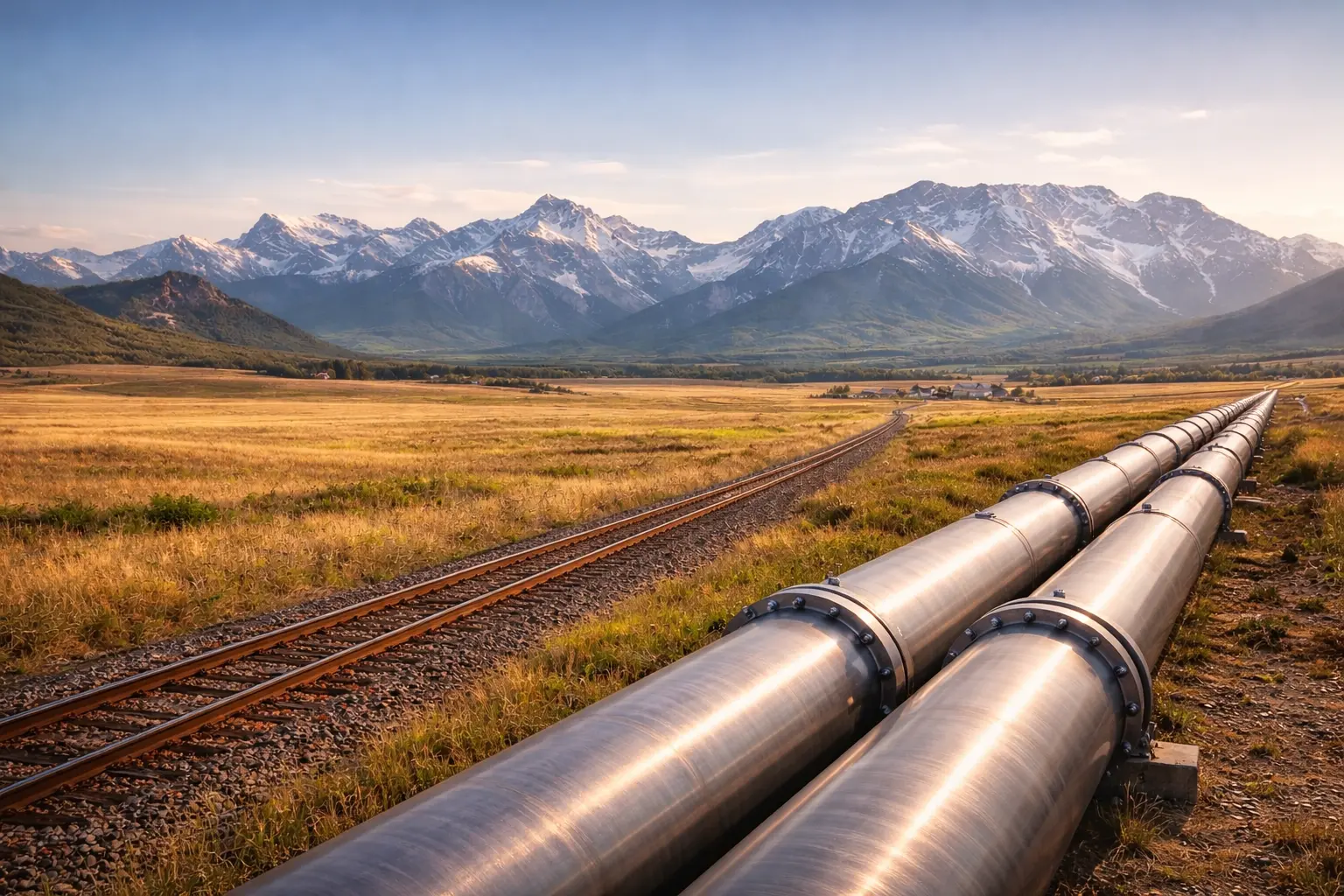
Alberta's Pipeline Geography
The debate about Alberta's pipelines generates more heat than light, in part because it is rarely conducted with actual infrastructure data. This essay describes the system that exists: seven decades of accumulated pipe, pump stations, fractionators, and terminals connecting one province's geology to markets from Vancouver to Louisiana. The numbers tell a more complicated and more interesting story than either side of the political argument typically acknowledges.
Prerequisites: None — narrative essay; see P1–P5 for mathematical treatments
The Argument Made in Iron and Steel
Somewhere northeast of Edmonton, a pipeline leaves the ground, passes over a river crossing on a steel bridge most drivers never notice, and continues south toward a tank farm at Hardisty, Alberta. The tank farm is not dramatic to look at — a cluster of white cylinders on the prairie, surrounded by a chain-link fence and some instrumentation — but it is one of the most economically significant pieces of real estate in Canada. Hardisty is where Alberta’s oil sands production meets the continental pipeline system. Everything that leaves the oil sands in liquid form passes through or near it.
The debate about Alberta’s pipeline system is one of the most persistent and least quantitative arguments in Canadian public life. It has been conducted mainly in the language of grievance and counter-grievance, of landlocked provinces and blocked opportunities, of social licence and energy sovereignty. Very little of it has been conducted in the language of the infrastructure itself: kilometres of pipe, pump station horsepower, barrels per day, tariff rates, and the geometry of a network that connects a northern province to refineries and markets across an entire continent.
This essay attempts the latter. It describes the system that exists, measured as carefully as public data allow. It does not argue that the system is adequate or inadequate, that more pipelines should be built or fewer, that Alberta has been treated fairly or unfairly. Those are political questions that data alone cannot answer. But data this specific sets a floor beneath the political argument — a set of physical facts that any honest account of Alberta’s pipeline situation must accommodate.
Seven Decades of Accumulated Infrastructure
Alberta’s pipeline system did not appear all at once. It was built incrementally, project by project, over roughly seven decades, tracking the development of the oil sands and the growth of western Canadian natural gas production.
The first major crude oil pipeline out of Alberta — the Interprovincial Pipe Line, now part of the Enbridge system — was completed in 1950, running from Edmonton to Superior, Wisconsin. At the time, it carried conventional crude from the Leduc discovery fields that had transformed Alberta’s economy three years earlier. The oil sands were understood to exist but were considered technically unrecoverable at any economic price.
Trans Mountain came next, in 1953, running west through the Rogers Pass corridor to Burnaby, British Columbia — the first pipeline to give Alberta crude access to a Pacific port. The original Trans Mountain was a 211,000 barrel-per-day system. It would take until 2024 for its successor to triple that capacity.
The natural gas system grew in parallel. The Trans-Canada pipeline, completed in 1958 after one of the most contentious debates in Canadian parliamentary history, ran 4,900 kilometres from Alberta to Quebec — at the time the longest natural gas pipeline in the world. It gave Alberta producers access to eastern Canadian markets and, via connecting pipelines, to the U.S. Midwest. The political controversy around its financing — the Pipeline Debate of 1956 that helped bring down the St. Laurent government — shows that arguments about Alberta pipeline politics are not new. They predate the oil sands, the environmental movement, and the Charter.
By the late 1990s and early 2000s, as oil sands production began its sustained climb toward multi-million-barrel-per-day volumes, the pipeline system expanded again. Enbridge’s Alberta Clipper (Line 67) added 800,000 barrels per day of Mainline capacity. Express Pipeline opened a southbound corridor to the U.S. Plains. Keystone connected Hardisty to Cushing, Oklahoma, bringing Alberta crude into the heart of the U.S. Gulf Coast refining complex.
The most recent major addition — Trans Mountain Expansion, entering service in 2024 — tripled the westbound corridor’s capacity from 300,000 to 890,000 barrels per day and opened a direct route to Asian markets for the first time at meaningful scale. It was federally built, federally owned, and preceded by years of regulatory proceedings, Indigenous consultation processes, court challenges, and political controversy at multiple levels of government.
What these seven decades of construction produced is a continental network of considerable size. Four separate commodity systems — crude oil, natural gas liquids, natural gas, and refined petroleum products — move outward from Alberta through overlapping but distinct pipeline corridors. Together they represent one of the largest concentrations of energy infrastructure per unit of population anywhere in the world.
Capacity accumulated incrementally over seven decades — each bar represents the approximate total at a key infrastructure milestone, not the single addition. The step from 2010 to 2024 reflects the Trans Mountain Expansion entering service.
The Crude Oil System: What the Numbers Say
Alberta’s crude oil export pipeline system has a total nameplate capacity of approximately 4.6 million barrels per day. Alberta’s current production of oil sands bitumen and conventional crude runs at approximately 3.6 million barrels per day. The system is running at roughly 78% of nameplate capacity — within the normal operating range for a large pipeline network that includes scheduled maintenance windows, seasonal demand variation, and operational flexibility.
Three corridors carry this volume outward. The Enbridge Mainline system — five parallel lines running from Hardisty to Superior, Wisconsin — carries approximately 62% of total exports, around 2.8 million barrels per day, into the U.S. Great Lakes refinery complex and onward to Sarnia, Ontario. Trans Mountain carries approximately 19% westward to Burnaby and the Westridge marine terminal, where it loads onto tankers for delivery to refineries in Washington state, California, and Asia. Keystone and Express carry the remaining 19% southward to the U.S. Plains and Gulf Coast.
These are not small numbers. The Enbridge Mainline alone — a single pipeline corridor with five parallel lines — moves more crude oil per day than the entire national production of Colombia, Ecuador, or the United Kingdom. Trans Mountain at 890,000 barrels per day exceeds the production of several OPEC member nations.
The Trans Mountain expansion matters in a specific way that public discussion often misses: it is not simply about adding capacity but about adding a new pricing geography. The refineries in the U.S. Midwest that receive Enbridge Mainline deliveries price Alberta crude against the West Texas Intermediate benchmark at Cushing, Oklahoma. The refineries and traders in Asia who receive Trans Mountain cargoes price against Brent and Dubai benchmarks, which have different supply-demand dynamics and often trade at different spreads relative to Alberta’s heavy crude grades. For an Alberta producer, having access to both price benchmarks is the equivalent of a farmer having access to two grain markets rather than one — the ability to sell where the price is better on any given day, and the negotiating position that comes from not being captive to a single buyer.
What Diluted Bitumen Actually Requires
There is a detail about oil sands production that rarely makes it into mainstream pipeline discussions but is central to understanding the system’s geography: bitumen cannot flow through a pipeline without help.
Raw bitumen — the heavy, viscous material mined or extracted from the oil sands — has the approximate consistency of cold peanut butter at ambient temperatures. To move it through a pipeline, producers dilute it with a lighter hydrocarbon called condensate (or, alternatively, with synthetic crude produced by upgrading facilities). The resulting blend — diluted bitumen, or dilbit — is roughly 70% bitumen and 30% diluent by volume, and it flows like a conventional heavy crude oil.
The implication of this chemistry is that Alberta’s oil sands production system requires approximately one million barrels per day of condensate and other diluent to function. That million barrels has to come from somewhere: primarily from natural gas processing plants across the Western Canadian Sedimentary Basin, which extract condensate from raw gas streams; from synthetic crude produced at upgrading facilities; and from imported condensate that arrives via the Cochin pipeline, which was reversed in 2014 to carry U.S.-sourced condensate northward from Illinois to Hardisty.
The Cochin reversal is worth pausing on. A 2,900-kilometre pipeline originally built in 1978 to carry propane eastward was repurposed four decades later to carry condensate northward — because the market changed, the economics changed, and the existing right-of-way made repurposing cheaper than building new. This is how mature pipeline infrastructure actually evolves: not through grand new projects alone, but through incremental adaptation of what already exists.
The diluent system also means that crude oil and natural gas liquids infrastructure are not independent. A shortage of condensate constrains oil sands production regardless of how much crude export pipeline capacity exists. A disruption to the Cochin pipeline, or a cold winter that reduces gas plant condensate output, tightens the diluent market and can force production curtailments at oil sands facilities. The systems are coupled in ways that the public debate, with its focus on individual pipeline projects, rarely acknowledges.
From Wellhead to Finished Product: The Processing Chain
Alberta’s pipeline debate tends to treat the pipe as the story. The pipe is not the story. It is the middle section of a longer chain that begins with extraction chemistry and ends at a refinery distillation tower. Understanding that chain — at even a rough level — changes how you read the capacity numbers, the commodity flows, and the infrastructure dependencies described above.
Extraction: Two Methods for One Resource
The oil sands contain bitumen at two depth ranges, and depth determines the extraction method. Deposits within roughly 75 metres of the surface — about 20% of the resource — are mined by open-pit excavation. Enormous electric shovels load oil sands into trucks feeding primary extraction plants, where the Clark hot water process separates bitumen from sand: oil sands are mixed with hot water and sodium hydroxide, creating a slurry in which bitumen rises as a froth that is then treated to remove residual water and fine solids. The tailings — sand, clay, and contaminated water — are stored in engineered ponds.
The remaining 80% of the resource is too deep to mine and is accessed by Steam-Assisted Gravity Drainage (SAGD). Two parallel horizontal wells are drilled into the bitumen formation, one above the other, spaced roughly five metres apart. Steam injected continuously through the upper well heats the surrounding bitumen from near-solid to fluid; heated bitumen and condensed water drain by gravity to the lower producer well and are pumped to surface. SAGD requires no tailings ponds but consumes large volumes of water and natural gas for steam generation — a different set of trade-offs rather than a better or worse outcome.
Two Processing Paths
At primary separation, Alberta bitumen faces a branching decision that shapes everything downstream.
The diluent route — approximately 60% of current output — is chemically simple. Raw bitumen is blended with condensate (the C5+ fraction recovered from natural gas processing) at roughly 30% diluent to 70% bitumen by volume. The resulting diluted bitumen meets pipeline transport specifications: density not exceeding 880 kg/m³ and viscosity not exceeding 350 centistokes at operating temperature. The condensate does not change the bitumen’s chemistry; it makes it fluid enough to pump. At the receiving terminal, condensate is separated and typically recycled northward as diluent for the next batch — the closed circuit that makes the Cochin reversal structurally indispensable.
The upgrader route — approximately 40% of output — involves genuine chemical transformation. Bitumen is subjected to thermal coking, which cracks long hydrocarbon chains into shorter ones under heat and pressure, leaving a carbon-rich coke byproduct; or to catalytic hydrocracking, which achieves the same chain-breaking by adding hydrogen under pressure with a catalyst. Both processes are followed by hydrotreating to remove sulphur. The output is Synthetic Crude Oil (SCO): API gravity of roughly 32–34°, equivalent to a conventional medium crude, needing no diluent and commanding a refinery feedstock premium. Upgraders are capital-intensive and energy-intensive; their marginal economics relative to the dilbit path vary with the light-heavy price spread.
flowchart TD
    A["Oil Sands — Athabasca region"] --> B{Deposit depth}
    B -->|"Surface — less than 75 m"| C["Open-pit mining\nShovels · trucks · extraction plant\nClark hot water separation"]
    B -->|"Deep — greater than 75 m"| D["SAGD\nSteam heats bitumen in situ\nDrains by gravity to producer well"]
    C --> E["Primary separation\nStrip residual sand and water\nOutput: raw bitumen"]
    D --> E
    E --> F{Processing route}
    F -->|"~60% of output"| G["Diluent blending\n30% condensate + 70% bitumen\nDensity target: 880 kg per cubic metre\nOutput: dilbit"]
    F -->|"~40% of output"| H["Upgrading\nCoking or hydrocracking\nHydrotreating removes sulphur\nOutput: SCO, 32 to 34 degrees API"]
    G --> I["Hardisty Hub\nStorage · blending · metering\nCustody transfer point"]
    H --> I
    I --> J["Export pipeline\nMultiple grades travel in sequence\nBatch-scheduled transport"]
    J -->|"Enbridge — 62%"| K["Midwest refineries\nSarnia · Superior · Patoka"]
    J -->|"Trans Mountain — 19%"| L["Pacific terminal\nBurnaby to tanker to Asia"]
    J -->|"Keystone and Express — 19%"| M["Gulf Coast\nPort Arthur · Cushing"]
    K --> N["Crude distillation tower\nFractionation by boiling point"]
    L --> N
    M --> N
    N --> O["Gasoline · Jet fuel · Diesel · Asphalt · Petrochemical feedstocks"]
One Pipe, Many Products: Batch Scheduling
Major petroleum pipelines do not carry a single homogeneous product. They carry multiple grades — different crude types, different refined products — that travel sequentially through the same pipe as discrete batches, managed with considerable precision.
On crude export lines, a scheduling window might contain: 275,000 barrels of heavy dilbit from one producer, followed by Synthetic Crude from an upgrader, followed by condensate returning northward as diluent feedstock, followed by another heavy batch from a different shipper. Each batch enters at Hardisty and travels at the same average velocity — set by pump throughput and pipe diameter. At the boundary between adjacent grades, turbulent mixing creates a transmix zone — a few hundred to a few thousand barrels of commingled product — managed at receiving terminals by blending into the lower-specification of the two grades, diverting to reprocessing tankage, or selling at a discount to a shipper who accepts off-spec material.
Products are tracked not by physical marker but by volume measurement: flow computers at injection and withdrawal meters account for temperature, pressure, and fluid dynamics, calculating when each batch will arrive at each delivery point along the route. Break-out tanks at intermediate pump stations allow product to be diverted off the mainline before the terminus, enabling deliveries to refineries short of the full pipeline length. On refined products lines — like the Trans Mountain products pipeline from Edmonton to Burnaby — the scheduling is more demanding: gasoline, diesel, and jet fuel share the same pipe in close sequence, and interface contamination between jet fuel and diesel is a flight safety threshold. Batch sizes and sequencing intervals are optimised to hold transmix below quality limits while meeting delivery commitments at every terminal.
Grey zones marked “tmx” are transmix — the interface where adjacent grades commingle during turbulent flow. Each is a few hundred to a few thousand barrels; managed at the receiving terminal by blending into the lower-specification product or diverting to reprocessing tankage. The coloured batches are tracked by volume through continuous meter readings at injection and delivery points, not by physical markers in the pipe.
The Natural Gas System and the Price It Gets
Alberta produces approximately 70% of Canada’s natural gas. The NOVA Gas Transmission system — 25,000 kilometres of pipe within Alberta alone — gathers this production from thousands of wells across the Western Canadian Sedimentary Basin and routes it to the AECO hub near Suffield, in southeastern Alberta, where it is traded and dispatched into export corridors.
Five main corridors carry Alberta gas outward: the TC Canadian Mainline eastward to Ontario and Quebec; Westcoast Energy southward through British Columbia to the U.S. Pacific Northwest and California; Alliance Pipeline on a direct route from northeastern Alberta to the Chicago area; and several smaller connections to the U.S. Midwest and Rockies. Total export capacity is approximately 10.9 billion cubic feet per day against production of 15–17 billion cubic feet per day, with the remainder consumed in-province.
The price Alberta producers receive for their gas — the AECO benchmark — has persistently traded at a discount to Henry Hub in Louisiana, the North American reference price. The discount fluctuates; it has averaged roughly one to two Canadian dollars per gigajoule over the past decade, with occasional spikes to four or five dollars during periods when production growth temporarily outran pipeline capacity.
This discount is not primarily a policy artefact or a regulatory failure. It is a physical consequence of geography: Alberta gas must travel further to reach the largest markets than Gulf Coast gas does, and that distance costs money in tariffs and compression energy. The basis differential is, in a precise sense, the price that geography charges for distance.
The 2018 AECO basis collapse — when Alberta gas fell to roughly one Canadian dollar per gigajoule while Henry Hub traded near four — is the clearest recent illustration of what happens when production growth temporarily exceeds pipeline capacity. Alberta’s Montney gas play was growing faster than TC Energy’s NGTL system could accommodate; gas backed up at AECO and prices collapsed. The crisis prompted accelerated NGTL expansion and new export interconnections. The basis subsequently recovered. The sequence was painful for producers but was structurally predictable from pipeline capacity data — which is precisely the value of examining this system quantitatively rather than politically.
The gap between the two lines is what Alberta gas producers lose relative to Gulf Coast pricing. The 2018 collapse — when AECO fell to roughly $1.10/GJ while Henry Hub traded near $2.80 USD — resulted directly from the Montney production ramp outrunning NGTL system capacity.
The Refinery Cluster That Most People Don’t Know About
Alberta refines petroleum products. This is not widely appreciated in public discussions about the province’s energy economy, which tend to treat Alberta as a raw material exporter and leave it at that.
Four refineries operate in the Edmonton metropolitan area. Imperial Oil’s Strathcona Refinery, the largest at 195,000 barrels per day, produces gasoline, diesel, jet fuel, and asphalt from a combination of Alberta conventional crude and oil sands feedstock. Shell’s Scotford complex at Fort Saskatchewan produces synthetic crude, diesel, and petrochemical feedstocks. The Co-operative Refinery Complex in Regina — just across the provincial border, within the same supply network — adds 145,000 barrels per day of capacity. And the North West Redwater Sturgeon Refinery, Alberta’s newest, was specifically designed to process oil sands bitumen and produce ultra-low sulphur diesel, partially financed through the provincial government’s bitumen royalty system.
Combined, these facilities have nameplate capacity of approximately 374,000 barrels per day against Alberta’s own refined products demand of roughly 180,000 barrels per day. The surplus — approximately 194,000 barrels per day — moves westward by pipeline to British Columbia and eastward to Saskatchewan and Manitoba.
A litre of diesel refined at Strathcona and destined for a Vancouver gas station travels approximately 1,150 kilometres through the Trans Mountain products pipeline in a batch that takes roughly nine to ten days to arrive. The Burnaby receiving terminal maintains enough storage to supply Metro Vancouver for approximately thirteen days — a buffer that is calibrated specifically to the pipeline’s transit time, with a modest margin for disruption. The supply chain from Edmonton refinery to Vancouver pump is not improvised; it is precisely engineered, with inventory buffers sized to the physics of the pipeline.
Combined capacity of 519,000 bbl/d against in-province demand of roughly 180,000 bbl/d. The surplus — approximately 339,000 bbl/d — moves westward to British Columbia by pipeline and eastward to Saskatchewan and Manitoba. Alberta refines more than it consumes.
What the Network Looks Like as a Whole
When all four commodity systems are mapped simultaneously — crude oil, natural gas liquids, natural gas, and refined products — the aggregate picture is of a network with three strategic orientations.
Alberta sits at the top-left of this map. Every marker is a pipeline destination: the continental reach of a landlocked province. The cluster of U.S. markers to the south and east reflects where most crude oil currently flows; Burnaby and Kitimat mark the westward Pacific option.
The dominant orientation is southward and eastward into the United States. Most of Alberta’s crude oil export reaches U.S. refineries. Most Alberta natural gas that leaves the province eventually crosses the border. The Enbridge Mainline, Keystone, Alliance, and Westcoast systems all cross into American jurisdiction within their first few hundred kilometres. This makes Alberta’s export infrastructure subject, in part, to U.S. regulatory frameworks, presidential permit requirements, and the legal systems of multiple American states — a geographic fact with real consequences that the cancellation of Keystone XL illustrated.
The second orientation is westward to Pacific tidewater. Trans Mountain is the only crude export route to the Pacific, constrained by the Rocky Mountains to a single corridor. For natural gas, Westcoast Energy runs through BC to the U.S. Pacific Northwest. LNG Canada at Kitimat, entering commissioning in 2024, represents the first meaningful Pacific liquefied natural gas export capacity from the WCSB — a new market orientation that could structurally improve Alberta gas prices by reducing the surplus supply at AECO.
The third orientation is eastward within Canada. The TC Canadian Mainline, at 4,900 kilometres, is still the longest gas pipeline in the world by some measures, but its utilization for eastward gas deliveries has declined significantly as Ontario and Quebec have found alternative supply routes. The Enbridge Mainline delivers crude to Ontario refineries at Sarnia. Refined products move eastward in smaller volumes. This Canadian orientation is the smallest of the three in throughput terms and the most structurally strained — eastern Canadian markets have diversified away from Alberta supply in ways that have reduced the province’s domestic market share.
Together, these three orientations produce a network that is simultaneously extensive and concentrated. Extensive because it reaches across a continent in multiple directions. Concentrated because most of the flow passes through a single geographic hub — the Hardisty-Edmonton corridor — before dispersing into export trunks. The mathematical concept of betweenness centrality, which measures how often a node appears on the shortest path between other nodes, gives Hardisty the highest score in the crude oil network. This is the network’s structural reality: it is not fragile in the aggregate, but it has one node whose disruption would affect all export directions simultaneously.
Economic Sovereignty as Geographic Fact
The concept of economic sovereignty — the ability of a jurisdiction to control the terms on which its resources reach markets — is usually discussed in political terms. But it has a geographic expression that pipeline infrastructure makes concrete.
A province with a single export corridor has limited sovereignty over the terms of sale: the operator of that corridor has pricing power, and destination refiners know that producers have no alternative. A province with multiple corridors reaching multiple price benchmarks has more sovereignty: it can direct product toward better-priced markets, arbitrage between destinations, and resist unfavorable terms by threatening to reroute.
Alberta’s infrastructure evolution over seven decades has been, in part, a story of progressively building toward the multi-corridor position. The Enbridge Mainline gave access to U.S. Midwest pricing. Keystone extended that access to Gulf Coast pricing. Trans Mountain Expansion opened Pacific pricing. Each addition reduced the leverage of any single market over Alberta’s producers.
The sovereighty position remains incomplete. Trans Mountain is a single mountain corridor with no redundancy. The AECO basis remains persistently negative because U.S. gas markets are not fully integrated with Alberta supply. Eastern Canadian markets have largely diversified away from Alberta gas, reducing the domestic market that would otherwise provide a floor price. And the regulatory and political complexity of building new infrastructure has increased substantially over the past two decades, raising the cost and extending the timeline of adding new corridors.
None of this is simple. The data do not resolve the policy debates about new pipeline construction, Indigenous consultation, climate commitments, or the pace of energy transition. What they do is establish the baseline from which those debates should proceed: a province that is large, well-connected, multi-directional in its export infrastructure, running near but not at capacity, and facing specific, identifiable constraints that are physical and geographic before they are political.
The argument about Alberta’s pipelines is ultimately an argument about what kind of energy province Alberta should be, and on what terms, and for how long. That is a values argument, and data cannot settle it. But the values argument is better conducted when the physical argument is settled — when the participants know what the network actually looks like, rather than arguing from impressions of a system they have never examined.
The system is large. It is more connected than the landlocked narrative suggests. It is also more constrained than the no-problems narrative suggests. Both of those things are true simultaneously, and the specifics of each constraint are knowable, because they are written in steel and pressure ratings and capacity filings with the Canada Energy Regulator.
That is what this cluster of essays has tried to show.
The Technical Essays in This Cluster
This narrative introduces a cluster of five computational geography essays, each examining one commodity system in mathematical detail:
P1 — Crude Oil Pipelines Flow rates, Darcy-Weisbach hydraulics, capacity utilization, and the netback price model. The Enbridge Mainline, Trans Mountain, and Keystone systems examined in detail.
P2 — NGL and Condensate Systems The fractionation cascade, diluent supply chain, and the Cochin reversal. Mass balance mathematics through a Fort Saskatchewan fractionator.
P3 — Natural Gas Transmission The NOVA Gas Transmission system, the Weymouth equation for compressible flow, and the AECO-Henry Hub basis differential derived from transport cost arithmetic.
P4 — Refined Products Distribution Batch scheduling, the Cola equation for transmix volume, and terminal inventory design from Edmonton to Burnaby.
P5 — The Integrated Network All four systems as a directed graph. Max-flow min-cut analysis, network centrality, and the full netback price surface across all market destinations.
A Note on Impartiality
This essay has tried to present Alberta’s pipeline situation as it is, not as either side of the political debate would prefer it. The network is large — larger than casual commentary suggests. It is also constrained in specific ways that the same commentary often ignores. The AECO basis discount is real and costs Alberta producers meaningful revenue. The Hardisty node concentration is a genuine structural vulnerability. The loss of eastern Canadian gas market share is a structural shift, not a temporary anomaly.
At the same time, the province is not landlocked. It has access to three continental market directions. Its crude oil export capacity substantially exceeds current production. Its refinery cluster processes and exports value-added products, not only raw bitumen. Its NGL fractionation hub at Fort Saskatchewan is the largest in Canada and anchors a downstream petrochemical industry.
Both of these pictures are accurate. The debate tends to use one or the other selectively, depending on the argument being made. The data support neither the maximally aggrieved narrative nor the maximally complacent one. They support the complicated truth, which is that Alberta is a resource economy of continental scale, substantially integrated into North American energy infrastructure, with specific and manageable vulnerabilities and genuine unresolved questions about its long-term market position as the energy transition proceeds.
That is a harder story to tell than the simple versions. It is also, we think, the correct one.
Sources and Further Reading
The five computational essays in this cluster contain detailed source tables for each commodity system. For general orientation, the following sources provide the most reliable current data on Alberta’s pipeline infrastructure:
| Source | Description |
|---|---|
| Canada Energy Regulator, Pipeline Profiles | The definitive public source for Canadian pipeline capacity, throughput, and utilization by system |
| Canada Energy Regulator, Energy Future series | Long-term supply and demand projections with pipeline context |
| Alberta Energy Regulator, ST98 | Annual reserves and production data, oil sands and conventional |
| Trans Mountain Corporation, public reporting | TMX capacity, route, and operational data |
| TC Energy, public disclosures | NGTL system extent, export pipeline data |
| Enbridge Inc., annual reports and investor presentations | Mainline throughput, capacity, and utilization |
| Trevor Tombe, University of Calgary, fiscal analysis | The most rigorous academic work on Alberta’s fiscal position within Confederation |
| Canadian Association of Petroleum Producers, statistical handbook | Production forecasts and industry-wide data |
References
Alberta Energy Regulator. 2024. ST98: Alberta Energy Outlook — Executive Summary. Calgary: AER. https://www.aer.ca/data-and-performance-reports/statistical-reports/alberta-energy-outlook-st98/executive-summary
Canada Energy Regulator. 2023. Canada’s Energy Future 2023: Energy Supply and Demand Projections to 2050. Calgary: CER. https://www.cer-rec.gc.ca/en/data-analysis/canada-energy-future/2023/
Canada Energy Regulator. 2024. Market Snapshot: Canada’s Oil Pipeline Capacity in 2024. Calgary: CER. https://www.cer-rec.gc.ca/en/data-analysis/energy-markets/market-snapshots/2024/market-snapshot-canadas-oil-pipeline-capacity-2024.html
Canada Energy Regulator. 2024. Market Snapshot: Exploring Canada’s Future in LNG Exports. Calgary: CER. https://www.cer-rec.gc.ca/en/data-analysis/energy-markets/market-snapshots/2024/market-snapshot-exploring-canadas-future-in-lng-exports.html
Canada Energy Regulator. 2024. Market Snapshot: Western Canada’s Natural Gas Export Pipelines Continued to See High Utilization in 2023. Calgary: CER. https://www.cer-rec.gc.ca/en/data-analysis/energy-markets/market-snapshots/2024/market-snapshot-western-canadas-natural-gas-export-pipelines-continued-to-see-high-utilization-in-2023.html
Canada Energy Regulator. 2024. Pipeline Profiles. Calgary: CER. https://www.cer-rec.gc.ca/en/data-analysis/facilities-we-regulate/pipeline-profiles/
Canada Energy Regulator. 2025. Market Snapshot: Oil Pipeline Throughputs for 2024 and the First Half of 2025 Remain High. Calgary: CER. https://www.cer-rec.gc.ca/en/data-analysis/energy-markets/market-snapshots/2025/market-snapshot-oil-pipeline-throughputs-for-2024-and-the-first-half-of-2025-remain-high.html
Canada Energy Regulator. 2025. Market Snapshot: Trans Mountain Expansion Eases Pipeline Constraints and Increases Exports to Overseas Markets. Calgary: CER. https://www.cer-rec.gc.ca/en/data-analysis/energy-markets/market-snapshots/2025/market-snapshot-trans-mountain-expansion-eases-pipeline-constraints-and-increases-exports-to-overseas-markets.html
Canadian Association of Petroleum Producers. 2024. Crude Oil Market Fundamentals. Calgary: CAPP. https://www.capp.ca/wp-content/uploads/2024/03/Crude-Oil-Market-Fundamentals.pdf
Enbridge Inc. 2022. “Line 3 Replacement Project Substantially Completed and Set to be Fully Operational.” News release. Calgary: Enbridge. https://www.enbridge.com/media-center/news/details?id=123692&lang=en
Imperial Oil. 2024. “Strathcona Refinery.” Calgary: Imperial Oil. https://www.imperialoil.ca/company/operations/strathcona
LNG Canada. 2024. “LNG Canada 2024 Fall Update.” Kitimat: LNG Canada. https://www.lngcanada.ca/news/lng-canada-2024-fall-update/
Natural Resources Canada. 2024. Energy Fact Book 2024–2025. Ottawa: NRCan. https://energy-information.canada.ca/en/energy-facts
Statistics Canada. 2025. “The Trans Mountain Pipeline Is Delivering.” Ottawa: Statistics Canada. https://www.statcan.gc.ca/o1/en/plus/8439-trans-mountain-pipeline-delivering
TC Energy. 2024. Canadian Mainline. Calgary: TC Energy. https://www.tcenergy.com/operations/natural-gas/canadian-mainline/
TC Energy. 2024. NGTL System. Calgary: TC Energy. https://www.tcenergy.com/operations/natural-gas/ngtl-system/
Trans Mountain Corporation. 2024. Our History. Calgary: Trans Mountain. https://www.transmountain.com/history
Trans Mountain Corporation. 2024. Trans Mountain Pipeline System. Calgary: Trans Mountain. https://www.transmountain.com/pipeline-system
This essay is the narrative introduction to the Pipeline Connectivity cluster within the Alberta in Context series. The computational essays P1–P5 follow with full mathematical treatments of each commodity system.