 WaywardHouse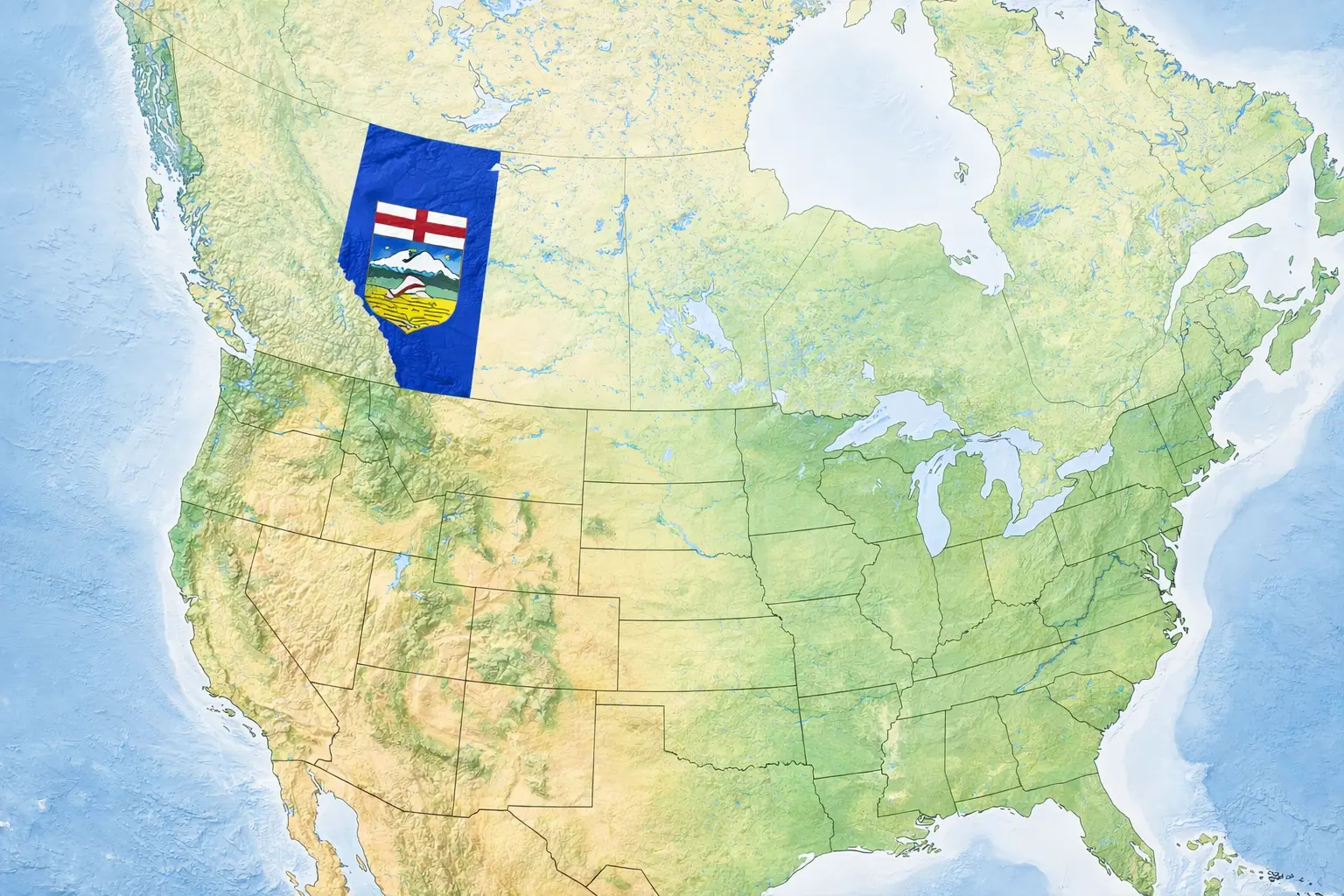
Landlocked by Default: The Economic Geography of Alberta's Connectivity Crisis
Alberta has no coastline, no navigable rivers to tidewater, and sits 1,200 kilometres from the nearest port. Every tonne of export and every passenger trip carries a geographic penalty baked into the province's location. This essay traces how that structural condition shapes Alberta's three transport channels — rail, road, and air — and how each is now under simultaneous pressure from financialization, pandemic legacy, and a geopolitical environment that has turned the Canada–US border from an administrative formality into an economic barrier.
Alberta does not get to choose its geography. Bounded by the Rocky Mountains to the west, the 49th parallel to the south, Saskatchewan’s unbroken plains to the east, and the boreal transition to the north, the province sits in one of the more isolated inland positions of any major commodity-producing economy in the world. It has no coastline, no navigable rivers to tidewater, and its nearest Pacific port — Vancouver — lies approximately 1,000 kilometres of mountain terrain away. Its nearest Atlantic access requires crossing five provinces. The Hudson Bay corridor, theoretically the shortest overland route to tidewater, remains economically marginal. Alberta exports its energy, its grain, its potash precursors, and its people through corridors it does not own, across provinces whose political interests do not always align with its own.
This is not merely a historical curiosity. It is the foundational condition of Alberta’s economic geography, and it has direct, measurable consequences for the cost, vulnerability, and resilience of every sector the province depends upon. When economists discuss the “landlocked penalty” — the empirical finding that landlocked nations pay substantially higher trade costs than their coastal counterparts — they are describing a structural deficit that Alberta carries even as a Canadian province with nominally free internal trade. Alberta cannot sign port agreements. It cannot build pipelines through provinces that refuse them. It cannot compel CN or CP to increase track capacity. And it cannot, on its own, sustain the air connectivity that increasingly functions as its most direct lifeline to global markets and international labour.
This essay examines Alberta’s transport geography across three channels: rail, road, and air. Each channel reveals a different dimension of the same underlying constraint. Rail shows how commodity export geography is shaped by infrastructure duopolies and chokepoints hundreds of kilometres from the province’s borders. Road shows how deep the integration with the United States has become, and how rapidly political decisions can degrade that integration. Air, examined in the most detail, shows how a geographically isolated province’s passenger and freight connectivity depends on a thin competitive market that has been successively destabilized by privatization, pandemic, labour conflict, and now a trade war that has redrawn the economics of cross-border flying.
The argument is not that Alberta’s situation is irreparable. It is that the costs of the landlocked position, long managed through infrastructure investment and bilateral openness, are now rising simultaneously across every channel — and that this convergence constitutes a structural connectivity crisis rather than a series of independent shocks.
I. The Geometry of Isolation
To understand Alberta’s transport economics, it is useful to begin with the basic spatial facts. Alberta covers approximately 661,848 square kilometres, roughly the size of France. Its two major urban centres — Calgary at roughly 51.0°N, 114.1°W and Edmonton at 53.5°N, 113.5°W — sit in the central interior of the continent at significant remove from every major maritime gateway.
The distance from Calgary International Airport (YYC) to the Port of Vancouver is approximately 970 kilometres by air and considerably longer by road through the Trans-Canada corridor. By rail, the distance is roughly 1,050 kilometres, traversing three mountain passes. The distance from Calgary to Prince Rupert — Canada’s second major Pacific gateway, and the preferred port for some grain and potash shipments due to its shorter great-circle routing to Asian markets — is approximately 1,500 kilometres by rail. The distance to Prince George, the nearest major northern BC rail hub, is over 1,200 kilometres. There is no southern exit to tidewater. The Pacific coast of the United States, accessible via Montana, Wyoming, and Washington State, sits approximately 2,000 kilometres from Calgary by road.
The international literature on landlocked economic geography finds that, controlling for GDP, population, and other factors, landlocked countries pay an average of 50% more in trade costs than coastal nations. The canonical analysis, formalized in the gravity model of trade, treats distance as a friction that diminishes trade flows according to an inverse power relationship. For Alberta, the relevant distance is not simply the distance to a trading partner — it is the distance to the port of embarkation, plus the transoceanic freight, plus the distance to the destination market. Alberta’s exports travel farther before they even leave Canada than many nations’ exports travel in total.
This spatial premium is partially offset by infrastructure — the CPR and CN mainlines that reach the coast, the Trans-Canada and Yellowhead Highway corridors, the pipeline networks that have gradually expanded Pacific export capacity for oil sands crude — but infrastructure does not eliminate the geographic penalty; it merely converts it into a capital and operating cost that must be paid by someone. When infrastructure is functioning well and trade corridors are politically stable, the cost is manageable. When they are not, the premium compounds.
Figure 1. Alberta’s principal export gateways and transport corridors. The CN Yellowhead and CPKC Kicking Horse rail mainlines must traverse the Rocky Mountain barrier before reaching Pacific tidewater. The Hudson Bay Railway offers an Arctic alternative with severely constrained capacity. Click or tap any corridor or marker for detail.
Figure 3. Gravity model decay curves showing trade intensity vs distance for a coastal origin (reference) and Alberta (landlocked). Alberta’s exports must overcome approximately 1,050 km of domestic overland distance before international freight begins, shifting the effective curve materially downward at every destination. Named trading partners annotated. The shaded gap represents the structural transport cost premium. β = 1.2 (empirical range: 0.9–1.5).
II. Rail: The Commodity Corridor and Its Constraints
Alberta’s rail geography is organized around two facts: the CPR and CN Rail constitute a duopoly over the province’s rail access to Pacific tidewater, and both mainlines must traverse the same Rocky Mountain passes to reach the coast.
In terms of volume, rail is the dominant mode for Alberta’s non-pipeline exports. Approximately 55% of non-pipeline exports from the province move by rail, according to Canada West Foundation analysis. The principal commodities are grain (wheat, canola, barley), potash precursors, coal from the Rockies foothills, and increasingly, intermodal containers carrying manufactured goods. Over 70% of Alberta’s non-American exports bound for overseas markets move through Vancouver or Prince Rupert — an almost total dependence on British Columbia’s port infrastructure for access to Pacific and Asian markets.
The CN/CPKC (formerly CP, now merged with Kansas City Southern to form CPKC) duopoly creates significant leverage asymmetry in contract negotiations. In regions where only one railway owns the operating line, shippers face a de facto monopoly with no alternative routing. The Canada West Foundation has documented that Alberta exporters report an uncompetitive rail environment and limited capacity on key corridors, with the railways holding considerable power in contract negotiations. This is not a new complaint — it has been a consistent feature of prairie grain transportation since the abolition of the Crow Rate in 1995, which eliminated a federal subsidy that had kept grain freight rates artificially low. The post-Crow transition shifted the cost of the geographic penalty squarely onto producers.
The Rocky Mountain chokepoint is not merely commercial — it is physical. Both the CPR Kicking Horse Pass route and the CN Yellowhead Pass route face capacity constraints imposed by gradient, tunnel length, and the volume of traffic they are asked to handle. A single derailment, wildfire, or flood event in the BC Interior can sever Alberta’s export rail access to the Pacific for days or weeks. The November 2021 atmospheric river event, which caused catastrophic flooding in the Fraser Valley and severed both rail mainlines simultaneously, demonstrated just how fragile this corridor is. The event stranded grain shipments, disrupted container import flows, and briefly isolated Metro Vancouver’s supply chain in both directions. For Alberta shippers, it was a reminder that “access” to tidewater is not a permanent condition — it is a contingent one, subject to climatic and physical interruption at points the province cannot control or invest in directly.
The competitive environment on the rail corridor has been further complicated by CPKC’s merger with Kansas City Southern, which created a single-line network from Canada to Mexico. While the merger creates long-term strategic opportunities for Alberta producers to access Mexican markets without transshipping in US intermodal hubs, its near-term effects on service and pricing in the Alberta-to-Vancouver corridor have been mixed. CPKC has prioritized its north-south transnational flows on the combined network, and there is documented concern among prairie grain handlers that the Vancouver corridor has received less capital attention as the merged railway focuses on its continental ambitions.
The federal government has modestly intervened through the National Trade Corridors Fund, which in 2025 announced over $33 million in rail infrastructure investment across Alberta and British Columbia — including a siding extension on the CN corridor between Kamloops and Vancouver, and a Battle River Railway upgrade in Forestburg, Alberta. These investments are welcome but modest relative to the scale of the constraint. The bottleneck is not primarily a matter of missing sidings; it is a matter of mountain geography, limited parallel routing, and a competitive structure that concentrates market power in the hands of two carriers.
III. Road: Deep Integration and the Border as Risk
Alberta’s road network connects the province to its largest single trade partner — the United States — through a series of crossing points along the 49th parallel. The CANAMEX Corridor, running south through Coutts/Sweetgrass to Montana and onward to the US interstate system, carries the bulk of Alberta’s road-borne trade. The Trans-Canada east provides secondary connection through Saskatchewan and Manitoba to the great lakes industrial corridor. Highway 2 between Calgary and Edmonton functions as the province’s internal spine, but for export purposes it is ultimately the southern crossings that matter.
The degree of integration between Alberta and the US economy is difficult to overstate. Alberta exported goods valued at over $4.3 billion to the United States through the Coutts port of entry alone in 2017 — and that figure captures only road traffic, not pipeline or rail flows that cross elsewhere. Total Alberta goods exports to the United States routinely exceed $100 billion annually when oil and gas pipeline flows are included, making the US the destination for roughly 90% of Alberta’s international export value in a typical year. The automotive supply chain, while less developed in Alberta than in Ontario, still routes components and finished goods across the border. The agriculture sector’s fertilizer inputs and equipment flow northward; the province’s beef, canola oil, and processed goods flow south.
This integration was a feature of the post-NAFTA, and later CUSMA, trade architecture — an architecture that assumed the border was, in commercial terms, nearly frictionless. That assumption has been progressively challenged since 2017 and shattered outright in 2025 when the Trump administration’s imposition of broad tariffs on Canadian goods — including a 25% levy on steel, aluminum, and many other categories — triggered retaliatory Canadian measures and a sustained deterioration of the bilateral trade relationship.
The road corridor’s vulnerability is not physical — the highways have not changed. It is regulatory and political. Tariffs impose cost; political hostility imposes hesitancy. Trucking firms must now price in the uncertainty of goods being assessed duties that change without notice. Cross-border supply chains that were built on the assumption of a few percent cost difference between Canadian and American suppliers now face potential 25% price shocks. The agriculture sector, which ships processed canola, beef, and pulse crops south and receives fertilizers and equipment north, faces margin compression on both sides. In Alberta’s case, where the US has historically absorbed the majority of goods exports, the tariff shock is not a disruption to a secondary market — it is a shock to the primary one.
The human geography consequences are visible in cross-border travel data. From January to October 2025, the number of Canadian personal vehicles crossing into the US fell by nearly 19% compared to the same period in 2024, with some border states recording declines of 27%. Canadian resident return trips by automobile from the US dropped 30.2% in December 2025 alone. These are not merely tourism numbers — they represent the suppression of the informal economic integration that stitches together border communities, business travel patterns, and the ordinary movement of people that lubricates a shared economic zone. For Alberta specifically, cross-border business travel to Montana, Washington State, and California tech and energy hubs has historically been an important component of the province’s commercial network. That network is now operating under conditions of explicit political tension that have no precedent in the post-NAFTA era.
IV. Air: The Gateway and Its Fractures
If rail and road are Alberta’s commodity corridors, air is its people corridor — and, increasingly, its high-value freight corridor for time-sensitive goods. Calgary International Airport (YYC) functions as Western Canada’s primary international hub for passenger travel, with connections to European, Asian, and transborder US markets. For a province with no port and a road network whose main foreign connection is to a single country, the airport is not merely convenient; it is structurally essential.
The economics of air connectivity in a landlocked interior city are different from those of a coastal hub. YYC does not benefit from natural geographic concentration of routes the way Vancouver or Toronto do — it must compete to attract long-haul services that could as easily be routed through those hubs, and it relies on a domestic feed network to aggregate sufficient passenger volumes for wide-body international operations. That feed network, in turn, depends on two carriers — Air Canada and WestJet — whose competitive behaviour directly determines which routes exist, at what frequency, and at what price.
Alberta’s air connectivity, over the past six years, has been subjected to a series of compounding shocks that have systematically degraded both the quality and the resilience of that feed. They arrive in rough sequence: privatization and financial restructuring (2019), pandemic collapse (2020–2021), asymmetric recovery and labour crisis (2022–2023), geopolitical demand destruction (2025), and now supply chain pressure on the aircraft themselves (2025–onward). Each shock is partially independent. Together, they constitute a structural degradation of connectivity that is not yet widely recognized as such.
The Financialization of WestJet
WestJet Airlines was founded in Calgary in 1996 as a low-cost domestic carrier on the Southwest Airlines model — lean, non-unionized, employee-ownership-oriented, with a corporate culture built around the premise that aviation could be made affordable for ordinary Albertans. Over two decades it grew into Canada’s second-largest carrier, a genuine competitor to Air Canada, and one of the few airlines in North America to generate consistent profits through the mid-2010s. It was, in its mature form, a Calgary institution: headquartered in the city, employing over 14,000 people provincially, and operating a hub at YYC that connected Alberta to over 100 destinations across North America and beyond.
In May 2019, Onex Corporation — a Toronto-based private equity firm — announced its intention to acquire WestJet in an all-cash transaction valued at approximately $5 billion including assumed debt. The purchase price of $31 per share represented a 67% premium to WestJet’s then-current trading price, a premium that signalled Onex’s belief that the airline was substantially undervalued, or that it could be more aggressively managed than its public-market shareholders had permitted. The deal closed in December 2019.
The timing was, in retrospect, among the most unfortunate in the history of Canadian aviation finance. Onex acquired WestJet with a leveraged capital structure — raising approximately $2.4 billion in debt to fund the buyout — and immediately began the work of transforming a public company into a PE-optimized asset. The growth strategy involved expanding international routes, absorbing Sunwing Airlines as a leisure carrier, and competing more directly with Air Canada on transatlantic services. All of this required capital. All of it required operational scale. None of it had time to develop before COVID-19 grounded the global airline industry in March 2020 — three months after the acquisition closed.
The pandemic was catastrophic for WestJet in particular because the debt structure of the Onex acquisition meant the airline entered the crisis with far less financial flexibility than it would have had as a publicly traded company managing its own balance sheet. Air Canada, which received approximately $5.9 billion in government liquidity support during the pandemic, emerged from COVID with its network largely intact and resumed aggressive expansion. WestJet, privately held and ineligible for comparable public support without greater government scrutiny of a PE-owned firm’s finances, managed a slower recovery in which cost reduction and labour discipline became the primary tools of financial management.
The labour consequences were stark. WestJet pilots — having accepted a first collective agreement during the pandemic period under conditions of significant duress — found themselves, when travel demand surged back in 2022, working under contract terms they viewed as exploitative relative to the North American market. By February 2023, the union representing approximately 1,800 WestJet and Swoop pilots was describing the negotiations as unproductive, reporting that pilots were leaving the airline at a rate of roughly one every 18 hours — primarily to US carriers offering dramatically higher compensation. The union documented WestJet pilot pay at approximately 45% of the average US airline pilot salary, a gap that the post-pandemic pilot shortage had made commercially untenable.
In May 2023, after nine months of failed negotiations, ALPA issued a 72-hour strike notice. WestJet, characteristically PE-managed to the last, responded by issuing a lockout notice — a tactical escalation that suggested a company more interested in cost-containment brinkmanship than operational continuity. A tentative agreement was ultimately reached, delivering approximately CAD $400 million in wage improvements over four years, retroactive back pay, and pension access. The deal resolved the immediate dispute but underscored a structural tension: a PE-owned carrier seeking to maximize return on leveraged investment has fundamentally different incentives than a publicly owned airline managing its network as a public service and competitive good.
By 2025, Onex had partially restructured its WestJet ownership position in a transaction valued at approximately $550 million, closing at more than a 25% premium to its net asset value in the airline — a 2.1 times multiple on its original equity investment according to CIBC Capital Markets analysis. The PE playbook, in other words, delivered its financial objective. What it left behind was an airline carrying more debt, more labour friction, and less operational agility than it had possessed as an independent public company.
For Alberta specifically, the PE transformation of WestJet represents a significant shift in the governance of a critical piece of provincial infrastructure. An airline headquartered in Calgary, publicly traded on the TSX, accountable to retail shareholders many of whom were its own employees — this is a different institution than a leveraged asset within an Onex Partners fund. The question of who controls WestJet’s route decisions, capacity allocation, and network priorities now runs through a Toronto-based PE firm whose obligations are to its investors, not to the communities WestJet was built to serve.
The Pandemic and the Permanent Loss of Routes
Air Canada’s response to the pandemic revealed a pre-existing strategic logic that COVID merely accelerated. In June 2020, the airline announced the suspension of service on 30 domestic regional routes and the closure of eight regional stations — cuts that disproportionately affected smaller Western Canadian communities. By February 2021, a further 1,500 workers were laid off as travel restrictions deepened. The airline was responding rationally to collapsing demand, but its rationality was not geographically neutral.
Air Canada’s network hierarchy places Toronto Pearson (YYZ) at its apex, followed by Montreal (YUL), then Vancouver (YVR), then Calgary (YYC). When capacity is constrained, the hierarchy determines where it is deployed. The pandemic period accelerated an existing tendency for Air Canada to concentrate its wide-body international capacity at YYZ and YUL — the eastern hubs where the airline’s corporate travel, government traffic, and financial services clientele are concentrated. Western Canada, and YYC in particular, received proportionally less recovery capacity.
By 2023, the pattern had hardened into explicit route rationalization. CBC reporting from August of that year documented Air Canada slashing connections from Calgary to six destinations — including, notably, Cancun and Honolulu — routes that the airline described as outside its core network competence. Aviation analysts at McGill University’s aviation management program described the dynamic explicitly: as each airline retreats to the geography where it has the greatest market strength, the zones of competitive overlap shrink, and the communities in the middle face reduced competition and higher fares. Air Canada is a national carrier in a Canadian sense but an eastern-anchored one in a commercial sense. Its strategic retreat from Western Canadian leisure routes — leaving them to WestJet — is a market segmentation decision that reduces competitive pressure on the routes that Western Canadians most depend on for discretionary travel.
The Saskatoon Chamber of Commerce filed a formal complaint with the federal Competition Bureau in 2023 over Air Canada’s decision to withdraw Saskatoon-Calgary service, arguing that the move gave WestJet an anti-competitive monopoly in Saskatchewan’s largest city. The complaint illustrates a broader dynamic: the implicit competitive duopoly that has historically provided some check on fares and service levels is, in segments of the Western Canadian network, becoming a de facto monopoly with different pricing power and accountability structures.
Figure 2. YYC’s principal route connections by operational status, 2025. Green: active. Orange dashed: reduced frequency. Grey dotted: suspended. Purple dashed: leisure-pivot routes new or restored as US demand collapsed. Hover or tap routes for detail.
The Transborder Collapse
The most dramatic and most recent shock to Alberta’s air connectivity has arrived from an unexpected direction: not from supply-side failures within the aviation industry, but from the political destruction of demand on the routes that connect Canada to the United States.
By March 2025, following the Trump administration’s broad tariff imposition on Canadian goods — 25% on steel, aluminum, and a range of other categories, framed rhetorically alongside annexation threats — the OAG aviation analytics firm recorded a 70% year-over-year decline in passenger bookings on Canada-US routes. Flight Centre Canada, one of Canada’s largest retail travel agencies, reported that US-bound bookings from Canadian customers had dropped 40% in Q1 2025 alone. The decline was not merely the response of individual travelers to changed economics — it was a statement of national sentiment in a country that had been told, by the President of its largest trading partner, that it should cease to exist as a sovereign state.
The consequences for YYC were direct and structural. Transborder flying — the routes connecting Calgary to Denver, Houston, Dallas, San Francisco, Los Angeles, and the dozens of US cities connected via airlines’ hub-and-spoke networks — constitutes a significant share of YYC’s total seat capacity. Airlines do not fly unprofitable routes for long. Through the middle quarters of 2025, airlines including WestJet, Air Canada, and the US carriers operating transborder services reduced frequencies and suspended some routes entirely. The summer travel season, historically YYC’s strongest transborder period, was reported by industry insiders as one of the weakest on record outside of the pandemic itself.
The geography of this demand destruction is important to understand. Air Canada responded with characteristic financial sophistication — pivoting capacity from the contracting transborder market to long-haul international routes in Europe and Asia, posting record revenues in 2025 despite the bilateral traffic decline. This strategic flexibility is available to a diversified national carrier with a mature international network. It is less available to WestJet, whose historical strength has been in North American leisure and transborder flying rather than long-haul widebody international operations. The routes that WestJet depended on most heavily were precisely the ones that collapsed.
For Alberta travelers, the practical effect is a significant degradation of the southward connection. The US market has historically provided not just leisure destinations but critical business connectivity — to Houston’s energy sector, to Silicon Valley’s technology investment community, to Seattle’s aerospace and technology employers, and to the dozens of US cities from which international connections are made for travelers whose transoceanic options from YYC directly are limited. When the transborder route network thins, the options for onward connections thin with it.
Note: January–March figures based on OAG and Flight Centre Canada reported data. Subsequent months represent plausible illustrative trend consistent with Statistics Canada return-trip data. Readers should treat post-March 2025 figures as indicative of the general trajectory rather than precise monthly measurements.
Figure 4. Jet-A fuel price index (2019 = 100) against indexed Canada domestic and transborder seat capacity. Red bars indicate above-baseline fuel costs; blue bars below-baseline. The pandemic collapse (2020), post-COVID fuel spike (2022), and 2025 geopolitical demand collapse are annotated. The 2025 contraction is notable for occurring with moderate fuel costs — a demand-side, not cost-side, shock. Sources: IATA fuel monitor; Transport Canada; OAG Analytics.
Aircraft Supply: The Tariff Compression of the Fleet
The final layer of pressure on Alberta’s air connectivity arrives not from demand but from supply — specifically, from the disruption of the global aircraft manufacturing and supply chain by the 2025 US tariff regime.
Commercial aviation depends on a remarkably globalized supply chain. A single Boeing 737 contains over two million parts sourced from approximately 700 suppliers in multiple countries, including substantial components from Canada and Mexico. A Boeing 787 Dreamliner sources avionics, composite fuselage sections, landing gear, and engine components from Japan, Italy, the United Kingdom, Australia, and Canada, among others. Airbus aircraft assembled at the Mirabel, Quebec facility for the A220 program, or at Toulouse and Hamburg for widebody types, draw on similarly international component networks.
The April 2025 US tariff package — imposing a 10% baseline tariff on all imported goods, with higher rates for specific categories — directly strikes the aerospace supply chain. Aluminium and steel duties reinstated under the 2025 measures are estimated to add $5 billion annually in production costs across the US aerospace sector. AerCap’s CEO Aengus Kelly estimated that tariffs could add up to $40 million to the cost of a single Boeing 787 Dreamliner. Boeing CFO Brian West acknowledged a first-quarter tariff impact of up to $150 million. Airbus formally warned that tariffs on parts from Canada and Mexico put its US assembly operations at risk — directly affecting the A220 program assembled at Mirabel and the supply chain for A320-family components manufactured in the broader NAFTA/CUSMA production zone.
For Canadian carriers, the effects are bifurcated. Air Canada — which has diversified its fleet toward Airbus products with an order for eight A350-1000 widebodies disclosed in late 2025 — faces tariff-related delivery pressures primarily from the 2027–2028 period onward, as its CFO acknowledged the airline had approximately two years of runway before supply chain disruptions materially affected fleet growth. WestJet, whose fleet is predominantly Boeing 737 and 787, faces the supply side constraints directly: Boeing’s production difficulties, compounded by the 2024 machinist strike that reduced deliveries by an estimated 38%, mean that aircraft ordered years ago are arriving late, and new orders are being placed in a market where manufacturer prices are rising and delivery queues are lengthening.
The strategic consequence is that Canadian airlines cannot easily expand their networks to offset the loss of US transborder demand. Growing European services from YYC requires widebody aircraft. Growing Asian services from YYC requires either widebodies or very long-range narrowbodies. Both categories are in constrained supply globally — and the cost of acquiring them is rising as tariff uncertainty flows through manufacturer pricing. Air Canada’s strategic pivot to Airbus for long-haul fleet renewal reflects a considered geopolitical hedge: in a world where Boeing’s US-assembly exposure to retaliatory tariffs is significant, and where 80% of Boeing’s deliveries are destined for overseas markets now potentially subject to retaliation, Airbus offers both technical capability and supply-chain diversification.
For WestJet and for the smaller regional operators that provide critical feed into YYC’s network, the fleet supply crisis is more acute and less manageable. The company does not have the balance sheet to absorb $40 million in additional cost per aircraft, and its leveraged capital structure — a PE acquisition legacy — means its capacity to place large new orders is constrained relative to Air Canada.
V. Convergence: The Multi-Channel Connectivity Crisis
The three channels — rail, road, and air — are conventionally analyzed separately, by different academic disciplines and different government ministries. Rail is infrastructure economics. Road is trade policy. Air is aviation regulation and competition policy. This sectoral compartmentalization obscures a critical feature of Alberta’s current situation: the channels are converging on simultaneous pressure in a way that is structurally unprecedented in the post-war period.
Rail faces physical chokepoints in the BC mountains, a duopoly freight market with limited competitive pressure, and a capital investment environment shaped by CN and CPKC’s continental strategic priorities, which do not necessarily align with Alberta’s export volumes. Road faces the geopolitical degradation of the Canada-US trade relationship — the most important bilateral economic relationship in the province’s commercial history — at a moment when tariff uncertainty has driven cross-border travel and goods shipment to levels not seen outside the pandemic. Air faces the legacy of PE-driven financial restructuring at WestJet, competitive withdrawal by Air Canada from Western Canadian markets, geopolitical demand destruction on transborder routes, and supply-side pressure on the aircraft needed to serve replacement markets.
The combined effect is a province whose connectivity to the world — via the only three channels available to a landlocked interior jurisdiction — is under greater simultaneous pressure than at any point in the post-1995 era of deregulated transportation markets. This matters not merely for the cost of shipping wheat to Asia or the inconvenience of a cancelled flight to Phoenix. It matters because connectivity is a precondition for economic diversification. The technology sector investments that Calgary has attracted over the past decade — the energy sector’s digital transformation, the emerging financial services cluster, the start-up ecosystem centred around the Bow Valley — all depend on the ability to move people and information efficiently to and from the international nodes of the knowledge economy. When those connections degrade, the province’s ability to attract and retain the mobile human capital that diversification requires degrades with it.
VI. Structural Responses and Their Limits
Alberta has not been passive in the face of its connectivity vulnerabilities. The provincial government has pursued the Prairie Provinces Memorandum of Understanding with Saskatchewan and Manitoba — signed in April 2023 — which commits the three provinces to coordinated advocacy for improved transport infrastructure, harmonized commercial regulations, and enhanced representation on the Vancouver Fraser Port Authority Board of Directors. This is sensible regional cooperation, but it operates at the level of advocacy rather than investment. The fundamental constraints — mountain geography, rail duopoly, bilateral trade politics — are not addressable through interprovincial MOU.
The Hudson Bay rail corridor, connecting the prairies to the Port of Churchill in northern Manitoba, has been proposed as an alternative Pacific-bypass route to tidewater. The route, currently managed by Arctic Gateway Group following the 2018 recovery from OmniTRAX’s abandonment, handles modest grain volumes and faces severe climatic and infrastructure constraints. It is not, in any near-term scenario, a viable alternative for Alberta’s scale of export commodity flows. It remains a contingency of limited practical utility.
On the air side, the structural question is whether Alberta’s connectivity interests are adequately represented in federal aviation and competition policy. The Competition Bureau complaint from Saskatoon over Air Canada’s route withdrawal is symptomatic of a broader regulatory failure: Canadian aviation competition policy was designed for a market with two national carriers competing head-to-head, not for a market in which the two carriers have progressively carved geographic spheres of influence. The fact that WestJet is now PE-owned — with reduced transparency, reduced accountability, and a capital structure optimized for financial return rather than network service — makes the regulatory challenge more acute, not less.
The 2025 geopolitical shock to transborder demand has created one genuine opportunity alongside the damage: WestJet has publicly disclosed that Canadian travelers are redirecting bookings away from US destinations toward Mexico and the Caribbean, and to a lesser extent toward European and transatlantic alternatives. From YYC, this is a potentially durable structural shift in travel behavior — and it creates commercial logic for expanded non-stop services to European destinations, and for maintaining or expanding Mexican and Caribbean leisure service that does not route through US hubs. Whether WestJet has the fleet and the financial capacity to execute on this opportunity is the question that the Onex leverage legacy makes genuinely uncertain.
VII. Conclusion: Geography as Policy Problem
Alberta’s landlocked condition is not, in the end, merely a geographical fact. It is a policy problem that requires persistent institutional attention, because the costs of the geographic penalty do not diminish over time — they accumulate, and they compound when the channels through which the penalty is managed come under simultaneous stress.
The rail corridor requires competitive reform that goes beyond incremental siding investments — it requires a genuine reckoning with whether two carriers serving a geographically constrained corridor constitutes adequate competition for an export economy of Alberta’s scale and value. The road corridor requires a federal trade posture that treats the Canada-US border as a strategic asset to be preserved rather than a bargaining chip to be leveraged — and, failing that, an accelerated diversification of Canada’s trade relationships toward Europe, Asia, and the Americas south of Mexico. The air corridor requires competition policy that keeps alive genuine service competition between Air Canada and WestJet across all of Western Canada, not merely in the corridors where each has sufficient market power to act without competitive constraint.
None of these responses is simple. All of them require sustained political will at a scale that has historically been difficult to sustain in Canadian federal politics, where Western Canadian infrastructure priorities compete with Eastern Canadian population weight in the legislative arithmetic. What has changed is the urgency. For most of the past three decades, Alberta’s connectivity vulnerabilities were manageable inconveniences — costs that were paid and complaints that were registered but not crises that demanded immediate structural response. The confluence of financialization, pandemic legacy, labour market disruption, geopolitical trade breakdown, and aircraft supply chain pressure has changed that calculus.
The province is not isolated — not yet, and not irreparably. But the geometry of its connection to the world has become appreciably more fragile than it was five years ago, and the institutional responses have not yet caught up to the speed of the degradation.
Further Reading
- Canada West Foundation (2025). By Rail, Road and Sea: Western Export Infrastructure Needs a Refresh. Calgary: Canada West Foundation.
- Combes, P.P. and Lafourcade, M. (2005). “Transport Costs: Measures, Determinants, and Regional Policy Implications for France.” Journal of Economic Geography, 5(3), 319–349.
- Limão, N. and Venables, A.J. (2001). “Infrastructure, Geographical Disadvantage, Transport Costs, and Trade.” World Bank Economic Review, 15(3), 451–479.
- Transport Canada (2024). Transportation in Canada: Annual Report. Ottawa: Minister of Transport.
- Canada Competition Bureau (2023). Air Passenger Services: Market Study. Gatineau: Competition Bureau Canada.
- OAG Aviation (2025). Canada-US Route Booking Analytics, Q1 2025. London: OAG.
References
AerCap Holdings. 2025. “Q1 2025 Earnings Call Transcript.” April 29, 2025. Remarks by CEO Aengus Kelly on tariff cost impacts per widebody aircraft.
Airbus SE. 2025. “Airbus Statement on US Tariff Impacts on Aerospace Supply Chains.” Press release, April 2025.
Boeing Company. 2025. “Q1 2025 Earnings Call.” April 23, 2025. Remarks by CFO Brian West on first-quarter tariff impact.
Canada Competition Bureau. 2023. Air Passenger Services: Market Study. Gatineau: Competition Bureau Canada.
Canada West Foundation. 2025. By Rail, Road and Sea: Western Export Infrastructure Needs a Refresh. Calgary: Canada West Foundation.
Combes, Pierre-Philippe, and Miren Lafourcade. 2005. “Transport Costs: Measures, Determinants, and Regional Policy Implications for France.” Journal of Economic Geography 5 (3): 319–349. https://doi.org/10.1093/jnlecg/lbh064
Government of Alberta, Government of Saskatchewan, and Government of Manitoba. 2023. Prairie Provinces Memorandum of Understanding on Economic Cooperation. Signed April 2023.
IATA (International Air Transport Association). 2025. Jet Fuel Price Monitor. Montreal: IATA. https://www.iata.org/en/publications/economics/fuel-monitor/
Limão, Nuno, and Anthony J. Venables. 2001. “Infrastructure, Geographical Disadvantage, Transport Costs, and Trade.” World Bank Economic Review 15 (3): 451–479. https://doi.org/10.1093/wber/15.3.451
OAG Aviation Worldwide. 2025. Canada–US Route Booking Analytics, Q1 2025. London: OAG.
Statistics Canada. 2025. International Travel Survey: Characteristics of Canadian Travellers. Ottawa: Statistics Canada. Catalogue no. 66-001-X. https://www150.statcan.gc.ca/n1/pub/66-001-x/66-001-x2025001-eng.htm
Transport Canada. 2024. Transportation in Canada: Annual Report. Ottawa: Minister of Transport. https://tc.canada.ca/en/corporate-services/transparency/corporate-management-reporting/transportation-canada-annual-reports
Transport Canada. 2025. National Trade Corridors Fund: Funded Projects. Ottawa: Transport Canada. https://tc.canada.ca/en/rail-transportation/national-trade-corridors-fund/funded-projects
This essay is part of the Alberta in Context series, which examines Alberta’s economic geography through quantitative and spatial analytical lenses. The series does not advocate for particular policy positions but aims to document the structural conditions that shape the province’s economic geography with analytical rigor and impartiality.