Corridors, state capacity, and how this week’s shocks move from infrastructure into daily cost
2026-04-03
Published April 3, 2026. System Signals is a recurring Wayward House briefing for readers who want the week sorted by system rather than by noise. The aim is not to cover everything. It is to identify a few developments that clarify how the larger machinery is moving.
This was a week of corridor dependence and state thickening.
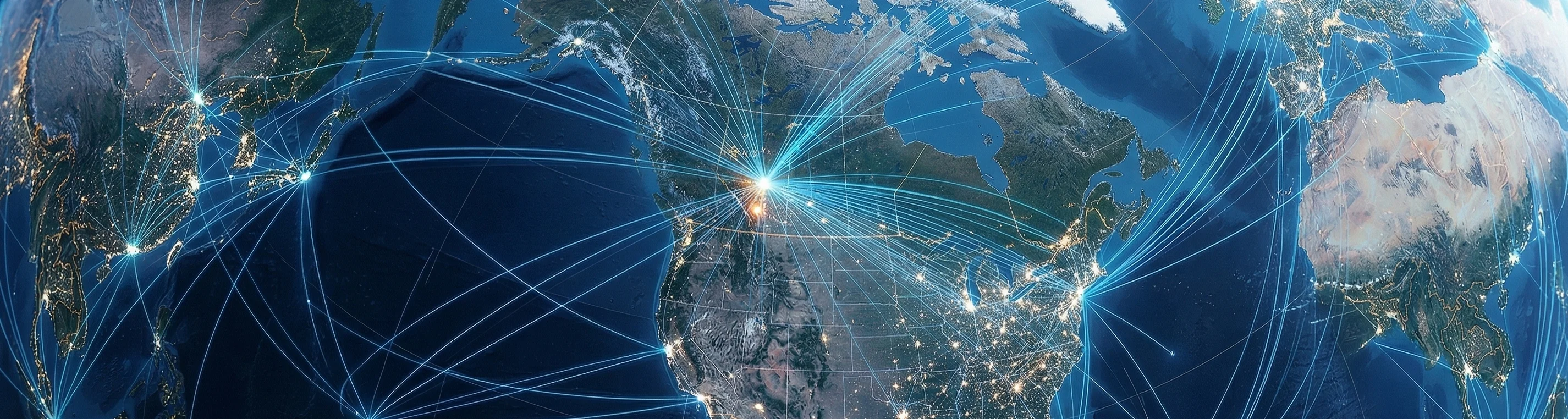
Across Alberta, Canada, and the wider world, the clearest stories were not really about isolated events. They were about what happens when trade, energy, and public systems tighten around a few critical channels. When those channels look less secure, governments do not merely talk about resilience. They move to thicken approvals, expand port and warehousing capacity, formalise observation, and secure infrastructure that would previously have been treated as peripheral.
The deeper pattern is that insecurity at the edge of a system often produces more administration at the centre.
The strongest Alberta signal this week was not a new price spike. It was a reminder that production strength still depends on corridor performance.
ATB Economics reported on April 2 that Alberta’s oil production averaged 4.2 million barrels per day over the first two months of 2026, up 3.3% from the same period in 2025.1 In a separate weekly note, ATB argued that the Trans Mountain expansion is likely to reach full capacity earlier than expected because Asian demand remains stronger than many forecasters assumed.2
That matters because it narrows the comforting distinction between “production story” and “transport story.” Alberta can raise output, but the value of that output still depends on a limited corridor architecture that the province does not fully control. A tight pipeline system is not just a market detail. It is the physical boundary condition around the province’s economic ambition.
The other Alberta signal was administrative rather than extractive. On April 2, Canada and Alberta signed a co-operation agreement intended to accelerate environmental and impact assessments for major projects.3 A week earlier, on March 25, the two governments also announced an agreement in principle on methane equivalency, allowing Alberta to pursue its own methane framework so long as it delivers equivalent results to the federal target.45
Read together, these are signs of a more legible project state. The practical message to industry is that Alberta and Ottawa are trying to reduce friction without publicly abandoning regulatory credibility. The systems point is that the province’s next investment phase likely depends not only on commodity demand, but on whether approvals, compliance, and environmental performance can be made to look governable at speed.
At the national scale, the clearest pattern was that trade diversification is becoming physical.
On April 1, the Canada Border Services Agency announced a new sufferance warehouse at the Port of Hamilton, explicitly framing it as a way to improve trade flow, reduce bottlenecks, and support secure movement of goods.6 By itself, a warehouse announcement is easy to dismiss as administrative clutter. It should not be. These are the kinds of low-drama capacity additions that determine whether a trade system can absorb shocks without becoming visibly brittle.
The same logic appeared in two different forms elsewhere this week.
Finance Minister François-Philippe Champagne concluded a visit to China on April 3 by emphasising trade and financial-services ties with one of Canada’s most important commercial partners.7 The diplomatic language was predictable. What matters is the structure beneath it: if Canada wants diversification, the strategy cannot live in speeches alone. It has to appear in port throughput, customs capacity, financing channels, and the institutional routines that make new trade patterns workable.
That same widening definition of infrastructure was visible in Nunavut. On April 2, the federal government announced more than $86 million to bring unlimited high-speed internet to over 11,000 homes across all 25 Nunavut communities, using low-Earth-orbit satellite service and fibre extensions.8 This is not merely a telecom story. It is a sovereignty, health-access, education, and emergency-capacity story. The north is being treated less as a blank space at the edge of the map and more as a domain that requires durable connective tissue.
The global signal this week was that energy insecurity is moving downstream into ordinary logistics.
The Associated Press reported on April 3 that Amazon would impose a 3.5% fuel and logistics surcharge on many third-party sellers in the United States and Canada, explicitly linking the move to higher fuel costs tied to the ongoing Iran war.9 That is an unusually clean example of a global chokepoint story propagating into everyday commerce. What begins as a distant energy conflict eventually reappears as a higher carrying cost on small goods moving through fulfillment networks.
This is the kind of signal worth watching because it sits one step beyond headline oil prices. A crude spike is dramatic, but it remains abstract for many readers. A surcharge on fulfillment, parcel movement, and retail operations is different. It is the moment when geopolitical exposure begins to alter the ordinary price architecture of daily life.
There is also a useful methodological lesson here. When a corridor shock becomes real, the first-order story is usually the commodity market. The second-order story is the logistics system. The third-order story is household experience. If the first issue of this series has a single argument, it is that readers should keep following the shock until it reaches the third stage.
At first glance, Alberta oil output, methane equivalency, a Hamilton warehouse, Nunavut broadband, and an Amazon surcharge do not look like one story.
They are.
They are all examples of systems trying to buy room under tighter conditions. Alberta wants room to move product. Ottawa wants room to approve projects and diversify trade. Arctic policy wants room to govern territory more credibly. Retail logistics wants room to absorb fuel cost without swallowing the entire burden.
The connective tissue is capacity under pressure.
That is why a weekly digest like this works better as a Wayward House series than as a generic news section. The editorial value is not in collecting links. It is in showing that a warehouse, a pipeline, a methane rule, a satellite network, and a fulfillment surcharge all belong to the same family of problems once you start asking how the system actually works.
ATB Economics, “Alberta oil production to February 2026,” published April 2, 2026.↩︎
Rob Roach, ATB Economics, “The Seven, March 27, 2026,” published March 27, 2026.↩︎
Impact Assessment Agency of Canada, “Alberta and Canada sign co-operation agreement to accelerate major project assessments,” published April 2, 2026.↩︎
Prime Minister of Canada, “Canada and Alberta reach agreement in principle on methane equivalency,” published March 25, 2026.↩︎
Government of Canada, “Agreement in principle between the Government of Canada and the Government of Alberta on methane equivalency,” accessed April 3, 2026.↩︎
Canada Border Services Agency, “Government of Canada announces new sufferance warehouse at the Port of Hamilton, Ontario to facilitate secure and efficient trade,” published April 1, 2026.↩︎
Department of Finance Canada, “Minister Champagne concludes productive visit to the People’s Republic of China, advances Canadian trade and financial services partnerships,” published April 3, 2026.↩︎
Innovation, Science and Economic Development Canada, “Canada is expanding high-speed internet access in Nunavut,” published April 2, 2026.↩︎
The Associated Press, “Amazon to slap a 3.5% surcharge on third-party sellers as Iran war drives up fuel prices,” published April 3, 2026.↩︎