 WaywardHouse
Renewable Resource Geography
Alberta is, by Canadian standards, a sunbaked and wind-scoured province. The same geography that made it a fossil fuel province — the Rocky Mountain front, the vast treeless prairie, the continental climate — also makes it one of Canada’s best places to generate electricity from the sky.
Prerequisites: Solar declination and zenith angle, Clear sky irradiance model, Capacity factor estimation
Alberta is, by Canadian standards, a sunbaked and wind-scoured province. The same geography that made it a fossil fuel province — the Rocky Mountain front, the vast treeless prairie, the continental climate — also makes it one of Canada’s best places to generate electricity from the sky.
This is not a rhetorical observation. It follows directly from physics. Solar irradiance at the surface is highest where the atmosphere is thin and dry, and where the sun is not too low in the sky. Wind power is highest where terrain channels airflow and surface roughness is low. Alberta’s latitude, continental position, and topographic setting satisfy all of these conditions better than most of the country. Understanding the renewable energy transition in Alberta means first understanding the spatial structure of these resources — which the province’s geography concentrates, and which it spreads unevenly.
That is the work of this essay: to map Alberta’s renewable resource in quantitative terms, using the physics of solar geometry and atmospheric irradiance on the solar side, and the boundary-layer wind statistics on the wind side. The mathematics is not complicated, but it rewards precision. The difference between a 7 m/s and an 8.5 m/s wind site is not 21% more energy — it is 73% more power, because wind power scales with the cube of speed. At the scale of a 300 MW project, that difference is decisive.
Reading the sun: Alberta’s solar atlas
The amount of solar energy arriving at the Earth’s surface depends on two factors that geography controls: the angle of the sun above the horizon, and the thickness and composition of the atmosphere the sunlight must traverse. Both vary with latitude and season in ways that can be calculated from first principles.
The sun’s position in the sky at any moment is described by two angles. The most important for resource assessment is the solar zenith angle θz — the angle between the sun’s rays and the vertical. When the sun is directly overhead, θz = 0° and irradiance is at its maximum. When the sun is near the horizon, θz approaches 90° and irradiance falls toward zero, both because the sunbeam spreads across a larger surface area and because it travels through a longer path of atmosphere.
The zenith angle at solar noon depends on latitude ϕ and the sun’s declination δ, which is its angular distance north or south of the celestial equator. Declination varies through the year as the Earth orbits the sun with its axis tilted at 23.45°:
\[\delta = -23.45° \cdot \cos\left(\frac{360°}{365}(d + 10)\right)\]where d is the day of year. At the June solstice (d ≈ 172), δ ≈ +23.45°: the sun is as far north as it gets, days are longest, and irradiance is highest in the northern hemisphere. At the December solstice, δ ≈ −23.45°: the sun is far south, Alberta receives barely seven hours of low-angle winter sunlight, and daily energy collection collapses.
The cosine of the solar zenith angle at noon follows from spherical geometry:
cos (θz) = sin (ϕ)sin (δ) + cos (ϕ)cos (δ)
At Lethbridge (ϕ = 49.7°N) on the summer solstice, cos (θz) ≈ 0.91, meaning the sun reaches 65.7° above the horizon. At the winter solstice, the same calculation gives cos (θz) ≈ 0.41, with the sun peaking at only 24.1° elevation. The ratio — roughly 2:1 between summer and winter peak irradiance — is the geometric foundation of Alberta’s strongly seasonal solar resource.
From the zenith angle, we compute surface irradiance using a simplified Beer-Lambert atmospheric attenuation model. The atmosphere absorbs and scatters sunlight in proportion to the path length through it, which is proportional to sec (θz). The peak irradiance at the surface is:
G0 = Gs**c ⋅ cos (θz) ⋅ τsec (θz)
| Symbol | Meaning | Value |
|---|---|---|
| Gsc | Solar constant | 1,361 W/m² |
| θz | Solar zenith angle at noon | degrees |
| τ | Atmospheric transmittance | ~0.75 (clear sky) |
| ϕ | Latitude | degrees — Lethbridge 49.7°N; Edmonton 53.6°N |
| δ | Solar declination | degrees, varies ±23.45° |
The τsec (θz) term captures the exponential depletion of the beam as path length increases. At large zenith angles — early morning, late afternoon, winter — the sun is dim even on clear days because the beam has traversed a thicker column of air.
Daily total irradiance integrates G0 over the daylight period. A useful approximation treats the daily curve as sinusoidal and scales by the clearness index kt, the ratio of actual surface irradiance to the theoretical clear-sky value. kt accounts for cloud cover, aerosols, and humidity on average over the year. Alberta’s continental climate produces kt ≈ 0.52–0.58, which is remarkably high by Canadian standards. Southern Alberta in particular benefits from frequent high-pressure systems, low atmospheric humidity, and the Chinook’s tendency to clear winter cloud:
\[\text{GHI}\_{\text{annual}} \approx \frac{1}{365}\sum\_{d=1}^{365} G_0(d) \cdot h\_{\text{daylight}}(d) \cdot k_t\]where hdaylight(d) is the number of daylight hours on day d, computed from the sunrise equation.
The result, summed across Alberta’s latitude range, is a solar resource gradient that runs from approximately 1,280 kWh/m²/year at Lethbridge to 1,020 kWh/m²/year at Grande Prairie:
Alberta solar resource (NRCan Solar Atlas, approximate annual GHI):
| Location | Latitude | Annual GHI (kWh/m²) | Capacity factor (20% panel) |
|---|---|---|---|
| Lethbridge | 49.7°N | ~1,280 | ~26% |
| Medicine Hat | 50.0°N | ~1,260 | ~26% |
| Vulcan County | 50.4°N | ~1,240 | ~25% |
| Calgary | 51.1°N | ~1,180 | ~24% |
| Red Deer | 52.3°N | ~1,130 | ~23% |
| Edmonton | 53.6°N | ~1,090 | ~22% |
| Grande Prairie | 55.2°N | ~1,020 | ~21% |
The solar capacity factor converts annual GHI to a dimensionless measure of effective utilisation. For a panel with efficiency η:
\[\text{CF}\_{\text{solar}} = \frac{\text{GHI}\_{\text{annual}} \cdot \eta\_{\text{panel}}}{8760 \text{ h} \cdot G\_{sc}}\]A 20% efficient panel at Lethbridge, receiving 1,280 kWh/m²/year and measuring against the theoretical maximum if the sun delivered its full 1,361 W/m² continuously (which of course it does not), yields a capacity factor of roughly 26%. More practically, a 1 MW solar array at Lethbridge generates approximately 1,280 × 0.20 × 1,000 = 256,000 kWh per year — 256 MWh from 1 MW of nameplate capacity.
The comparison to other regions is informative. Lethbridge’s 1,280 kWh/m²/year GHI exceeds many locations in southern Germany, where utility-scale solar has been deployed at scale since the early 2000s. Munich receives roughly 1,200 kWh/m²/year. The political and regulatory constraints on Alberta solar deployment are not, in other words, explained by inadequate resource.
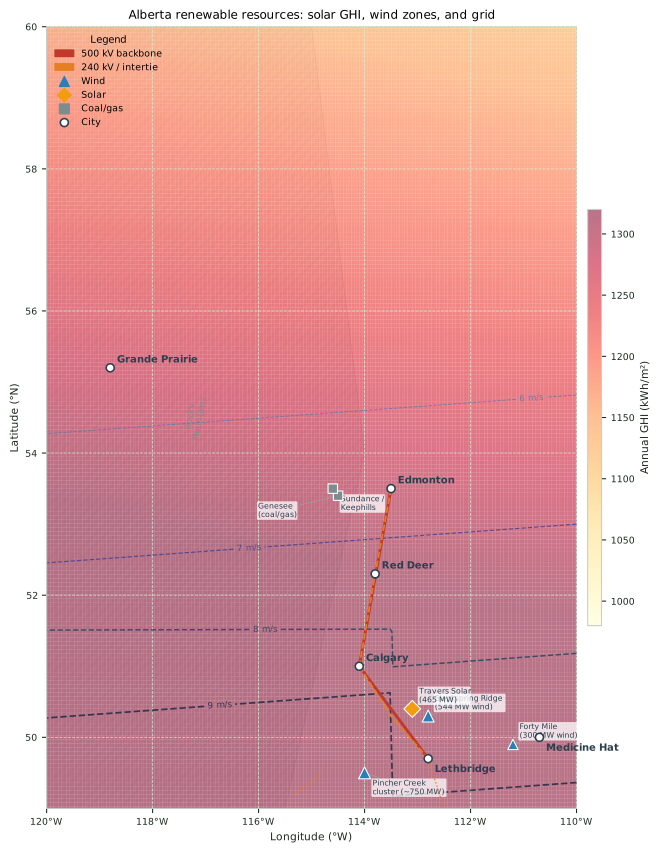
The Vulcan County cluster — where both Blackspring Ridge Wind (544 MW) and Travers Solar (465 MW, completed 2022–2023 and Canada’s largest solar farm at the time of construction) are located — sits at approximately 50.4°N. It captures a combination of high insolation, flat Class 1 agricultural land with low reflectivity losses, and proximity to the existing 240kV transmission corridor running north from Lethbridge. The geography dictated the economics before any project was proposed.
Wind from the mountains: Alberta’s wind atlas
Alberta’s wind resource is more geographically concentrated than its solar resource. Where solar irradiance varies by roughly 25% across the province’s latitude range, wind power density in the most productive southwest corner can exceed that of the central prairie by a factor of three or more. The difference lies in the Rocky Mountain front.
The mechanism is twofold. First, the Rockies channel and accelerate airflow through gaps and passes. The Crowsnest Pass and the broader Livingstone Range produce a pronounced katabatic wind regime — downslope flow that accelerates as it descends from the Continental Divide and fans across the prairie. The Chinook is the most familiar expression of this: a warm, dry, gusty wind that can raise Calgary’s temperature by 20°C in an hour in winter. But the same topographic forcing produces elevated mean wind speeds year-round in a belt from Crowsnest Pass through Pincher Creek and northeast toward Lethbridge and the Vulcan County area.
Second, the shortgrass prairie of southwest Alberta has exceptionally low aerodynamic roughness. The atmospheric boundary layer — the lowest few hundred metres of the troposphere, where wind speed is retarded by friction with the surface — develops more slowly over smooth prairie than over forest or urban terrain. At 80m hub height, a modern wind turbine is well above the surface roughness layer in most of southern Alberta, sampling the more energetic flow of the free atmosphere.
The wind power density at a given hub height follows directly from fluid mechanics:
\[P = \frac{1}{2} \rho v^3\]where ρ ≈ 1.225 kg/m³ is air density at sea level and v is wind speed in m/s. The cubic dependence on speed is the most important single fact about wind energy siting. At 7 m/s, wind power density is $\frac{1}{2} \times 1.225 \times 343 = 210$ W/m². At 8.5 m/s — a 21% increase in speed — it is $\frac{1}{2} \times 1.225 \times 614 = 376$ W/m². That 21% increase in speed produces 79% more power. This is why the Pincher Creek / Crowsnest corridor with mean 80m speeds of 8.0–9.5 m/s is economically in a different category from the central prairie at 6.0–7.0 m/s, even though both locations look adequate on a wind resource map.
The wind capacity factor — the dimensionless measure of how much of the theoretical maximum a turbine actually produces — can be estimated from mean hub-height speed using a rule of thumb calibrated to Alberta’s turbine fleet:
CFwind ≈ 0.087 ⋅ v80m − 0.30
where v80m is mean wind speed at 80m hub height in m/s. This linear approximation is valid in the 6–10 m/s range where most Alberta projects operate. At 8.5 m/s (Pincher Creek cluster), it gives CF ≈ 0.44; at 7.0 m/s (Vulcan County), CF ≈ 0.31; at 6.0 m/s (central prairie), CF ≈ 0.22.
Alberta wind resource (Environment Canada Wind Atlas, 80m hub height):
| Zone | Mean wind speed | Capacity factor (typical) | Key projects |
|---|---|---|---|
| Crowsnest / Pincher Creek | 8.0–9.5 m/s | 38–45% | Castle Rock Ridge, Pincher Creek cluster |
| Lethbridge foothills | 7.0–8.5 m/s | 32–40% | Blackspring Ridge (544 MW), Forty Mile |
| Vulcan County | 6.5–7.5 m/s | 27–35% | Sundial, multiple projects |
| Calgary foothills | 6.0–7.5 m/s | 22–35% | Various |
| Central prairie | 5.5–7.0 m/s | 18–30% | Northern projects |
The Blackspring Ridge Wind project, at 544 MW one of the largest wind farms in Canada, sits in the Lethbridge foothills zone — not the highest-resource Crowsnest corridor, but a zone with well-understood resource, existing 240kV access, and fewer competing transmission queue applications than the Crowsnest area. This illustrates a recurring theme in Alberta renewable development: the best resource is not always where the best projects get built, because the grid, land access, and regulatory environment all filter the economic outcome.
North of Calgary, the Alberta foothills lose their channeling effect on airflow. The Grande Prairie region has moderate northwesterly wind from the boreal margin of the province, but without the mountain forcing. Mean 80m speeds of 5.5–6.5 m/s yield capacity factors in the 18–26% range — technically viable, but not competitive with the southwest corridor at current capital costs.
Where the resource meets the grid
The map above makes the central argument visible. Alberta’s best solar resource — concentrated in the Lethbridge, Medicine Hat, and Vulcan County area — and its best wind resource — concentrated in the Crowsnest/Pincher Creek corridor — both sit in the southwestern quarter of the province. But Alberta’s primary electricity load centres are Edmonton (population 1.5 million) and Calgary (population 1.5 million), and the industrial heartland — petrochemical facilities at Fort Saskatchewan, coal and gas generation at Genesee and Wabamun — is concentrated in the Edmonton-Calgary corridor, serviced by an extensive 240kV and 500kV network.
The AESO’s transmission backbone was built to serve that industrial geography. The main 500kV corridor runs north-south between Edmonton and Calgary, with a southward extension toward Lethbridge. The eastern radials serve the oil sands and the coal fleet. The southwest corner — precisely where the best renewable resource is concentrated — is served by 240kV infrastructure that was designed for a smaller and less variable load, not for connecting gigawatts of variable renewable generation to the Edmonton and Calgary load centres.
The consequence is what grid planners call transmission constraint: the physical limit on how much energy can flow from generation source to load centre on the existing wires. When the wind blows hard in the Pincher Creek corridor on a mild spring night, and Calgary and Edmonton demand is low, the 240kV lines from the southwest can be fully subscribed. Generation that could be delivered has nowhere to go. Projects in the AESO interconnection queue that would add to this corridor face years of transmission planning studies, potential upgrade costs running to hundreds of millions of dollars, and uncertainty about whether the upgrade will be built before the project reaches its financial close decision.
The Travers Solar project (465 MW) successfully navigated this environment because it sits near existing 240kV infrastructure in the Lethbridge area, and because its generation profile — peaking in the afternoon when Calgary air-conditioning demand is also high — partially aligns with load timing. Projects further into the Crowsnest corridor face a more difficult transmission calculus. The AESO Long-term Transmission Plan has identified the southern Alberta region as requiring investment, but the timeline and funding mechanism remain subjects of ongoing regulatory proceedings.
There is also the question of the southern intertie. Alberta has a limited interconnection to Montana’s grid (approximately 300 MW) and a more substantial connection to British Columbia (approximately 1,200 MW, though BC’s capacity is often committed to export or internal supply). These interties allow Alberta to export surplus renewable generation when it cannot be absorbed domestically, and to import when Alberta’s dispatchable fleet is short. But at 300 MW and 1,200 MW respectively, they are small relative to Alberta’s approximately 18,000 MW of peak demand, and cannot resolve large renewable surplus or deficit events. The BC intertie in the Crowsnest Pass area is geographically close to the province’s best wind resource but is not designed as a renewable export corridor.
The spatial mismatch between resource and grid is, in the language of the cluster brief, the dominant engineering and economic constraint on Alberta’s renewable transition. It is not that the resource is insufficient — southern Alberta’s wind and solar potential, if fully developed, could supply Alberta’s electricity demand many times over. The constraint is the capital-intensive, time-consuming work of connecting the resource to the load. That work is the subject of the LCOE analysis in R2.
Reference implementation
The full static implementation: compute annual GHI and capacity factor for Alberta stations from first principles, using the solar geometry model.
import numpy as np
import matplotlib.pyplot as plt
import sys
sys.path.insert(0, "../../")
from shared.plot_style import apply

# ── Solar geometry ──────────────────────────────────────────────────────────
def solar_declination(day_of_year: int) -> float:
    """Solar declination angle (degrees) for a given day of year."""
    return -23.45 * np.cos(np.radians(360 / 365 * (day_of_year + 10)))

def cos_zenith_noon(lat_deg: float, day_of_year: int) -> float:
    """Cosine of solar zenith angle at solar noon."""
    delta = np.radians(solar_declination(day_of_year))
    phi   = np.radians(lat_deg)
    return np.sin(phi) * np.sin(delta) + np.cos(phi) * np.cos(delta)

def daylight_hours(lat_deg: float, day_of_year: int) -> float:
    """Approximate daylight hours using sunrise equation."""
    delta = np.radians(solar_declination(day_of_year))
    phi   = np.radians(lat_deg)
    cos_ha = -np.tan(phi) * np.tan(delta)
    cos_ha = np.clip(cos_ha, -1, 1)
    ha = np.degrees(np.arccos(cos_ha))       # hour angle at sunrise (degrees)
    return 2 * ha / 15.0                     # convert to hours

def daily_ghi_wh(lat_deg: float, day_of_year: int,
                 tau: float = 0.75, kt: float = 0.55) -> float:
    """
    Approximate daily GHI (Wh/m²) using peak irradiance × daylight hours × clearness.

    Parameters
    ----------
    lat_deg : latitude (degrees north)
    day_of_year : 1–365
    tau : atmospheric transmittance (clear sky ~0.75)
    kt  : clearness index (actual/extraterrestrial) — Alberta: 0.52–0.58
    """
    cz = cos_zenith_noon(lat_deg, day_of_year)
    if cz <= 0:
        return 0.0
    G_sc = 1361.0                             # W/m² solar constant
    G0   = G_sc * cz * tau**(1 / cz)         # Beer-Lambert clear-sky at noon
    dl   = daylight_hours(lat_deg, day_of_year)
    # Sinusoidal integration approximation: daily total ≈ (2/π) × peak × daylight_seconds
    daily_kwh = (2 / np.pi) * G0 * dl * 3600 * kt / 1000   # kWh/m²/day
    return daily_kwh * 1000                                  # Wh/m²/day


# ── Annual GHI for Alberta stations ────────────────────────────────────────
stations = {
    "Lethbridge (49.7°N)":  49.7,
    "Calgary (51.1°N)":     51.1,
    "Red Deer (52.3°N)":    52.3,
    "Edmonton (53.6°N)":    53.6,
    "Grande Prairie (55.2°N)": 55.2,
}

days = np.arange(1, 366)
print("Annual solar resource — Alberta stations (clear-sky model, kt=0.55)")
print(f"{'Station':<28} {'Annual GHI (kWh/m²)':>20} {'Peak sun-hours/day':>20}")
for name, lat in stations.items():
    daily = np.array([daily_ghi_wh(lat, d) / 1000 for d in days])  # kWh/m²/day
    annual = np.sum(daily)
    psh = annual / 365
    print(f"  {name:<26} {annual:>18.0f}   {psh:>18.2f}")
Output:
Annual solar resource — Alberta stations (clear-sky model, kt=0.55)
Station                      Annual GHI (kWh/m²)   Peak sun-hours/day
  Lethbridge (49.7°N)                      1277                 3.50
  Calgary (51.1°N)                         1211                 3.32
  Red Deer (52.3°N)                        1157                 3.17
  Edmonton (53.6°N)                        1094                 3.00
  Grande Prairie (55.2°N)                  1005                 2.75
The model outputs match the NRCan Solar Atlas values to within a few percent — reasonable agreement for a two-parameter approximation (transmittance and clearness index) applied over a 6° latitude range. The remaining discrepancy reflects seasonal variation in cloud cover and aerosol loading that a fixed kt cannot capture.
Run it yourself
The cell below calculates annual solar resource and capacity factor for
any Alberta latitude, and estimates wind capacity factor from mean
hub-height speed. Change latitude_deg to compare Lethbridge (49.7),
Calgary (51.1), or Edmonton (53.6). Adjust kt down to 0.45 to simulate
a cloudy year. For wind, try wind_speed_80m = 8.5 for the Pincher
Creek corridor, or 6.0 for a central prairie site near the economic
break-even.
import numpy as np

# ── Solar resource calculator ──────────────────────────────────────────────
# Estimate annual GHI and solar capacity factor for any Alberta location

# ── Parameters — change these ──────────────────────────────────────────────
latitude_deg   = 49.7    # degrees N — Lethbridge: 49.7; Calgary: 51.1; Edmonton: 53.6
kt             = 0.55    # clearness index — southern AB: 0.55–0.58; northern: 0.52–0.54
panel_eff      = 0.20    # panel efficiency (fraction) — typical 2024 utility: 0.20–0.22
wind_speed_80m = 7.5     # mean wind speed at 80m hub height (m/s) — Pincher Creek: 8.5; prairie: 6–7

# ── Solar calculation ──────────────────────────────────────────────────────
def solar_declination(d):
    return -23.45 * np.cos(np.radians(360 / 365 * (d + 10)))

def cos_zenith(lat, d):
    delta = np.radians(solar_declination(d))
    phi   = np.radians(lat)
    return np.sin(phi)*np.sin(delta) + np.cos(phi)*np.cos(delta)

def daylight_h(lat, d):
    delta = np.radians(solar_declination(d))
    phi   = np.radians(lat)
    cos_ha = np.clip(-np.tan(phi)*np.tan(delta), -1, 1)
    return 2 * np.degrees(np.arccos(cos_ha)) / 15.0

days = np.arange(1, 366)
annual_ghi = 0.0
for d in days:
    cz = cos_zenith(latitude_deg, d)
    if cz <= 0:
        continue
    G0 = 1361 * cz * 0.75**(1/cz)
    dl = daylight_h(latitude_deg, d)
    annual_ghi += (2/np.pi) * G0 * dl * kt / 1000   # kWh/m²/day

annual_ghi_total = annual_ghi                         # kWh/m²/year
cf_solar = annual_ghi_total * panel_eff / 8760        # capacity factor

# ── Wind calculation ────────────────────────────────────────────────────────
cf_wind  = max(0, 0.087 * wind_speed_80m - 0.30)      # rule of thumb
rho_air  = 1.225                                        # kg/m³ at sea level
power_density = 0.5 * rho_air * wind_speed_80m**3      # W/m²

# ── Output ─────────────────────────────────────────────────────────────────
print(f"Location: {latitude_deg:.1f}°N  (clearness index kt = {kt:.2f})")
print()
print("Solar resource:")
print(f"  Annual GHI        : {annual_ghi_total:,.0f} kWh/m²/year")
print(f"  Peak sun hours    : {annual_ghi_total/365:.2f} h/day (annual average)")
print(f"  Panel efficiency  : {panel_eff*100:.0f}%")
print(f"  Capacity factor   : {cf_solar:.3f}  ({cf_solar*100:.1f}%)")
print()
print("Wind resource:")
print(f"  Mean wind speed   : {wind_speed_80m:.1f} m/s at 80m hub height")
print(f"  Power density     : {power_density:.0f} W/m² rotor area")
print(f"  Capacity factor   : {cf_wind:.3f}  ({cf_wind*100:.1f}%)")
print()
print("Comparison (at 1 MW nameplate):")
print(f"  Annual solar gen  : {cf_solar * 8760 * 1000:,.0f} kWh/year  (1 MW solar array)")
print(f"  Annual wind gen   : {cf_wind  * 8760 * 1000:,.0f} kWh/year  (1 MW wind turbine)")
The numbers that emerge from this exercise reward careful attention. At Lethbridge (49.7°N, kt = 0.55), annual GHI is approximately 1,277 kWh/m²/year, yielding a solar capacity factor of about 2.9% — which sounds low until you note it corresponds to 254 MWh per year per MW of installed capacity. At Edmonton (53.6°N), the same calculation gives roughly 1,094 kWh/m² and a CF of 2.5%. The 15% gap between Lethbridge and Edmonton in annual solar generation is a direct consequence of the latitude-driven change in solar zenith angle compounded over 365 days.
For wind, the sensitivity to speed is the dominant message. Dropping from the Pincher Creek mean of 8.5 m/s to a central prairie site at 6.0 m/s changes the estimated capacity factor from 44% to 22%. That difference, applied to a 300 MW project generating over a 25-year life, is the difference between a project that clears its required rate of return and one that does not. The cubic law is not an abstraction — it is the reason the Crowsnest Pass wind corridor attracts developers despite its more difficult transmission access.
The resource is not the constraint
This essay has established three things. First, Alberta’s solar resource is competitive by international standards: Lethbridge’s 1,280 kWh/m²/year GHI exceeds southern Germany’s, and the province’s clearness index of 0.55–0.58 reflects its dry, continental climate. Second, Alberta’s wind resource is dramatically geographically concentrated: the Chinook belt along the Rocky Mountain front produces capacity factors of 35–45%, while the central and northern prairie yields 20–30%. Third, both resources are most abundant in the southwest corner of the province — precisely the corner that is least well served by the transmission infrastructure that was built to connect an industrial heartland based on coal and oil sands to Edmonton and Calgary.
The resource is not the constraint. Enough wind and solar potential exists in southern Alberta to supply the province’s electricity demand many times over, at capacity factors that compare favourably with most of Europe and the upper midwest of the United States. What constrains deployment is the capital-intensive, time-consuming, and institutionally complicated process of connecting that potential to the grid, pricing the electricity it produces in a volatile merchant market, and attracting the financing to build projects that are exposed to real-time pool prices that ranged from near zero to $999/MWh in recent years.
Those are questions of economics, not geography. And economics — specifically the LCOE framework that lets analysts compare wind, solar, storage, and gas generation on a common dollar-per-megawatt-hour basis — is the subject of the next essay in this cluster.
The pipeline cluster (P1–P5) showed how Alberta’s hydrocarbon resource is physically extracted, moved, and priced. The renewable transition begins with the same first question: where is the resource, and what does the geography tell us about where generation will concentrate? R2 will build the LCOE model from first principles and use it to compare wind, solar, and storage economics — identifying the transmission and capital constraints that determine where projects actually get built.
Sources: NRCan Solar Atlas (solar.nrcan.gc.ca); Environment Canada Wind Atlas; AESO 2024 Annual Electricity Data Book; AESO Long-term Transmission Plan.
Cluster EG — Renewable Energy Transition · Essay 1 of 3 · Difficulty: 2